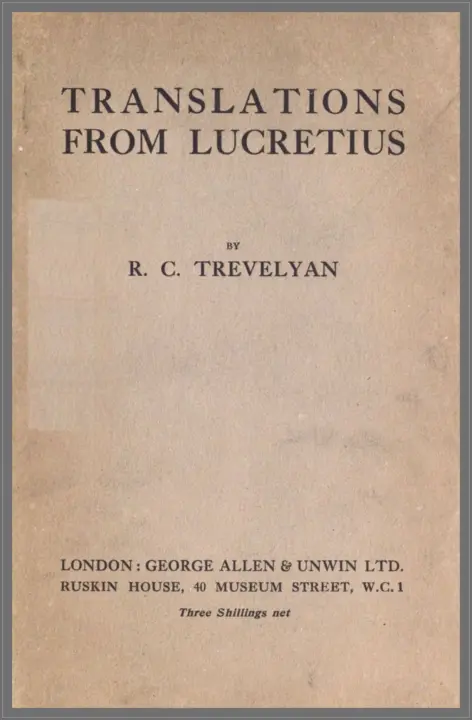
Translations from Lucretius
Titus Lucretius Carus
THE CLASSIC COLLECTION · 1921
"On the Nature of Things" by Titus Lucretius Carus is a didactic poem written in the first century BC. Spanning 7,400 verses across six books, this work aims to explain Epicurean philosophy to Roman readers through poetic language. Lucretius explores atomism, the nature of mind and soul, and celestial phenomena, arguing that the universe operates by physical principles and chance rather than divine intervention. The poem seeks to free readers from religious fear by demonstrating that natural laws, not gods, govern existence.
Introduction adapted from the source catalogue; source summaries may be automatically generated.
Free to read · English · 73,942 words · No account needed
MAKE TIME FOR A GOOD BOOK
On by default. Untick to stop anonymous reading totals. Each page counts after 10 seconds in view. How this works.
Anonymous counting is on unless you have switched it off.
Thus, then, the All that is is limited
In no one region of its onward paths,
For then 'tmust have forever its beyond.
And a beyond 'tis seen can never be
For aught, unless still further on there be
A somewhat somewhere that may bound the same--
So that the thing be seen still on to where
The nature of sensation of that thing
Can follow it no longer. Now because
Confess we must there's naught beside the sum,
There's no beyond, and so it lacks all end.
It matters nothing where thou post thyself,
In whatsoever regions of the same;
Even any place a man has set him down
Still leaves about him the unbounded all
Outward in all directions; or, supposing
A moment the all of space finite to be,
If some one farthest traveller runs forth
Unto the extreme coasts and throws ahead
A flying spear, is't then thy wish to think
It goes, hurled off amain, to where 'twas sent
And shoots afar, or that some object there
Can thwart and stop it? For the one or other
Thou must admit and take. Either of which
Shuts off escape for thee, and does compel
That thou concede the all spreads everywhere,
Owning no confines. Since whether there be
Aught that may block and check it so it comes
Not where 'twas sent, nor lodges in its goal,
Or whether borne along, in either view
'Thas started not from any end. And so
I'll follow on, and whereso'er thou set
The extreme coasts, I'll query, "what becomes
Thereafter of thy spear?" 'Twill come to pass
That nowhere can a world's-end be, and that
The chance for further flight prolongs forever
The flight itself. Besides, were all the space
Of the totality and sum shut in
With fixed coasts, and bounded everywhere,
Then would the abundance of world's matter flow
Together by solid weight from everywhere
Still downward to the bottom of the world,
Nor aught could happen under cope of sky,
Nor could there be a sky at all or sun--
Indeed, where matter all one heap would lie,
By having settled during infinite time.
But in reality, repose is given
Unto no bodies 'mongst the elements,
Because there is no bottom whereunto
They might, as 'twere, together flow, and where
They might take up their undisturbed abodes.
In endless motion everything goes on
Forevermore; out of all regions, even
Out of the pit below, from forth the vast,
Are hurtled bodies evermore supplied.
The nature of room, the space of the abyss
Is such that even the flashing thunderbolts
Can neither speed upon their courses through,
Gliding across eternal tracts of time,
Nor, further, bring to pass, as on they run,
That they may bate their journeying one whit:
Such huge abundance spreads for things around--
Room off to every quarter, without end.
Lastly, before our very eyes is seen
Thing to bound thing: air hedges hill from hill,
And mountain walls hedge air; land ends the sea,
And sea in turn all lands; but for the All
Truly is nothing which outside may bound.
That, too, the sum of things itself may not
Have power to fix a measure of its own,
Great nature guards, she who compels the void
To bound all body, as body all the void,
Thus rendering by these alternates the whole
An infinite; or else the one or other,
Being unbounded by the other, spreads,
Even by its single nature, ne'ertheless
Immeasurably forth....
Nor sea, nor earth, nor shining vaults of sky,
Nor breed of mortals, nor holy limbs of gods
Could keep their place least portion of an hour:
For, driven apart from out its meetings fit,
The stock of stuff, dissolved, would be borne
Along the illimitable inane afar,
Or rather, in fact, would ne'er have once combined
And given a birth to aught, since, scattered wide,
It could not be united. For of truth
Neither by counsel did the primal germs
'Stablish themselves, as by keen act of mind,
Each in its proper place; nor did they make,
Forsooth, a compact how each germ should move;
But since, being many and changed in many modes
Along the All, they're driven abroad and vexed
By blow on blow, even from all time of old,
They thus at last, after attempting all
The kinds of motion and conjoining, come
Into those great arrangements out of which
This sum of things established is create,
By which, moreover, through the mighty years,
It is preserved, when once it has been thrown
Into the proper motions, bringing to pass
That ever the streams refresh the greedy main
With river-waves abounding, and that earth,
Lapped in warm exhalations of the sun,
Renews her broods, and that the lusty race
Of breathing creatures bears and blooms, and that
The gliding fires of ether are alive--
What still the primal germs nowise could do,
Unless from out the infinite of space
Could come supply of matter, whence in season
They're wont whatever losses to repair.
For as the nature of breathing creatures wastes,
Losing its body, when deprived of food:
So all things have to be dissolved as soon
As matter, diverted by what means soever
From off its course, shall fail to be on hand.
Nor can the blows from outward still conserve,
On every side, whatever sum of a world
Has been united in a whole. They can
Indeed, by frequent beating, check a part,
Till others arriving may fulfil the sum;
But meanwhile often are they forced to spring
Rebounding back, and, as they spring, to yield,
Unto those elements whence a world derives,
Room and a time for flight, permitting them
To be from off the massy union borne
Free and afar. Wherefore, again, again:
Needs must there come a many for supply;
And also, that the blows themselves shall be
Unfailing ever, must there ever be
An infinite force of matter all sides round.
Your reading position is saved on this browser. Take it to another device with a library code. Reading pages adapt to text, rather than matching a printed edition.
Titus Lucretius Carus
BEHIND THE BOOK
This eBook is for the use of anyone anywhere in the United States and most other parts of the world at no cost and with almost no restrictions whatsoever. You may copy it, give it away or re-use it under the terms of the Project Gutenberg License included with this eBook or online at www.gutenberg.org. If you are not located in the United States, you will have to check the laws of the country where you are located before using this eBook. Read the source licence.
The original source file, including credits and licence, is retained by this library. Request an original-format copy at no charge. Please include the book title and Project Gutenberg identifier #785.
KEEP YOUR CURIOSITY GOING

David Patterson (Spirit) Hatch
Coulson Kernahan

Ralph Waldo Emerson
Frances Wright

Edwin Abbott Abbott

Joseph Droz