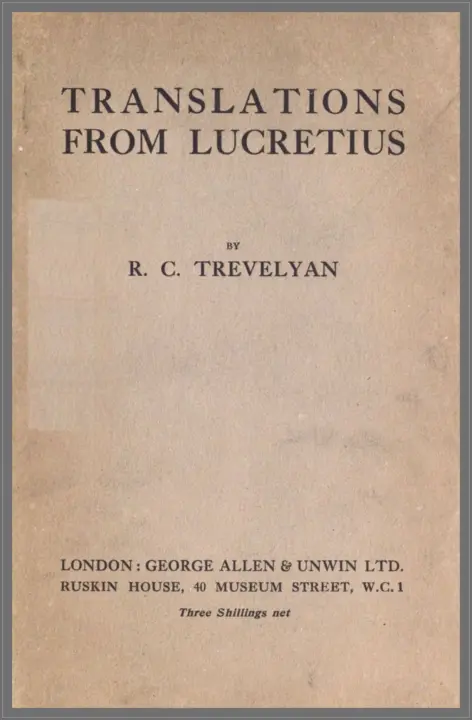
Translations from Lucretius
Titus Lucretius Carus
THE CLASSIC COLLECTION · 1921
"On the Nature of Things" by Titus Lucretius Carus is a didactic poem written in the first century BC. Spanning 7,400 verses across six books, this work aims to explain Epicurean philosophy to Roman readers through poetic language. Lucretius explores atomism, the nature of mind and soul, and celestial phenomena, arguing that the universe operates by physical principles and chance rather than divine intervention. The poem seeks to free readers from religious fear by demonstrating that natural laws, not gods, govern existence.
Introduction adapted from the source catalogue; source summaries may be automatically generated.
Free to read · English · 73,942 words · No account needed
MAKE TIME FOR A GOOD BOOK
On by default. Untick to stop anonymous reading totals. Each page counts after 10 seconds in view. How this works.
Anonymous counting is on unless you have switched it off.
'Twas such a manner of disease, 'twas such Mortal miasma in Cecropian lands Whilom reduced the plains to dead men's bones, Unpeopled the highways, drained of citizens The Athenian town. For coming from afar, Rising in lands of Aegypt, traversing Reaches of air and floating fields of foam, At last on all Pandion's folk it swooped; Whereat by troops unto disease and death Were they o'er-given. At first, they'd bear about A skull on fire with heat, and eyeballs twain Red with suffusion of blank glare. Their throats, Black on the inside, sweated oozy blood; And the walled pathway of the voice of man Was clogged with ulcers; and the very tongue, The mind's interpreter, would trickle gore, Weakened by torments, tardy, rough to touch. Next when that Influence of bane had chocked, Down through the throat, the breast, and streamed had E'en into sullen heart of those sick folk, Then, verily, all the fences of man's life Began to topple. From the mouth the breath Would roll a noisome stink, as stink to heaven Rotting cadavers flung unburied out. And, lo, thereafter, all the body's strength And every power of mind would languish, now In very doorway of destruction. And anxious anguish and ululation (mixed With many a groan) companioned alway The intolerable torments. Night and day, Recurrent spasms of vomiting would rack Alway their thews and members, breaking down With sheer exhaustion men already spent. And yet on no one's body couldst thou mark The skin with o'er-much heat to burn aglow, But rather the body unto touch of hands Would offer a warmish feeling, and thereby Show red all over, with ulcers, so to say, Inbranded, like the "sacred fires" o'erspread Along the members. The inward parts of men, In truth, would blaze unto the very bones; A flame, like flame in furnaces, would blaze Within the stomach. Nor couldst aught apply Unto their members light enough and thin For shift of aid--but coolness and a breeze Ever and ever. Some would plunge those limbs On fire with bane into the icy streams, Hurling the body naked into the waves; Many would headlong fling them deeply down The water-pits, tumbling with eager mouth Already agape. The insatiable thirst That whelmed their parched bodies, lo, would make A goodly shower seem like to scanty drops. Respite of torment was there none. Their frames Forspent lay prone. With silent lips of fear Would Medicine mumble low, the while she saw So many a time men roll their eyeballs round, Staring wide-open, unvisited of sleep, The heralds of old death. And in those months Was given many another sign of death: The intellect of mind by sorrow and dread Deranged, the sad brow, the countenance Fierce and delirious, the tormented ears Beset with ringings, the breath quick and short Or huge and intermittent, soaking sweat A-glisten on neck, the spittle in fine gouts Tainted with colour of crocus and so salt, The cough scarce wheezing through the rattling throat. Aye, and the sinews in the fingered hands Were sure to contract, and sure the jointed frame To shiver, and up from feet the cold to mount Inch after inch: and toward the supreme hour At last the pinched nostrils, nose's tip A very point, eyes sunken, temples hollow, Skin cold and hard, the shuddering grimace, The pulled and puffy flesh above the brows!-- O not long after would their frames lie prone In rigid death. And by about the eighth Resplendent light of sun, or at the most On the ninth flaming of his flambeau, they Would render up the life. If any then Had 'scaped the doom of that destruction, yet Him there awaited in the after days A wasting and a death from ulcers vile And black discharges of the belly, or else Through the clogged nostrils would there ooze along Much fouled blood, oft with an aching head: Hither would stream a man's whole strength and flesh. And whoso had survived that virulent flow Of the vile blood, yet into thews of him And into his joints and very genitals Would pass the old disease. And some there were, Dreading the doorways of destruction So much, lived on, deprived by the knife Of the male member; not a few, though lopped Of hands and feet, would yet persist in life, And some there were who lost their eyeballs: O So fierce a fear of death had fallen on them! And some, besides, were by oblivion Of all things seized, that even themselves they knew No longer. And though corpse on corpse lay piled Unburied on ground, the race of birds and beasts Would or spring back, scurrying to escape The virulent stench, or, if they'd tasted there, Would languish in approaching death. But yet Hardly at all during those many suns Appeared a fowl, nor from the woods went forth The sullen generations of wild beasts-- They languished with disease and died and died. In chief, the faithful dogs, in all the streets Outstretched, would yield their breath distressfully For so that Influence of bane would twist Life from their members. Nor was found one sure And universal principle of cure: For what to one had given the power to take The vital winds of air into his mouth, And to gaze upward at the vaults of sky, The same to others was their death and doom.
Your reading position is saved on this browser. Take it to another device with a library code. Reading pages adapt to text, rather than matching a printed edition.
Titus Lucretius Carus
BEHIND THE BOOK
This eBook is for the use of anyone anywhere in the United States and most other parts of the world at no cost and with almost no restrictions whatsoever. You may copy it, give it away or re-use it under the terms of the Project Gutenberg License included with this eBook or online at www.gutenberg.org. If you are not located in the United States, you will have to check the laws of the country where you are located before using this eBook. Read the source licence.
The original source file, including credits and licence, is retained by this library. Request an original-format copy at no charge. Please include the book title and Project Gutenberg identifier #785.
KEEP YOUR CURIOSITY GOING

David Patterson (Spirit) Hatch
Coulson Kernahan

Ralph Waldo Emerson
Frances Wright

Edwin Abbott Abbott

Joseph Droz