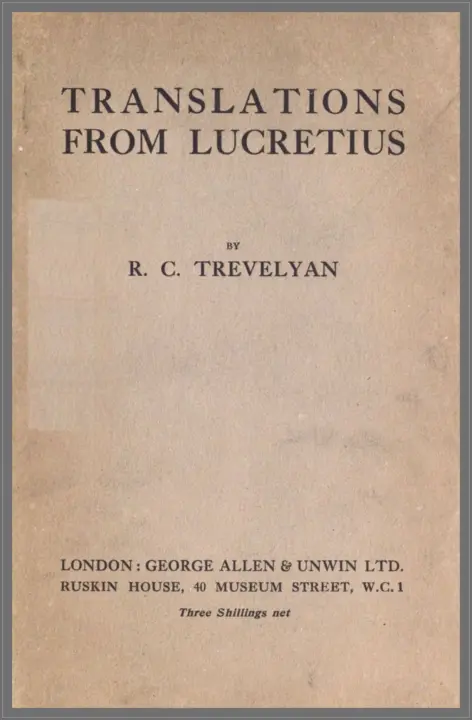
Translations from Lucretius
Titus Lucretius Carus
THE CLASSIC COLLECTION · 1921
"On the Nature of Things" by Titus Lucretius Carus is a didactic poem written in the first century BC. Spanning 7,400 verses across six books, this work aims to explain Epicurean philosophy to Roman readers through poetic language. Lucretius explores atomism, the nature of mind and soul, and celestial phenomena, arguing that the universe operates by physical principles and chance rather than divine intervention. The poem seeks to free readers from religious fear by demonstrating that natural laws, not gods, govern existence.
Introduction adapted from the source catalogue; source summaries may be automatically generated.
Free to read · English · 73,942 words · No account needed
MAKE TIME FOR A GOOD BOOK
On by default. Untick to stop anonymous reading totals. Each page counts after 10 seconds in view. How this works.
Anonymous counting is on unless you have switched it off.
Now in what manner engendered are these things,
How fashioned of such impetuous strength
As to cleave towers asunder, and houses all
To overtopple, and to wrench apart
Timbers and beams, and heroes' monuments
To pile in ruins and upheave amain,
And to take breath forever out of men,
And to o'erthrow the cattle everywhere,--
Yes, by what force the lightnings do all this,
All this and more, I will unfold to thee,
Nor longer keep thee in mere promises.
The bolts of thunder, then, must be conceived As all begotten in those crasser clouds Up-piled aloft; for, from the sky serene And from the clouds of lighter density, None are sent forth forever. That 'tis so Beyond a doubt, fact plain to sense declares: To wit, at such a time the densed clouds So mass themselves through all the upper air That we might think that round about all murk Had parted forth from Acheron and filled The mighty vaults of sky--so grievously, As gathers thus the storm-clouds' gruesome might, Do faces of black horror hang on high-- When tempest begins its thunderbolts to forge. Besides, full often also out at sea A blackest thunderhead, like cataract Of pitch hurled down from heaven, and far away Bulging with murkiness, down on the waves Falls with vast uproar, and draws on amain The darkling tempests big with thunderbolts And hurricanes, itself the while so crammed Tremendously with fires and winds, that even Back on the lands the people shudder round And seek for cover. Therefore, as I said, The storm must be conceived as o'er our head Towering most high; for never would the clouds O'erwhelm the lands with such a massy dark, Unless up-builded heap on lofty heap, To shut the round sun off. Nor could the clouds, As on they come, engulf with rain so vast As thus to make the rivers overflow And fields to float, if ether were not thus Furnished with lofty-piled clouds. Lo, then, Here be all things fulfilled with winds and fires-- Hence the long lightnings and the thunders loud. For, verily, I've taught thee even now How cavernous clouds hold seeds innumerable Of fiery exhalations, and they must From off the sunbeams and the heat of these Take many still. And so, when that same wind (Which, haply, into one region of the sky Collects those clouds) hath pressed from out the same The many fiery seeds, and with that fire Hath at the same time inter-mixed itself, O then and there that wind, a whirlwind now, Deep in the belly of the cloud spins round In narrow confines, and sharpens there inside In glowing furnaces the thunderbolt. For in a two-fold manner is that wind Enkindled all: it trembles into heat Both by its own velocity and by Repeated touch of fire. Thereafter, when The energy of wind is heated through And the fierce impulse of the fire hath sped Deeply within, O then the thunderbolt, Now ripened, so to say, doth suddenly Splinter the cloud, and the aroused flash Leaps onward, lumining with forky light All places round. And followeth anon A clap so heavy that the skiey vaults, As if asunder burst, seem from on high To engulf the earth. Then fearfully a quake Pervades the lands, and 'long the lofty skies Run the far rumblings. For at such a time Nigh the whole tempest quakes, shook through and through, And roused are the roarings,--from which shock Comes such resounding and abounding rain, That all the murky ether seems to turn Now into rain, and, as it tumbles down, To summon the fields back to primeval floods: So big the rains that be sent down on men By burst of cloud and by the hurricane, What time the thunder-clap, from burning bolt That cracks the cloud, flies forth along. At times The force of wind, excited from without, Smiteth into a cloud already hot With a ripe thunderbolt. And when that wind Hath splintered that cloud, then down there cleaves forthwith Yon fiery coil of flame which still we call, Even with our fathers' word, a thunderbolt. The same thing haps toward every other side Whither that force hath swept. It happens, too, That sometimes force of wind, though hurtled forth Without all fire, yet in its voyage through space Igniteth, whilst it comes along, along,-- Losing some larger bodies which cannot Pass, like the others, through the bulks of air,-- And, scraping together out of air itself Some smaller bodies, carries them along, And these, commingling, by their flight make fire: Much in the manner as oft a leaden ball Grows hot upon its aery course, the while It loseth many bodies of stark cold And taketh into itself along the air New particles of fire. It happens, too, That force of blow itself arouses fire, When force of wind, a-cold and hurtled forth Without all fire, hath strook somewhere amain-- No marvel, because, when with terrific stroke 'Thas smitten, the elements of fiery-stuff Can stream together from out the very wind And, simultaneously, from out that thing Which then and there receives the stroke: as flies The fire when with the steel we hack the stone; Nor yet, because the force of steel's a-cold, Rush the less speedily together there Under the stroke its seeds of radiance hot. And therefore, thuswise must an object too Be kindled by a thunderbolt, if haply 'Thas been adapt and suited to the flames. Yet force of wind must not be rashly deemed As altogether and entirely cold-- That force which is discharged from on high With such stupendous power; but if 'tis not Upon its course already kindled with fire, It yet arriveth warmed and mixed with heat.
Your reading position is saved on this browser. Take it to another device with a library code. Reading pages adapt to text, rather than matching a printed edition.
Titus Lucretius Carus
BEHIND THE BOOK
This eBook is for the use of anyone anywhere in the United States and most other parts of the world at no cost and with almost no restrictions whatsoever. You may copy it, give it away or re-use it under the terms of the Project Gutenberg License included with this eBook or online at www.gutenberg.org. If you are not located in the United States, you will have to check the laws of the country where you are located before using this eBook. Read the source licence.
The original source file, including credits and licence, is retained by this library. Request an original-format copy at no charge. Please include the book title and Project Gutenberg identifier #785.
KEEP YOUR CURIOSITY GOING

David Patterson (Spirit) Hatch
Coulson Kernahan

Ralph Waldo Emerson
Frances Wright

Edwin Abbott Abbott

Joseph Droz