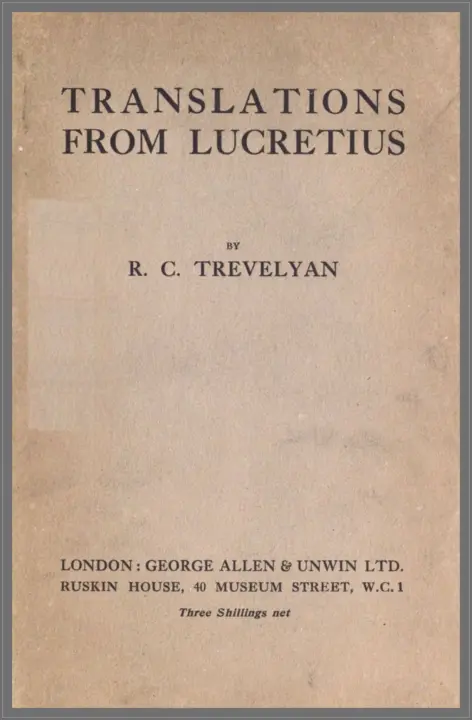
Translations from Lucretius
Titus Lucretius Carus
THE CLASSIC COLLECTION · 1921
"On the Nature of Things" by Titus Lucretius Carus is a didactic poem written in the first century BC. Spanning 7,400 verses across six books, this work aims to explain Epicurean philosophy to Roman readers through poetic language. Lucretius explores atomism, the nature of mind and soul, and celestial phenomena, arguing that the universe operates by physical principles and chance rather than divine intervention. The poem seeks to free readers from religious fear by demonstrating that natural laws, not gods, govern existence.
Introduction adapted from the source catalogue; source summaries may be automatically generated.
Free to read · English · 73,942 words · No account needed
MAKE TIME FOR A GOOD BOOK
On by default. Untick to stop anonymous reading totals. Each page counts after 10 seconds in view. How this works.
Anonymous counting is on unless you have switched it off.
And therefore kings were slain,
And pristine majesty of golden thrones
And haughty sceptres lay o'erturned in dust;
And crowns, so splendid on the sovereign heads,
Soon bloody under the proletarian feet,
Groaned for their glories gone--for erst o'er-much
Dreaded, thereafter with more greedy zest
Trampled beneath the rabble heel. Thus things
Down to the vilest lees of brawling mobs
Succumbed, whilst each man sought unto himself
Dominion and supremacy. So next
Some wiser heads instructed men to found
The magisterial office, and did frame
Codes that they might consent to follow laws.
For humankind, o'er wearied with a life
Fostered by force, was ailing from its feuds;
And so the sooner of its own free will
Yielded to laws and strictest codes. For since
Each hand made ready in its wrath to take
A vengeance fiercer than by man's fair laws
Is now conceded, men on this account
Loathed the old life fostered by force. 'Tis thence
That fear of punishments defiles each prize
Of wicked days; for force and fraud ensnare
Each man around, and in the main recoil
On him from whence they sprung. Not easy 'tis
For one who violates by ugly deeds
The bonds of common peace to pass a life
Composed and tranquil. For albeit he 'scape
The race of gods and men, he yet must dread
'Twill not be hid forever--since, indeed,
So many, oft babbling on amid their dreams
Or raving in sickness, have betrayed themselves
(As stories tell) and published at last
Old secrets and the sins.
But nature 'twas Urged men to utter various sounds of tongue And need and use did mould the names of things, About in same wise as the lack-speech years Compel young children unto gesturings, Making them point with finger here and there At what's before them. For each creature feels By instinct to what use to put his powers. Ere yet the bull-calf's scarce begotten horns Project above his brows, with them he 'gins Enraged to butt and savagely to thrust. But whelps of panthers and the lion's cubs With claws and paws and bites are at the fray Already, when their teeth and claws be scarce As yet engendered. So again, we see All breeds of winged creatures trust to wings And from their fledgling pinions seek to get A fluttering assistance. Thus, to think That in those days some man apportioned round To things their names, and that from him men learned Their first nomenclature, is foolery. For why could he mark everything by words And utter the various sounds of tongue, what time The rest may be supposed powerless To do the same? And, if the rest had not Already one with other used words, Whence was implanted in the teacher, then, Fore-knowledge of their use, and whence was given To him alone primordial faculty To know and see in mind what 'twas he willed? Besides, one only man could scarce subdue An overmastered multitude to choose To get by heart his names of things. A task Not easy 'tis in any wise to teach And to persuade the deaf concerning what 'Tis needful for to do. For ne'er would they Allow, nor ne'er in anywise endure Perpetual vain dingdong in their ears Of spoken sounds unheard before. And what, At last, in this affair so wondrous is, That human race (in whom a voice and tongue Were now in vigour) should by divers words Denote its objects, as each divers sense Might prompt?--since even the speechless herds, aye, since The very generations of wild beasts Are wont dissimilar and divers sounds To rouse from in them, when there's fear or pain, And when they burst with joys. And this, forsooth, 'Tis thine to know from plainest facts: when first Huge flabby jowls of mad Molossian hounds, Baring their hard white teeth, begin to snarl, They threaten, with infuriate lips peeled back, In sounds far other than with which they bark And fill with voices all the regions round. And when with fondling tongue they start to lick Their puppies, or do toss them round with paws, Feigning with gentle bites to gape and snap, They fawn with yelps of voice far other then Than when, alone within the house, they bay, Or whimpering slink with cringing sides from blows. Again the neighing of the horse, is that Not seen to differ likewise, when the stud In buoyant flower of his young years raves, Goaded by winged Love, amongst the mares, And when with widening nostrils out he snorts The call to battle, and when haply he Whinnies at times with terror-quaking limbs? Lastly, the flying race, the dappled birds, Hawks, ospreys, sea-gulls, searching food and life Amid the ocean billows in the brine, Utter at other times far other cries Than when they fight for food, or with their prey Struggle and strain. And birds there are which change With changing weather their own raucous songs-- As long-lived generations of the crows Or flocks of rooks, when they be said to cry For rain and water and to call at times For winds and gales. Ergo, if divers moods Compel the brutes, though speechless evermore, To send forth divers sounds, O truly then How much more likely 'twere that mortal men In those days could with many a different sound Denote each separate thing.
Your reading position is saved on this browser. Take it to another device with a library code. Reading pages adapt to text, rather than matching a printed edition.
Titus Lucretius Carus
BEHIND THE BOOK
This eBook is for the use of anyone anywhere in the United States and most other parts of the world at no cost and with almost no restrictions whatsoever. You may copy it, give it away or re-use it under the terms of the Project Gutenberg License included with this eBook or online at www.gutenberg.org. If you are not located in the United States, you will have to check the laws of the country where you are located before using this eBook. Read the source licence.
The original source file, including credits and licence, is retained by this library. Request an original-format copy at no charge. Please include the book title and Project Gutenberg identifier #785.
KEEP YOUR CURIOSITY GOING

David Patterson (Spirit) Hatch
Coulson Kernahan

Ralph Waldo Emerson
Frances Wright

Edwin Abbott Abbott

Joseph Droz