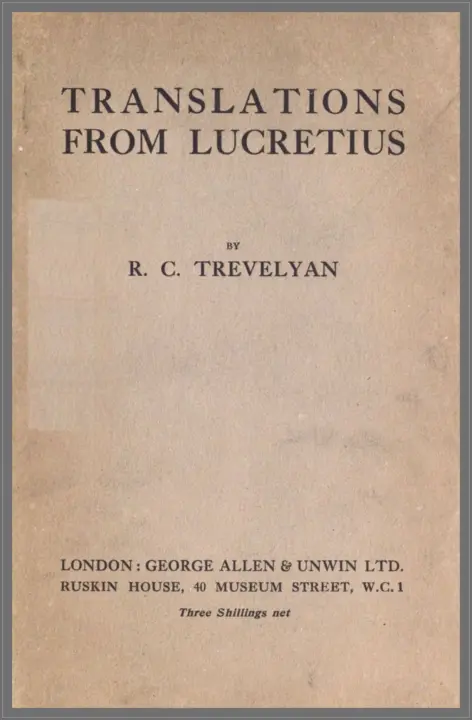
Translations from Lucretius
Titus Lucretius Carus
THE CLASSIC COLLECTION · 1921
"On the Nature of Things" by Titus Lucretius Carus is a didactic poem written in the first century BC. Spanning 7,400 verses across six books, this work aims to explain Epicurean philosophy to Roman readers through poetic language. Lucretius explores atomism, the nature of mind and soul, and celestial phenomena, arguing that the universe operates by physical principles and chance rather than divine intervention. The poem seeks to free readers from religious fear by demonstrating that natural laws, not gods, govern existence.
Introduction adapted from the source catalogue; source summaries may be automatically generated.
Free to read · English · 73,942 words · No account needed
MAKE TIME FOR A GOOD BOOK
On by default. Untick to stop anonymous reading totals. Each page counts after 10 seconds in view. How this works.
Anonymous counting is on unless you have switched it off.
Likewise, days may wax
Whilst the nights wane, and daylight minished be
Whilst nights do take their augmentations,
Either because the self-same sun, coursing
Under the lands and over in two arcs,
A longer and a briefer, doth dispart
The coasts of ether and divides in twain
His orbit all unequally, and adds,
As round he's borne, unto the one half there
As much as from the other half he's ta'en,
Until he then arrives that sign of heaven
Where the year's node renders the shades of night
Equal unto the periods of light.
For when the sun is midway on his course
Between the blasts of northwind and of south,
Heaven keeps his two goals parted equally,
By virtue of the fixed position old
Of the whole starry Zodiac, through which
That sun, in winding onward, takes a year,
Illumining the sky and all the lands
With oblique light--as men declare to us
Who by their diagrams have charted well
Those regions of the sky which be adorned
With the arranged signs of Zodiac.
Or else, because in certain parts the air
Under the lands is denser, the tremulous
Bright beams of fire do waver tardily,
Nor easily can penetrate that air
Nor yet emerge unto their rising-place:
For this it is that nights in winter time
Do linger long, ere comes the many-rayed
Round Badge of the day. Or else because, as said,
In alternating seasons of the year
Fires, now more quick, and now more slow, are wont
To stream together,--the fires which make the sun
To rise in some one spot--therefore it is
That those men seem to speak the truth [who hold
A new sun is with each new daybreak born].
The moon she possibly doth shine because
Strook by the rays of sun, and day by day
May turn unto our gaze her light, the more
She doth recede from orb of sun, until,
Facing him opposite across the world,
She hath with full effulgence gleamed abroad,
And, at her rising as she soars above,
Hath there observed his setting; thence likewise
She needs must hide, as 'twere, her light behind
By slow degrees, the nearer now she glides,
Along the circle of the Zodiac,
From her far place toward fires of yonder sun,--
As those men hold who feign the moon to be
Just like a ball and to pursue a course
Betwixt the sun and earth. There is, again,
Some reason to suppose that moon may roll
With light her very own, and thus display
The varied shapes of her resplendence there.
For near her is, percase, another body,
Invisible, because devoid of light,
Borne on and gliding all along with her,
Which in three modes may block and blot her disk.
Again, she may revolve upon herself,
Like to a ball's sphere--if perchance that be--
One half of her dyed o'er with glowing light,
And by the revolution of that sphere
She may beget for us her varying shapes,
Until she turns that fiery part of her
Full to the sight and open eyes of men;
Thence by slow stages round and back she whirls,
Withdrawing thus the luminiferous part
Of her sphered mass and ball, as, verily,
The Babylonian doctrine of Chaldees,
Refuting the art of Greek astrologers,
Labours, in opposition, to prove sure--
As if, forsooth, the thing for which each fights,
Might not alike be true,--or aught there were
Wherefore thou mightest risk embracing one
More than the other notion. Then, again,
Why a new moon might not forevermore
Created be with fixed successions there
Of shapes and with configurations fixed,
And why each day that bright created moon
Might not miscarry and another be,
In its stead and place, engendered anew,
'Tis hard to show by reason, or by words
To prove absurd--since, lo, so many things
Can be create with fixed successions:
Spring-time and Venus come, and Venus' boy,
The winged harbinger, steps on before,
And hard on Zephyr's foot-prints Mother Flora,
Sprinkling the ways before them, filleth all
With colours and with odours excellent;
Whereafter follows arid Heat, and he
Companioned is by Ceres, dusty one,
And by the Etesian Breezes of the north;
Then cometh Autumn on, and with him steps
Lord Bacchus, and then other Seasons too
And other Winds do follow--the high roar
Of great Volturnus, and the Southwind strong
With thunder-bolts. At last earth's Shortest-Day
Bears on to men the snows and brings again
The numbing cold. And Winter follows her,
His teeth with chills a-chatter. Therefore, 'tis
The less a marvel, if at fixed time
A moon is thus begotten and again
At fixed time destroyed, since things so many
Can come to being thus at fixed time.
Likewise, the sun's eclipses and the moon's
Far occultations rightly thou mayst deem
Your reading position is saved on this browser. Take it to another device with a library code. Reading pages adapt to text, rather than matching a printed edition.
Titus Lucretius Carus
BEHIND THE BOOK
This eBook is for the use of anyone anywhere in the United States and most other parts of the world at no cost and with almost no restrictions whatsoever. You may copy it, give it away or re-use it under the terms of the Project Gutenberg License included with this eBook or online at www.gutenberg.org. If you are not located in the United States, you will have to check the laws of the country where you are located before using this eBook. Read the source licence.
The original source file, including credits and licence, is retained by this library. Request an original-format copy at no charge. Please include the book title and Project Gutenberg identifier #785.
KEEP YOUR CURIOSITY GOING

David Patterson (Spirit) Hatch
Coulson Kernahan

Ralph Waldo Emerson
Frances Wright

Edwin Abbott Abbott

Joseph Droz