The diary of a superfluous man, and other stories
Ivan Sergeevich Turgenev
THE CLASSIC COLLECTION · 1859
"On the eve: A novel by Ivan Sergeevich Turgenev" is a novel first published in 1859. The story follows Elena Stakhova, a young woman pursued by multiple suitors on the eve of the Crimean War. When she meets Dmitri Insarov, a revolutionary Bulgarian, they fall in love and secretly marry, defying her parents' wishes. Their union leads them on a tragic journey that tests their ideals and devotion, ultimately taking Elena far from home in search of a cause greater than herself.
Introduction adapted from the source catalogue; source summaries may be automatically generated.
Free to read · English · 59,844 words · No account needed
MAKE TIME FOR A GOOD BOOK
On by default. Untick to stop anonymous reading totals. Each page counts after 10 seconds in view. How this works.
Anonymous counting is on unless you have switched it off.
‘Who is his father?’ inquired Anna Vassilyevna.
‘His father? His father is a man well-known in his own line, of the highest moral character, un vrai stoïcien, a retired major, I think, overseer of all the estates of the Count B----’
‘Ah!’ observed Anna Vassilyevna.
‘Ah! why ah?’ interposed Nikolai Artemyevitch. ‘Can you be infected with
prejudice?’
‘Why, I said nothing----’ Anna Vassilyevna was beginning.
‘No, you said, ah!--However that may be, I have thought it well to acquaint you with my way of thinking; and I venture to think--I venture to hope Mr. Kurnatovsky will be received à bras ouverts. He is no Montenegrin vagrant.’
‘Of course; I need only call Vanka the cook and order a few extra
dishes.’
‘You are aware that I will not enter into that,’ said Nikolai Artemyevitch; and he got up, put on his hat, and whistling (he had heard some one say that whistling was only permissible in a country villa and a riding court) went out for a stroll in the garden. Shubin watched him out of the little window of his lodge, and in silence put out his tongue at him.
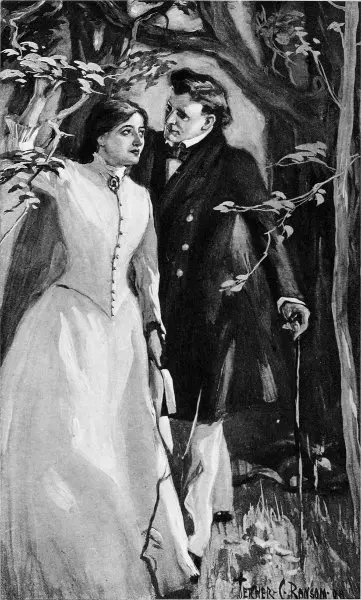
At ten minutes to four, a hackney-carriage drove up to the steps of the Stahovs’s villa, and a man, still young, of prepossessing appearance, simply and elegantly dressed, stepped out of it and sent up his name. This was Yegor Andreyevitch Kurnatovsky.
This was what, among other things, Elena wrote next day to Insarov:
‘Congratulate me, dear Dmitri, I have a suitor. He dined with us yesterday: papa made his acquaintance at the English club, I fancy, and invited him. Of course he did not come yesterday as a suitor. But good mamma, to whom papa had made known his hopes, whispered in my ear what this guest was. His name is Yegor Andreyevitch Kurnatovsky; he is upper-secretary to the Senate. I will first describe to you his appearance. He is of medium height, shorter than you, and a good figure; his features are regular, he is close-cropped, and wears large whiskers. His eyes are rather small (like yours), brown, and quick; he has a flat wide mouth; in his eyes and on his lips there is a perpetual sort of official smile; it seems to be always on duty there. He behaves very simply and speaks precisely, and everything about him is precise; he moves, laughs, and eats as though he were doing a duty. “How carefully she has studied him!” you are thinking, perhaps, at this minute. Yes; so as to be able to describe him to you. And besides, who wouldn’t study her suitor! There’s something of iron in him--and dull and empty at the same time--and honest; they say he is really very honest. You, too, are made of iron; but not like this man. At dinner he sat next me, and facing us sat Shubin. At first the conversation turned on commercial undertakings; they say he is very clever in business matters, and was almost throwing up his government post to take charge of a large manufacturing business. Pity he didn’t do it! Then Shubin began to talk about the theatre; Mr. Kurnatovsky declared and--I must confess--without false modesty, that he has no ideas about art. That reminded me of you--but I thought; no, Dmitri and I are ignorant of art in a very different way though. This man seemed to mean, “I know nothing of it, and it’s quite superfluous, still it may be admitted in a well-ordered state.” He seems, however, to think very little about Petersburg and comme il faut: he once even called himself one of the proletariat. ‘We are working people,’ he said; I thought if Dmitri had said that, I shouldn’t have liked it; but he may talk about himself, he may boast if he likes. With me he is very attentive; but I kept feeling that a very, very condescending superior was talking with me. When he means to praise any one, he says So-and-so is a man of principle--that’s his favourite word. He seems to be self-confident, hardworking, capable of self-sacrifice (you see, I am impartial), that’s to say, of sacrificing his own interest; but he is a great despot. It would be woeful to fall into his power! At dinner they began talking about bribes.
Your reading position is saved on this browser. Take it to another device with a library code. Reading pages adapt to text, rather than matching a printed edition.
Ivan Sergeevich Turgenev
Ivan Sergeevich Turgenev
Ivan Sergeevich Turgenev
Ivan Sergeevich Turgenev
BEHIND THE BOOK
This eBook is for the use of anyone anywhere in the United States and most other parts of the world at no cost and with almost no restrictions whatsoever. You may copy it, give it away or re-use it under the terms of the Project Gutenberg License included with this eBook or online at www.gutenberg.org. If you are not located in the United States, you will have to check the laws of the country where you are located before using this eBook. Read the source licence.
The original source file, including credits and licence, is retained by this library. Request an original-format copy at no charge. Please include the book title and Project Gutenberg identifier #6902.
KEEP YOUR CURIOSITY GOING
Coulson Kernahan

Maurice Baring
Frances Wright
Cécile Tormay

Frederic Jesup Stimson

W. H. P. (William Henry Pope) Jarvis