Switch off
Oliver Optic
THE CLASSIC COLLECTION · 1890
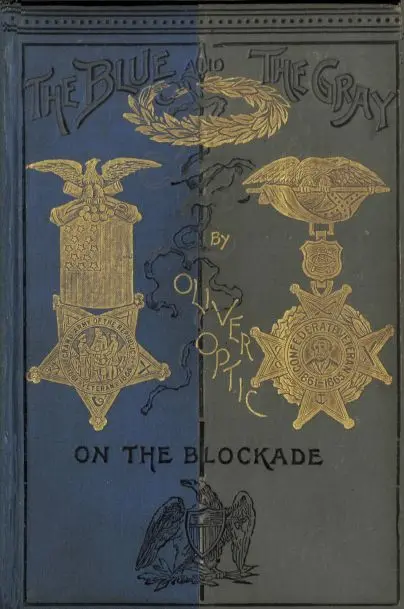
"On The Blockade" by Oliver Optic is a novel written in the late 19th century. This work is part of "The Blue and the Gray" series, set during the American Civil War, focusing on the naval conflicts along the Southern coast. The story centers around Christy Passford, a young commander in the United States Navy, as he navigates the dangers of blockade running and encounters treachery among his crew. The beginning of "On The Blockade" introduces Christy Passford, who is reluctantly leaving his previous ship, the Bellevite, as he takes command of the United States Steamer Bronx. The narrative captures his complex emotions about his new role and the seriousness of his mission, revealing crucial intelligence about blockade runners and suspected Confederate vessels. The dialogue between Christy and his father, Captain Passford, hints at the importance of duty, loyalty, and the impending threats they face, establishing a sense of tension as they prepare for Christy's journey into enemy waters.
Introduction adapted from the source catalogue; source summaries may be automatically generated.
Free to read · English · 68,481 words · No account needed
MAKE TIME FOR A GOOD BOOK
On by default. Untick to stop anonymous reading totals. Each page counts after 10 seconds in view. How this works.
Anonymous counting is on unless you have switched it off.
"I begin to see into your system, father; and I suppose the government will carry out your plan."
"Very likely; for it would hardly be proper to send such information as these men have to transmit in plain English, for there may be spies or operators bribed by Confederate agents to suppress such matter."
"I see. I understand the system very well, father," said Christy.
"It is simple enough," added his father, as he took a paper from his
pocket-book.
"If you only understand it, it is simple enough."
"I can interpret the language of this message, and there is not another person on the western continent that can do so. Now, look at the cablegram, Christy," continued Captain Passford, as he opened the paper he held in his hand. "What is the first word?"
"Mutton," replied the commander.
"Mutton means armed; that is to say the Scotian and the Arran took an armament on board at some point south of England, as indicated by the fact that the intelligence comes from Warnock. In about a week the mail will bring me a letter from him in which he will explain how he obtained this information."
"He must have chartered a steamer and cruised off the Isle of Wight to pick it up," suggested Christy.
"He is instructed to do that when necessary. What is the next word?"
"'Three,'" replied Christy.
"One means large, two medium, and three small," explained his father.
"Three what, does it say?"
"'Three veal.'"
"Veal means ship's company, or crew."
"Putting the pieces together, then, 'three veal' means that the Scotian and the Arran have small crews," said Christy, intensely interested in the information.
"Precisely so. Read the rest of the message," added Captain Passford.
"'Four sea chickens,'" the commander read.
"'Four' means some, a few, no great number; in other words, rather indefinite. Very likely Warnock could not obtain exact information. 'C' stands for Confederate, and 'sea' is written instead of the letter. 'Chickens' means officers. 'Four sea chickens,' translated means 'some Confederate officers.'"
Christy had written down on a piece of paper the solution of the enigma, as interpreted by his father, though not the symbol words of the cablegram. He continued to write for a little longer time, amplifying and filling in the wanting parts of the message. Then he read what he had written, as follows: "'The Scotian and the Arran are armed; there are some Confederate officers on board, but their ship's companies are small.' Is that it, father?"
Your reading position is saved on this browser. Take it to another device with a library code. Reading pages adapt to text, rather than matching a printed edition.
BEHIND THE BOOK
This eBook is for the use of anyone anywhere in the United States and most other parts of the world at no cost and with almost no restrictions whatsoever. You may copy it, give it away or re-use it under the terms of the Project Gutenberg License included with this eBook or online at www.gutenberg.org. If you are not located in the United States, you will have to check the laws of the country where you are located before using this eBook. Read the source licence.
The original source file, including credits and licence, is retained by this library. Request an original-format copy at no charge. Please include the book title and Project Gutenberg identifier #18617.
KEEP YOUR CURIOSITY GOING
Cécile Tormay

Moritz Busch
Coulson Kernahan
John L. Ransom

Maurice Baring
Frances Wright