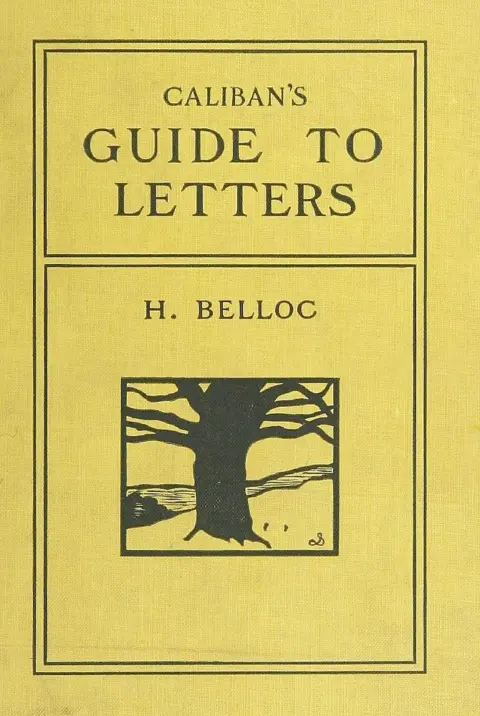
The Aftermath; Or, Gleanings from a Busy Life Called upon the outer cover, for purposes of sale, Caliban’s Guide to Letters
Hilaire Belloc

THE CLASSIC COLLECTION · 1909
"On Everything" by Hilaire Belloc is a collection of essays written in the early 20th century. The essays explore various topics ranging from the significance of song in society to personal reflections on life experiences and the English landscape. Belloc, a noted writer and political figure, delves into the philosophical and social implications of these subjects with a blend of wit and insight. The beginning of the collection introduces themes of hope, human connection, and culture through the essay "On Song." Here, Belloc argues that the presence of song is essential to the vitality of society, suggesting that its absence signals a form of despair. He reflects on various social groups like sailors and soldiers, emphasizing the role of music in creating a communal spirit and shared resilience. The opening portion sets the tone for the essays to come, establishing Belloc's contemplative style, detailed observations, and profound understanding of human nature and society's intricacies.
Introduction adapted from the source catalogue; source summaries may be automatically generated.
Free to read · English · 70,715 words · No account needed
MAKE TIME FOR A GOOD BOOK
On by default. Untick to stop anonymous reading totals. Each page counts after 10 seconds in view. How this works.
Anonymous counting is on unless you have switched it off.
Unless a man understands the Weald he cannot easily write about the beginnings of England, and yet historians have not understood it. Only the men mixed into it and married with it or born upon it have understood it, and these, I say, until lately were not permitted by constant travel that judgment by analogy and by contrast which teaches us the true meaning of things that we had hitherto only instinctively known. Now a Wealden man can say certain things about his countryside which are of real value to history and perhaps to politics as well; at any rate, to politics in that larger sense of patriotism intelligently appreciating the future of one’s own land. Thus the Wealden man, now that he knows so much else in England, can tell the historian that the Weald was never the impenetrable forest which historians would make of it. It lay in a barrier between the ports of the Channel and the Thames Valley. But the barrier was not uninhabited; it was not impassable. Its scattered brushwood was patchy, its soil never permanently marshy nor ever for long distances difficult for a mounted man or a man on foot. The Weald from the very beginning had homesteads in it, but it had not agglomerations of houses, nor had it parishes save in very few places. If you look at the map now you can see how the old parishes stretch northward and southward in long strips from the chalk and loam country up towards the forest ridge which is the centre of the Weald. Those long strips were the hunting rights of the village folk and their lords. Of some parishes carved out of the central Weald we can accurately tell the origin. We know that they were colonised as it were, cleared, and had their church built for them in the great spurt of civilisation which marked the twelfth and thirteenth centuries. Men would understand the early history of the Weald better, and with it the early military history of South-Eastern England, if they would take one of the old forest paths--as that from Rusper, for instance, which works its way down, now as a metalled road, now as a green lane, now as a mere footpath with right of way, past the two old “broad” fords on the upper Arun and the marshy land east of Pulborough until it gets to Roundabout, and so to Storrington. All the history of communications in the Weald is exemplified in such a journey--and it is a journey which, though it is little more than twenty miles in length, takes quite a day. You have the modern high road, the green lane of the immediate past, and in places a mere track of remote antiquity. You see just how difficult it is to traverse the clay, how the occasional knobs of sand relieve your going; you can notice the character of the woodland where it is still untouched, and if you are wise you will notice one thing above all, and that is the character of the water. Now it is this which explains the Weald. Many bad bits of clay in Europe have formed highways for armies--for instance, all that rotten land in the great bend of the Loire which the Romans called the Solitarium, and which the French called the Sologne. But the Weald differs from most others in this, that good and plentiful water is hard to find. It is not the muddiness of the streams that is the chief defence of the place against human travel and habitation; it is the way in which, when rain has fallen and when water is plentiful, going is difficult, and the way in which, when a few days of dry weather come, the going becomes easy, but the water in the little streams disappears. There is evidence that the Romans, when they built their great military road--perhaps their only purely military road in Britain--across the Weald skipped one intervening station which should, upon the analogy of others, have been present upon it in the heart of the Weald, and pressed the march in this place to nearly double its usual length. The French armies do precisely the same thing in the bad lands of the Plain of Chalons to-day. Wherever there is ancient habitation in the Weald, or rather upon the fringes of the Weald, there is good, plentiful, and perennial water; elsewhere the Weald is still what it has been throughout history--a great rolling place, not deserted, not lonely, and yet not humanised. It is exactly the place for a seclusion from men, for you can see some men, but not too many of them; and I have always thought that King wise, who, when his enemies desired to kill him, wandered in the Andredsweald. The historians say that he took refuge in the impassable thickets of the forest. This is bosh. No man can sleep out in this climate for a season round, nor can any man live without cooked meat, nor do I see an Anglo-Saxon king living without wine and a good deal of pomp into the bargain. As to the wine, men might argue, but as to the pomp, they cannot. I will tell you what this King did without any doubt. He went from steading to steading and was royally entertained, and if you ask why it was a refuge for him the answer is that it was a refuge against the pursuit of many men.
Your reading position is saved on this browser. Take it to another device with a library code. Reading pages adapt to text, rather than matching a printed edition.
Hilaire Belloc
Hilaire Belloc
Hilaire Belloc
Hilaire Belloc
BEHIND THE BOOK
This eBook is for the use of anyone anywhere in the United States and most other parts of the world at no cost and with almost no restrictions whatsoever. You may copy it, give it away or re-use it under the terms of the Project Gutenberg License included with this eBook or online at www.gutenberg.org. If you are not located in the United States, you will have to check the laws of the country where you are located before using this eBook. Read the source licence.
The original source file, including credits and licence, is retained by this library. Request an original-format copy at no charge. Please include the book title and Project Gutenberg identifier #61076.
KEEP YOUR CURIOSITY GOING

David Patterson (Spirit) Hatch

David Patterson (Spirit) Hatch

David Patterson (Spirit) Hatch

Ralph Waldo Emerson

Maurice Baring
Oscar Wilde & James McNeill Whistler