
The Aftermath; Or, Gleanings from a Busy Life Called upon the outer cover, for purposes of sale, Caliban’s Guide to Letters
Hilaire Belloc
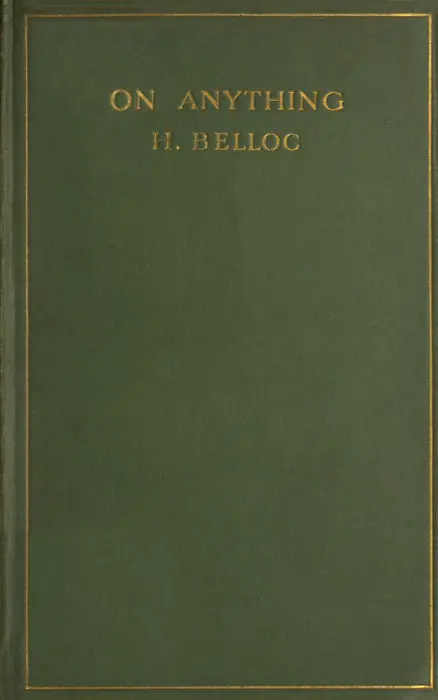
THE CLASSIC COLLECTION · 1910
"On Anything" by Hilaire Belloc is a collection of philosophical essays written in the early 20th century. The essays explore a wide range of topics, including human nature, culture, and the essence of life, often infused with Belloc's wit and wisdom. The work reflects on the mundane and the profound aspects of existence, inviting readers to ponder various life experiences and observations." "The opening of the collection starts with an essay titled "On Building Castles in Spain." The narrative unfolds in Perpignan, where the author encounters a man in a secluded garden who muses about life and his youthful aspirations of building metaphorical castles in Spain. Through whimsical reflections, the protagonist recounts his journey through Spain in search of these castles, only to discover the futility of such endeavors. This whimsical tale serves not only as a humorous anecdote but also as a metaphor for dreams and ambitions that may not align with reality, setting the tone for the introspective and contemplative themes that will be explored throughout the remainder of the essays."
Introduction adapted from the source catalogue; source summaries may be automatically generated.
Free to read · English · 67,160 words · No account needed
MAKE TIME FOR A GOOD BOOK
On by default. Untick to stop anonymous reading totals. Each page counts after 10 seconds in view. How this works.
Anonymous counting is on unless you have switched it off.
It is often remarked that the lines of European travel can hardly be permanently altered, that Nature has designed them. Generations do sometimes pass in which some profound change in man rather than in Nature affects a few of the great roads. The Roman line from the south northward, the highway from the Saone to the Straits of Dover, passing by Laon and Amiens, was deflected as the Dark Ages closed round the mind of Gaul. Water carriage succeeded the degraded high-roads. The convergence of water-ways in the basin of Paris made that basin the centre of travel, and the old way by Laon was forgotten. Yet modern conditions restored it. The railway has done again what the Roman engineers accomplished, and Laon is once again a halt upon the great road southwards, and once again the most direct avenue from the Channel to the Mediterranean follows the plain to the east of Paris. So it has come to be with a road equally famous, equally forgotten, the High Road from the North into Spain.
The Pyrenees lie, as every one knows, like an artificial wall between the valley of the Ebro and Gaul. How great the division is only those can believe who have seen with their own eyes the meadows and the deep orchards of Bearn, and then, after a painful crossing of the hills, have come upon the burnt deserts of Aragon. The road from the one to the other, the administrative road which bound Spain to Gaul, which connected Cæsaraugusta with Tolosa, that is, Saragossa with Toulouse, was a Roman Highway, called "the High Pyrenean," the highest and most central of the two main passes. It had, as I have said, Toulouse for its northern terminus, Saragossa for its southern. It had for two mountain towns, or depots, at the foot of either climb, Oloron, the town of the Ilurones, on the north; on the south the Bishop's town of Jaca. It had for its last outpost just before the last steep Urdos, the Forum Ligneum, to the north; to the south a cluster of huts and a station, whose Roman name has not come down to us, but which since the barbarian invasions has been called "Canfranc." This great road, like so many throughout the Empire, fell. You may yet trace its structure in those places where it is not identical with the modern way, but with the close of the Empire, and on nearly to our own time its surface was left unrepaired. Armies used it, as they used all the great Roman roads of the north and west, till the Twelfth Century. The Merovingians crossed it in their raids to the Ebro; Charlemagne sent men down it in the advance upon (and failure before) Saragossa--the expedition whose retreat was clinched by the destruction of his rearguard and the death of Roland in Roncesvalles. It was still a gate for armies when the reconquest of Spain from the Mohammedan began. Jaca was free before any other town of the Central North, Huesca fell before the first Crusade was fought, Saragossa before the second. Bearn, and indeed all Christendom, still used that high notch until the new civilisation of the Middle Ages had set in with the Twelfth Century, but from that beginning till our own time it was more and more forgotten. Spain, reconquered, corresponded with Europe by the sea. The two land roads that bound the Peninsula to Christendom ran round either end of the Pyrenean Chain. The central pass was abandoned when the great development of French roads, which was the work of Louis XIV, was imitated--most imperfectly--by his grandson in Madrid, it was the road by Burgos, Vittoria, and Bayonne that was renewed; the commercial energy of the Catalans in the same generation opened the Perthuis, broke into the Roussillon, and connected Barcelona with Perpignan and with Narbonne. But Aragon, the pivot and centre of the old Reconquest, Saragossa, the main town of the Roman communication with the north, lay off the two tracks of travel, half forgot Europe and by Europe were ill-remembered. It was Napoleon, or, to be more accurate, the Revolutionary Crusade, which reopened the central pass, and here, as in so many other places, began the return to Roman things. While the armies of the Empire, with their train and their artillery, were still tied to the sea road from the Roussillon, a small force without guns passed up the old Roman road (now come to be called the "Somport"), marched over its silent grasses, wading the Arroyos, the bridges over which had long since fallen in, appeared suddenly before Jaca, occupied that citadel, and pursued the way to Saragossa, there to join the main army and to lay a siege memorable beyond all modern sieges for an heroic defence. Buonaparte seized the advantage of that passage. He desired a road over which artillery could go. It was one of twenty which he so desired over the mountain ranges of Europe, and which a full century has barely seen completed; for within four years of his resolution his supremacy was broken at Leipsic and destroyed at Waterloo. The Third Empire continued the tradition; the road was carried up on the French side of the pass, but the universal power of 1808 was gone and the Spanish approach was neglected. It was not till the other day, till our own generation, that the full work was done, and that the great street from Toulouse to Saragossa right over the hills was once more open to the full power of travel. Yet travel failed it. In the meanwhile the railways had come; they had followed the coast roads, and the main line from Madrid to Paris ran tortuously through the mountains of Castile and turned twenty times in the labyrinth of Basque Valleys, between Vittoria and Irun. Saragossa was still upon one side; Aragon still remained remote; the new road was empty beneath the cliffs of its great hills.
Your reading position is saved on this browser. Take it to another device with a library code. Reading pages adapt to text, rather than matching a printed edition.
Hilaire Belloc
Hilaire Belloc
Hilaire Belloc
Hilaire Belloc
BEHIND THE BOOK
This eBook is for the use of anyone anywhere in the United States and most other parts of the world at no cost and with almost no restrictions whatsoever. You may copy it, give it away or re-use it under the terms of the Project Gutenberg License included with this eBook or online at www.gutenberg.org. If you are not located in the United States, you will have to check the laws of the country where you are located before using this eBook. Read the source licence.
The original source file, including credits and licence, is retained by this library. Request an original-format copy at no charge. Please include the book title and Project Gutenberg identifier #61550.
KEEP YOUR CURIOSITY GOING

David Patterson (Spirit) Hatch

David Patterson (Spirit) Hatch

David Patterson (Spirit) Hatch

Ralph Waldo Emerson

Maurice Baring

Oscar Wilde & James McNeill Whistler