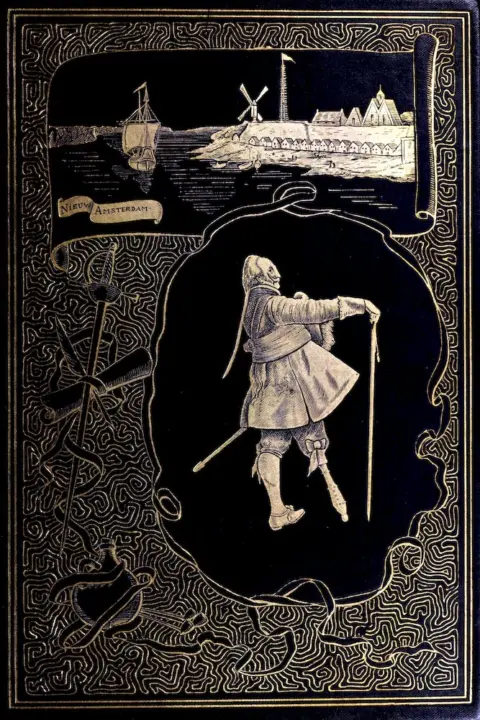
Knickerbocker’s history of New York, vol. 2 (of 2)
Washington Irving
THE CLASSIC COLLECTION · 1840
"Oliver Goldsmith: A Biography" by Washington Irving is a biographical account written in the mid-19th century. The book explores the life of the celebrated author and poet Oliver Goldsmith, delving into his early years, education, and personal struggles, while also highlighting the characteristics and influences of his family. The narrative spans Goldsmith's journey from his modest upbringing in Ireland to his various adventures and misadventures, ultimately painting a vivid picture of his profound yet whimsical nature. At the start of the biography, Irving introduces Goldsmith, emphasizing the personal warmth readers feel toward him, shaped by his relatable experiences and struggles. The opening chapters outline Goldsmith's origins in a less-than-prosperous household, detailing his schooling under whimsical yet demanding tutors and his early literary inclinations. Irving recounts Goldsmith's formative experiences, including humorous episodes from his adolescence and the challenges he faced at university. Overall, the opening establishes a foundation for understanding Goldsmith's character and foreshadows the trials that would shape his literary voice and ambitions.
Introduction adapted from the source catalogue; source summaries may be automatically generated.
Free to read · English · 103,316 words · No account needed
MAKE TIME FOR A GOOD BOOK
On by default. Untick to stop anonymous reading totals. Each page counts after 10 seconds in view. How this works.
Anonymous counting is on unless you have switched it off.
Cut off thus from the kind co-operation of his uncle, he addresses a letter to his daughter Jane, the companion of his schoolboy and happy days, now the wife of Mr. Lawder. The object was to secure her interest with her husband in promoting the circulation of his proposals. The letter is full of character.
"If you should ask," he begins, "why, in an interval of so many years, you never heard from me, permit me, madam, to ask the same question. I have the best excuse in recrimination. I wrote to Kilmore from Leyden in Holland, from Louvain in Flanders, and Rouen in France, but received no answer. To what could I attribute this silence but to displeasure or forgetfulness? Whether I was right in my conjecture I do not pretend to determine; but this I must ingenuously own that I have a thousand times in my turn endeavored to forget them, whom I could not but look upon as forgetting me. I have attempted to blot their names from my memory, and, I confess it, spent whole days in efforts to tear their image from my heart. Could I have succeeded, you had not now been troubled with this renewal of a discontinued correspondence; but, as every effort the restless make to procure sleep serves but to keep them waking, all my attempts contributed to impress what I would forget deeper on my imagination. But this subject I would willingly turn from, and yet, 'for the soul of me,' I can't till I have said all. I was, madam, when I discontinued writing to Kilmore, in such circumstances that all my endeavors to continue your regards might be attributed to wrong motives. My letters might be looked upon as the petitions of a beggar, and not the offerings of a friend; while all my professions, instead of being considered as the result of disinterested esteem, might be ascribed to venal insincerity. I believe, indeed, you had too much generosity to place them in such a light, but I could not bear even the shadow of such a suspicion. The most delicate friendships are always most sensible of the slightest invasion, and the strongest jealousy is ever attendant on the warmest regard. I could not--I own I could not--continue a correspondence in which every acknowledgment for past favors might be considered as an indirect request for future ones; and where it might be thought I gave my heart from a motive of gratitude alone, when I was conscious of having bestowed it on much more disinterested principles. It is true, this conduct might have been simple enough; but yourself must confess it was in character. Those who know me at all, know that I have always been actuated by different principles from the rest of mankind: and while none regarded the interest of his friend more, no man on earth regarded his own less. I have often affected bluntness to avoid the imputation of flattery; have frequently seemed to overlook those merits too obvious to escape notice, and pretended disregard to those instances of good nature and good sense, which I could not fail tacitly to applaud; and all this lest I should be ranked among the grinning tribe, who say 'very true' to all that is said; who fill a vacant chair at a tea-table; whose narrow souls never moved in a wider circle than the circumference of a guinea; and who had rather be reckoning the money in your pocket than the virtue in your breast. All this, I say, I have done, and a thousand other very silly, though very disinterested, things in my time, and for all which no soul cares a farthing about me.... Is it to be wondered that he should once in his life forget you, who has been all his life forgetting himself? However, it is probable you may one of these days see me turned into a perfect hunks, and as dark and intricate as a mouse-hole. I have already given my landlady orders for an entire reform in the state of my finances. I declaim against hot suppers, drink less sugar in my tea, and check my grate with brickbats. Instead of hanging my room with pictures, I intend to adorn it with maxims of frugality. Those will make pretty furniture enough, and won't be a bit too expensive; for I will draw them all out with my own hands, and my landlady's daughter shall frame them with the parings of my black waistcoat. Each maxim is to be inscribed on a sheet of clean paper, and wrote with my best pen; of which the following will serve as a specimen. Look sharp: Mind the main chance: Money is money now: If you have a thousand pounds you can put your hands by your sides, and say you are worth a thousand pounds every day of the year: Take a farthing from a hundred and it will be a hundred no longer. Thus, which way soever I turn my eyes, they are sure to meet one of those friendly monitors; and as we are told of an actor who hung his room round with looking-glass to correct the defects of his person, my apartment shall be furnished in a peculiar manner, to correct the errors of my mind. Faith! madam, I heartily wish to be rich, if it were only for this reason, to say without a blush how much I esteem you. But, alas! I have many a fatigue to encounter before that happy times comes, when your poor old simple friend may again give a loose to the luxuriance of his nature; sitting by Kilmore fireside, recount the various adventures of a hard-fought life; laugh over the follies of the day; join his flute to your harpsichord; and forget that ever he starved in those streets where Butler and Otway starved before him. And now I mention those great names--my uncle! he is no more that soul of fire as when I once knew him. Newton and Swift grew dim with age as well as he. But what shall I say? His mind was too active an inhabitant not to disorder the feeble mansion of its abode: for the richest jewels soonest wear their settings. Yet who but the fool would lament his condition! He now forgets the calamities of life. Perhaps indulgent Heaven has given him a foretaste of that tranquillity here, which he so well deserves hereafter. But I must come to business; for business, as one of my maxims tells me, must be minded or lost. I am going to publish in London a book entitled 'The Present State of Taste and Literature in Europe.' The booksellers in Ireland republish every performance there without making the author any consideration. I would, in this respect, disappoint their avarice and have all the profits of my labor to myself. I must therefore request Mr. Lawder to circulate among his friends and acquaintances a hundred of my proposals which I have given the bookseller, Mr. Bradley, in Dame Street, directions to send to him. If, in pursuance of such circulation, he should receive any subscriptions, I entreat, when collected, they may be sent to Mr. Bradley, as aforesaid, who will give a receipt, and be accountable for the work, or a return of the subscription. If this request (which, if it be complied with, will in some measure be an encouragement to a man of learning) should be disagreeable or troublesome, I would not press it; for I would be the last man on earth to have my labors go a-begging; but if I know Mr. Lawder (and sure I ought to know him), he will accept the employment with pleasure. All I can say--if he writes a book, I will get him two hundred subscribers, and those of the best wits in Europe. Whether this request is complied with or not, I shall not be uneasy; but there is one petition I must make to him and to you, which I solicit with the warmest ardor, and in which I cannot bear a refusal. I mean, dear madam, that I may be allowed to subscribe myself, your ever affectionate and obliged kinsman, OLIVER GOLDSMITH. Now see how I blot and blunder, when I am asking a favor."
Your reading position is saved on this browser. Take it to another device with a library code. Reading pages adapt to text, rather than matching a printed edition.
Washington Irving
William Irving & Washington Irving & James Kirke Paulding
Washington Irving
Washington Irving
BEHIND THE BOOK
This eBook is for the use of anyone anywhere in the United States and most other parts of the world at no cost and with almost no restrictions whatsoever. You may copy it, give it away or re-use it under the terms of the Project Gutenberg License included with this eBook or online at www.gutenberg.org. If you are not located in the United States, you will have to check the laws of the country where you are located before using this eBook. Read the source licence.
The original source file, including credits and licence, is retained by this library. Request an original-format copy at no charge. Please include the book title and Project Gutenberg identifier #7993.
KEEP YOUR CURIOSITY GOING
John L. Ransom

Herman W. Mudgett

Harriet Monroe
Daniel Dulany Addison
Charles Lanman

Harold Rosher