THE CLASSIC COLLECTION✦Stories of RomanceCLASSIC FREE BOOKS
Stories of Romance
Dinah Maria Mulock Craik & Allan Cunningham & Oliver Wendell Holmes & Harriet Elizabeth Prescott Spofford & John Wilson
THE CLASSIC COLLECTION · 1850
"Olive: A Novel" by Dinah Maria Mulock Craik is a fictional work written in the mid-19th century. The novel introduces us to the titular character, Olive Rothesay, who is born into a world filled with superstitions and societal expectations. As the narrative unfolds, we witness the complex emotions surrounding her birth, her mother Sybilla's struggles, and her nurse Elspie's fierce loyalty as they navigate a society that often equates worth with outward beauty. The opening of the novel presents Olive's arrival into the world, accompanied by a foreboding prophecy from an old nurse who hints at troubles ahead. As Olive's mother, Sybilla, grapples with the reality of her daughter's deformity, the contrast between her beauty and her child's perceived ugliness sets the stage for the emotional turmoil that follows. The doctor, representing a voice of cold practicality, shares the grim news of Olive's condition with Elspie, who immediately feels a deep, protective love for the helpless babe. This initial glimpse of Olive's precarious place in a world fixated on appearances suggests a story rich with themes of maternal instinct, societal judgment, and the search for inner beauty amidst external struggles.
Introduction adapted from the source catalogue; source summaries may be automatically generated.
Free to read · English · 141,678 words · No account needed
MAKE TIME FOR A GOOD BOOK
On by default. Untick to stop anonymous reading totals. Each page counts after 10 seconds in view. How this works.
Anonymous counting is on unless you have switched it off.
Hurriedly, Elspie continued to relate the histories: of noble Jean Rothesay, who died by an arrow aimed at her husband's heart; and Alison, her sister, the beauty of James the Fifth's reckless court, who was “no gude;” and Mistress Katharine Rothesay, who hid two of the “Prince's” soldiers after Culloden, and stood with a pair of pistols before their bolted door.
“Nay, I'll have none of these--they frighten me,” said Sybilla, “I wonder I ever had courage to marry the descendant of such awful women. No! my sweet innocent! you shall not be christened after them,” she continued, stroking the baby cheek with her soft finger. “You shall not be like them at all, except in their beauty. And they were all handsome--were they, Elspie?”
“Ne'er a ane o' the Rothesay line, man or woman, that wasna fair to
see.”
“Then so will my baby be!--like her father, I hope--or just a little like her mother, who is not so very ugly, either; at least, Angus says not.” And Mrs. Rothesay drew up her tiny figure, patted one dainty hand--the wedded one--with its fairy fellow; then--touched perhaps with a passing melancholy that he who most prized her beauty, and for whose sake she most prized it herself, was far away--she leaned back and sighed.
However, in a few minutes, she cried out, her words showing how light and wandering was the reverie, “Elspie, I have a thought! The baby shall be christened Olive!”
“It's a strange, heathen name, Mrs. Rothesay.”
“Not at all. Listen how I chanced to think of it. This very morning, just before you came to waken me, I had such a queer, delicious dream.”
“Dream! Are ye sure it was i' the morning-tide?” cried Elspie, aroused
into interest.
“Yes; and so it certainly means something, you will say, Elspie? Well, it was about my baby. She was then lying fast asleep in my bosom, and her warm, soft breathing soon sent me to sleep too. I dreamt that somehow I had gradually let her go from me, so that I felt her in my arms no more, and I was very sad, and cried out how cruel it was for any one to steal my child, until I found I had let her go of my own accord. Then I looked up, after awhile, and saw standing at the foot of the bed a little angel--a child-angel--with a green olive-branch in its hand. It told me to follow; so I rose up, and followed it over a wide desert country, and across rivers and among wild beasts; but at every peril the child held out the olive-branch, and we passed on safely. And when I felt weary, and my feet were bleeding with the rough journey, the little angel touched them with the olive, and I was strong again. At last we reached a beautiful valley, and the child, said, 'You are quite safe now.' I answered, 'And who is my beautiful comforting angel?' Then the white wings fell off, and I only saw a sweet child's face, which bore something of Angus's likeness and something of my own, and the little one stretched out her hands and said, 'Mother!'”
Your reading position is saved on this browser. Take it to another device with a library code. Reading pages adapt to text, rather than matching a printed edition.
Dinah Maria Mulock Craik & Allan Cunningham & Oliver Wendell Holmes & Harriet Elizabeth Prescott Spofford & John Wilson
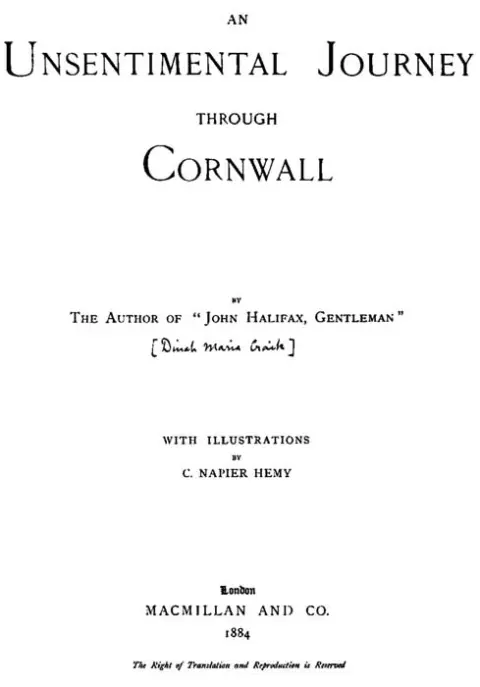
Dinah Maria Mulock Craik
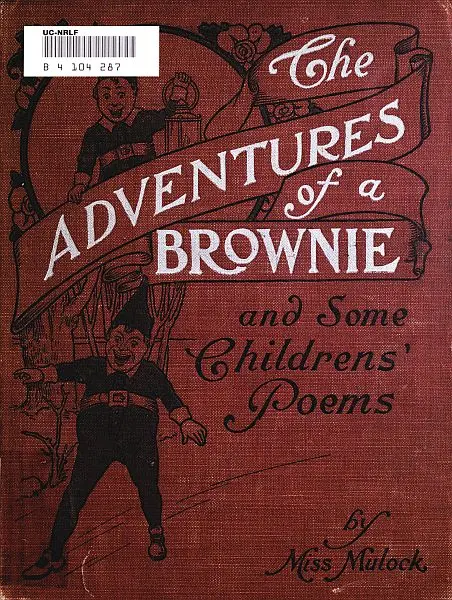
Dinah Maria Mulock Craik
Dinah Maria Mulock Craik
BEHIND THE BOOK
This eBook is for the use of anyone anywhere in the United States and most other parts of the world at no cost and with almost no restrictions whatsoever. You may copy it, give it away or re-use it under the terms of the Project Gutenberg License included with this eBook or online at www.gutenberg.org. If you are not located in the United States, you will have to check the laws of the country where you are located before using this eBook. Read the source licence.
The original source file, including credits and licence, is retained by this library. Request an original-format copy at no charge. Please include the book title and Project Gutenberg identifier #22121.
KEEP YOUR CURIOSITY GOING
Coulson Kernahan

Maurice Baring
Frances Wright
Cécile Tormay

Frederic Jesup Stimson

W. H. P. (William Henry Pope) Jarvis