THE CLASSIC COLLECTION✦Andersonville diaryCLASSIC FREE BOOKS
Andersonville diary
John L. Ransom
THE CLASSIC COLLECTION · 1883
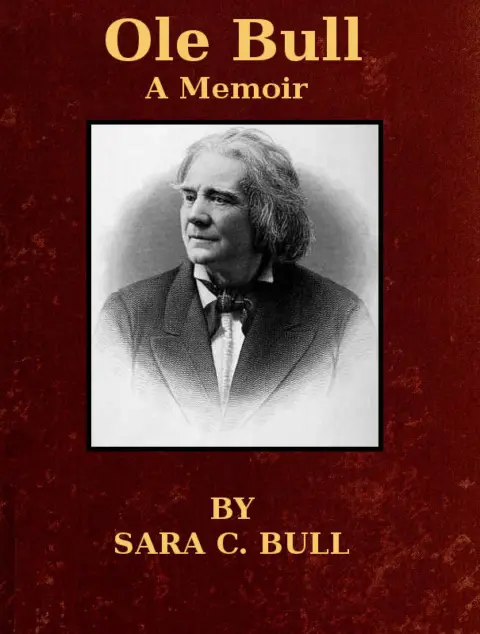
"Ole Bull: A Memoir" by Sara Chapman Thorp Bull is a biographical account written in the late 19th century. The work explores the life and legacy of Ole Bull, a celebrated Norwegian violinist and composer. Through various anecdotes and tributes, it aims to highlight Bull’s artistic journey, his rich cultural background, and the influence of Norwegian folklore and musical traditions on his development as a musician. At the start of the memoir, we are introduced to the picturesque city of Bergen, Norway, where Ole Bull was born in 1810. The opening portion presents a detailed glimpse into his childhood, describing his early experiences with music and nature, along with familial influences that shaped his artistic inclinations. Key moments include his first exposure to music through family gatherings and the poignant memories of his connection with the natural landscape that conveyed deep emotional resonance to his developing musical identity. His initial struggles with formal education, his burgeoning passion for the violin, and the subsequent artistic triumphs are also described, establishing a foundation for understanding his evolution into a prominent musical figure.
Introduction adapted from the source catalogue; source summaries may be automatically generated.
Free to read · English · 106,460 words · No account needed
MAKE TIME FOR A GOOD BOOK
On by default. Untick to stop anonymous reading totals. Each page counts after 10 seconds in view. How this works.
Anonymous counting is on unless you have switched it off.
The concert was advertised, and the Polacca was in the programme; still it had no existence, except in the musician’s soul. “Have you written that music?” said Thorwaldsen. “Are you crazy?” inquired the painter. But he would throw his arms around them, and laugh and jest, as if his musical reputation concerned everybody more than it did himself. The day before the concert his friends were in despair when they saw him prepare to go out after breakfast. “Have you written any of that music?” said they, entreatingly. “No, my dear friends, but I have it all here,” replied he, playfully touching his forehead. They urged that the concert was to be the next day, and that the piece must be rehearsed. “I will do it this evening,” said he. “You are an imprudent man,” they replied; “the public of Rome will not bear such treatment even from a favorite like yourself; you will make a complete failure.” He laughed, and coaxed them caressingly not to be troubled on his account. The evening was far spent when he returned. The artist, in anxious tones, asked, “Dear Ole, have you done anything about that music?” “No, I have not had time.” “Well, do set about it this moment.” “Oh, I cannot; I am so tired that I must go directly to bed.” In vain the artist remonstrated and entreated. A spirit of mischief had taken possession of the wayward minstrel. He plunged into bed, and soon pretended to be sound asleep. The young man had the habit of talking to himself; and as he listened to the bass solo of the counterfeit sleeper, he muttered, “How can he go to sleep with nothing done about that music? It is more than I can comprehend. I wish I could feel as easy about it as he does.” He retired to rest early, and as soon as he was fairly asleep, Ole sprang out of bed, lighted a candle, and stepped softly into an adjoining room, where he began to write down his music with prestissimo speed. The outline had long been in his mind, and new thoughts for the filling up came with a rush of inspiration. He wrote as fast as the pen could fly. At four o’clock the score for all the orchestral parts was written out. For his violin part he trusted entirely to his own wonderful memory. Having arranged all, he crept quietly back into bed. The artist, who was an early riser, soon began to stir. Ole breathed sonorously, as if he were in a deep sleep. “Still asleep!” murmured his friend: “as quietly as if the music were all ready for the orchestra. I wish we were safely through this evening.” It was not long before his anxiety took a more active form. He began to shake the sleeper, saying, “Ole, do wake up, and try to do something about that music.” But he obtained only the drowsy answer, “Oh I cannot, I am so very sleepy.” Vexed and discouraged, the painter went to his easel, and said no more. At breakfast, Ole was full of fun and frolic; but Thorwaldsen and the artist were somewhat impatient with what they deemed such thoughtless trifling with public expectation. “You will come to my concert to–night, will you not?” said the mischievous musician. In dismal tones, they replied, “No, Ole, we love you too well to witness your disgrace. Take it as lightly as you please; but you may be assured the public of Rome will not bear such treatment.” “Oh, do come,” pleaded the musician coaxingly, “just a little, little within the door; and then when I am disgraced, you can easily slip away.” They would not promise, however, and he hurried off to keep his appointment with the orchestra. He had an excellent band of musicians, who could play the most difficult music with the slightest preparation. The rehearsal went off to his complete satisfaction, and he returned to his friends as gay as a lark. His apparent recklessness made them still more sad. The dreaded evening came. The house was crowded. Ole was full of that joyful confidence which genius is so apt to feel in effusions that have just burst freshly from its overflowing fountain. The orchestra delighted in the composition and played it with their hearts. The brilliancy of the theme and the uncommon beauty of the cantabile took the audience by surprise. The novelty and marvelous difficulty of the finale, in which the violin alone performs four distinct parts and keeps up a continuous shake through fifteen bars, completely electrified them. There was a perfect tempest of applause. In the midst of his triumph, the composer, looking as quiet and demure as possible, glanced toward the door. There stood Thorwaldsen and the artist. The latter had a trick of moving tobacco from one side of his mouth to the other when he was excited and pleased. It was now flying from cheek to cheek almost as rapidly as the violin bow through the continuous shake of fifteen bars.
Your reading position is saved on this browser. Take it to another device with a library code. Reading pages adapt to text, rather than matching a printed edition.
BEHIND THE BOOK
This eBook is for the use of anyone anywhere in the United States and most other parts of the world at no cost and with almost no restrictions whatsoever. You may copy it, give it away or re-use it under the terms of the Project Gutenberg License included with this eBook or online at www.gutenberg.org. If you are not located in the United States, you will have to check the laws of the country where you are located before using this eBook. Read the source licence.
The original source file, including credits and licence, is retained by this library. Request an original-format copy at no charge. Please include the book title and Project Gutenberg identifier #40297.
KEEP YOUR CURIOSITY GOING
John L. Ransom

Herman W. Mudgett

Harriet Monroe
Daniel Dulany Addison
Charles Lanman

Harold Rosher