THE CLASSIC COLLECTION✦Andersonville diaryCLASSIC FREE BOOKS
Andersonville diary
John L. Ransom
THE CLASSIC COLLECTION · 1883
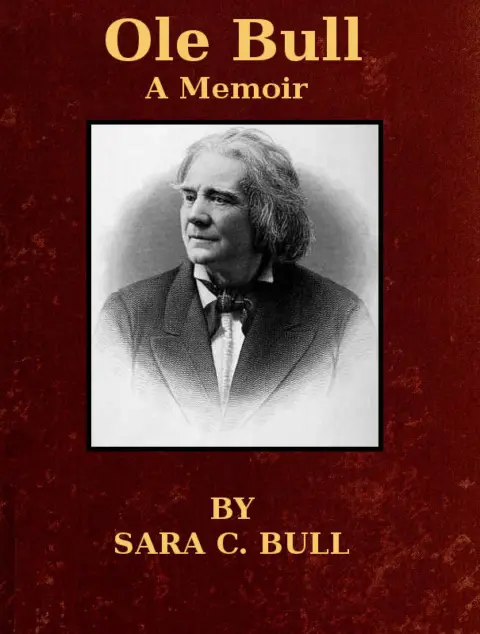
"Ole Bull: A Memoir" by Sara Chapman Thorp Bull is a biographical account written in the late 19th century. The work explores the life and legacy of Ole Bull, a celebrated Norwegian violinist and composer. Through various anecdotes and tributes, it aims to highlight Bull’s artistic journey, his rich cultural background, and the influence of Norwegian folklore and musical traditions on his development as a musician. At the start of the memoir, we are introduced to the picturesque city of Bergen, Norway, where Ole Bull was born in 1810. The opening portion presents a detailed glimpse into his childhood, describing his early experiences with music and nature, along with familial influences that shaped his artistic inclinations. Key moments include his first exposure to music through family gatherings and the poignant memories of his connection with the natural landscape that conveyed deep emotional resonance to his developing musical identity. His initial struggles with formal education, his burgeoning passion for the violin, and the subsequent artistic triumphs are also described, establishing a foundation for understanding his evolution into a prominent musical figure.
Introduction adapted from the source catalogue; source summaries may be automatically generated.
Free to read · English · 106,460 words · No account needed
MAKE TIME FOR A GOOD BOOK
On by default. Untick to stop anonymous reading totals. Each page counts after 10 seconds in view. How this works.
Anonymous counting is on unless you have switched it off.
From this ardent study, assisted by eminent teachers of Italian song, came his command of melody, which enabled him to reproduce with their true native character the most delicate and varied modifications of foreign music that he met with—Italian, Spanish, Irish, Arabian, Hungarian, as well as the national songs of his own country. But the chief result of these studies was, that he found himself; he learned to know the nature and limits of his own talent, and was able to give form to his musical feelings.
In a letter to a friend, at this time, he mentions a kind of vision which he had. Worn out and exhausted by the difficulties which he met in the work of a new composition, his “Concerto in A major,” his father seemed suddenly to stand before him as he was playing, and to speak, with his eyes rather than his lips, this warning: “The more you overwork the more wretched you make yourself; and the more wretched you are the harder you will have to struggle.” Ever afterwards he avoided over–practice, lest it should deaden the finer sensibilities which must be relied upon for inspiration.
In studying Italian music, he discovered how great was his need of schooling; but he found, too, that the rules taught for playing the violin were not sufficient to help him in developing the capacity of the instrument. He therefore kept up, at the same time, a course of independent study. Here again we may quote from Mr. Goldschmidt, who says of his studies at that time:—
We will endeavor to give an exposition of the musical principles upon which he acted, and of the means by which he strove to bring them into practice. What was his aim, and how did he endeavor to reach it? We have heard of his marvelous dexterity, of wonderful “tricks” he displayed on his violin, and of “stupendous effects” which he produced,—and the question arises, Were these tricks and effects the end, as some have fancied, or were they the means to an end? I answer, they were the means to an end, and this end was to reproduce the Hulder. You will ask me to give you an idea of what the Hulder is, not only as a popular fancy, but as a poetic symbol. In trying to do so, let me remind you that from the mountains, forests, and valleys of the North proceeded that race which has conquered half the world; from whose love, devotion, and aspirations chivalry sprang into existence under a more Southern sky; their yearning souls and powerful hands produced the wonders of Gothic architecture; their blood throbs in the veins of your proudest aristocracy; whilst the stern tribe, remaining at home, struggling against a severe climate, against the wild beasts of the forest, and in internal feuds among themselves, had no other organs for their longings, hopes, aspirations, triumphs, and woes, than song and music. As future purple–clad kings and emperors were hidden in the “Odelsbonde,”[3] who sent out his sons as “Vikings,” so an unspeakable majesty and delicacy is hidden in the simplicity of Northern strains. But there is more. Amid the subdued yet intense feeling of the glory and dignity of man, suddenly enters the foreboding of death: there is almost always beneath the highest mirth an under–current of melancholy,—the pictures are golden, on a black ground. But, at the same time, the foreboding of death augments the feeling of life. The waters, the trees, the mountains, live a life of their own, tempting you with the sweetest, the most potent and secret powers of nature, or crushing you with their colossal strength; no blind powers, no mere creations of superstitious terror, but always animated by a higher spirit, as behooves the fairy beings created by a big–brained race. And, amid all these sounds, terrible or mysterious, is heard the innocent bell–shaped flower, accompanied by the grass of the meadow. This may give you a faint idea of the Hulder—the spirit of the North. Southern music generally consists of sounds that please the ear, whilst Northern music strives to tell you secret tales of your own soul.
Your reading position is saved on this browser. Take it to another device with a library code. Reading pages adapt to text, rather than matching a printed edition.
BEHIND THE BOOK
This eBook is for the use of anyone anywhere in the United States and most other parts of the world at no cost and with almost no restrictions whatsoever. You may copy it, give it away or re-use it under the terms of the Project Gutenberg License included with this eBook or online at www.gutenberg.org. If you are not located in the United States, you will have to check the laws of the country where you are located before using this eBook. Read the source licence.
The original source file, including credits and licence, is retained by this library. Request an original-format copy at no charge. Please include the book title and Project Gutenberg identifier #40297.
KEEP YOUR CURIOSITY GOING
John L. Ransom

Herman W. Mudgett

Harriet Monroe
Daniel Dulany Addison
Charles Lanman

Harold Rosher