THE CLASSIC COLLECTION✦Andersonville diaryCLASSIC FREE BOOKS
Andersonville diary
John L. Ransom
THE CLASSIC COLLECTION · 1883
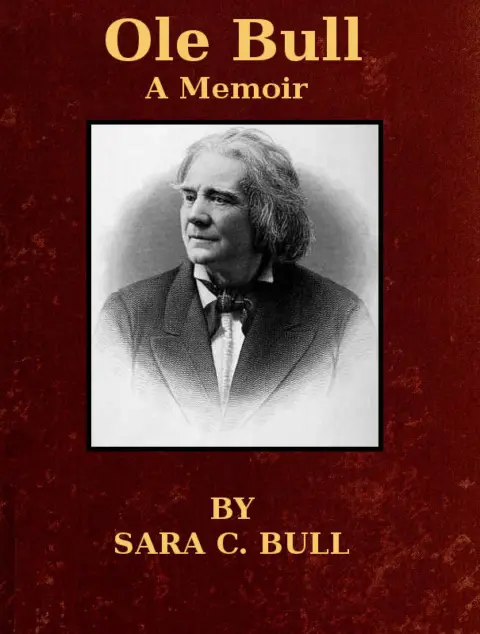
"Ole Bull: A Memoir" by Sara Chapman Thorp Bull is a biographical account written in the late 19th century. The work explores the life and legacy of Ole Bull, a celebrated Norwegian violinist and composer. Through various anecdotes and tributes, it aims to highlight Bull’s artistic journey, his rich cultural background, and the influence of Norwegian folklore and musical traditions on his development as a musician. At the start of the memoir, we are introduced to the picturesque city of Bergen, Norway, where Ole Bull was born in 1810. The opening portion presents a detailed glimpse into his childhood, describing his early experiences with music and nature, along with familial influences that shaped his artistic inclinations. Key moments include his first exposure to music through family gatherings and the poignant memories of his connection with the natural landscape that conveyed deep emotional resonance to his developing musical identity. His initial struggles with formal education, his burgeoning passion for the violin, and the subsequent artistic triumphs are also described, establishing a foundation for understanding his evolution into a prominent musical figure.
Introduction adapted from the source catalogue; source summaries may be automatically generated.
Free to read · English · 106,460 words · No account needed
MAKE TIME FOR A GOOD BOOK
On by default. Untick to stop anonymous reading totals. Each page counts after 10 seconds in view. How this works.
Anonymous counting is on unless you have switched it off.
Paganini’s last Parisian concert occurred in the year 1832, at the Grand Opéra. He played three pieces. Habeneck, professor of music at the Conservatoire, on this occasion wielded the bâton. He had been instrumental in introducing the symphonies of Beethoven for the first time, in opposition to the opinions of the other professors of the Conservatoire. The orchestra was composed of the professors, and such pupils as had taken the first prize; it was justly regarded as the finest orchestra in Europe. Habeneck wished to introduce Beethoven, but had hitherto failed in exciting an appreciation for his mighty works. Finally he hit upon a strategem. It was his birthday, and he invited the members of the orchestra to a collation to be given in the concert–hall of the Conservatoire, and he begged them to bring their instruments. When his health was proposed, he suggested in response that, if they really wished to give him great joy, they would consent to play the “Allegro in C minor” from the first symphony of Beethoven. He explained to them beforehand how he would have them handle the principal motive. Of course all agreed. He knew his success from the manner in which they struck the first chords. Exclamations of admiration followed the close of the Allegro, and the concluding movement of the symphony was played with enthusiasm to the end. Now they requested that the symphony should be played at the next concert, and after twenty rehearsals it was given with immense success. Such was the man who conducted on this occasion. He was a leader of great ability, and the players, the majority of them graduates of the Conservatoire, were entirely under his command. Paganini played, as far as I can remember, his “Concerto in B minor,” with the “Rondo Campanella,” also two variations of Haydn’s famous “Austrian National Hymn,” and concluded with his “Moto Perpetuo.” The public were accustomed to applaud (I have the whole scene before me as if it were to–day) when he appeared at the side. When his shadow was seen approaching, the audience applauded as usual, but to their astonishment Paganini did not appear, but instead a man in black, with a music–stand, which he placed on the stage near the conductor. Again a shadow was seen on the wall, and again the applause sounded. A man appeared clad in livery; he bore two candles, which he placed on the stand and lighted. He disappeared, amid the laughter of the audience. Then came the first fellow in black, this time with a manuscript in his hand. The house behaved as before, evidently confusing the black fellow. Finally came another shadow, and this time it was Paganini, but the applause was now withheld, and he was not recognized until he came forward to the foot–lights. There he made a forced salutation, accompanied with a contraction of the facial muscles, seeming much puzzled at his silent reception. He had been in another room, and knew nothing of the ludicrous scene which had preceded his appearance. Immediately Habeneck raised his bâton, as if to give his order to the orchestra, but Paganini shook his head. He took his bow in his left hand together with his violin, and thrust his right into the recesses of the pockets of his swallow–tailed coat, and brought out a pair of dark–green gloves, which he transferred to his left hand. He shook his head again, and, after a deeper plunge, produced a large white handkerchief, which he also placed in his left hand, accompanying the action with an audible expression of dissatisfaction. A still deeper thrust revealed a brown box, which he regarded with a nod and a smile, and added to the other things in his left hand. He now went through the same deliberate motions in passing the handkerchief and gloves back to his pocket. He then opened the box and took out a pair of spectacles, meditated a moment, apparently considering the next move, and finally, taking the bow in his right hand, and bending a little, put the spectacles on and looked about in a complacent manner. But how changed he was! The glasses were dark blue, giving a ghastly appearance to his emaciated face; they looked like two large holes in his countenance. Raising his foot and bringing it down promptly, he gave the signal to begin. It had been announced as his last concert in Paris for the season, and a true foreboding seemed to thrill through his listeners that they would not again see that lank, angular figure, with its haggard face, or hear again the wondrous witchery of his violin.
Your reading position is saved on this browser. Take it to another device with a library code. Reading pages adapt to text, rather than matching a printed edition.
BEHIND THE BOOK
This eBook is for the use of anyone anywhere in the United States and most other parts of the world at no cost and with almost no restrictions whatsoever. You may copy it, give it away or re-use it under the terms of the Project Gutenberg License included with this eBook or online at www.gutenberg.org. If you are not located in the United States, you will have to check the laws of the country where you are located before using this eBook. Read the source licence.
The original source file, including credits and licence, is retained by this library. Request an original-format copy at no charge. Please include the book title and Project Gutenberg identifier #40297.
KEEP YOUR CURIOSITY GOING
John L. Ransom

Herman W. Mudgett

Harriet Monroe
Daniel Dulany Addison
Charles Lanman

Harold Rosher