THE CLASSIC COLLECTION✦Andersonville diaryCLASSIC FREE BOOKS
Andersonville diary
John L. Ransom
THE CLASSIC COLLECTION · 1883
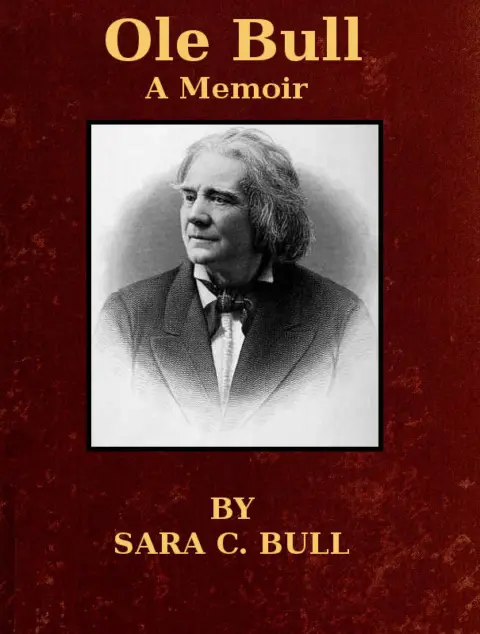
"Ole Bull: A Memoir" by Sara Chapman Thorp Bull is a biographical account written in the late 19th century. The work explores the life and legacy of Ole Bull, a celebrated Norwegian violinist and composer. Through various anecdotes and tributes, it aims to highlight Bull’s artistic journey, his rich cultural background, and the influence of Norwegian folklore and musical traditions on his development as a musician. At the start of the memoir, we are introduced to the picturesque city of Bergen, Norway, where Ole Bull was born in 1810. The opening portion presents a detailed glimpse into his childhood, describing his early experiences with music and nature, along with familial influences that shaped his artistic inclinations. Key moments include his first exposure to music through family gatherings and the poignant memories of his connection with the natural landscape that conveyed deep emotional resonance to his developing musical identity. His initial struggles with formal education, his burgeoning passion for the violin, and the subsequent artistic triumphs are also described, establishing a foundation for understanding his evolution into a prominent musical figure.
Introduction adapted from the source catalogue; source summaries may be automatically generated.
Free to read · English · 106,460 words · No account needed
MAKE TIME FOR A GOOD BOOK
On by default. Untick to stop anonymous reading totals. Each page counts after 10 seconds in view. How this works.
Anonymous counting is on unless you have switched it off.
He was born February 5, 1810. His paternal grandmother, Gedsken Edvardine Storm, married to the apothecary and army surgeon, Ole Bornemann Bull, was sister to the poet, Edvard Storm. His father, Johan Storm Bull, like his father before him a physician and apothecary in Bergen, was an accomplished man, and a chemist of unusual ability. He had studied under Tromsdorf, and corresponded with the first German specialists of his day. His mother, Anna Dorothea Bull, was of the old Dutch family Geelmuyden. Her father, an able lawyer, died before the age of forty, leaving his widow with several children to rear alone; and of her four sons, two were captains in the army, one was a sea–captain, and one, “Uncle Jens,” for some years a merchant, and afterwards the publisher of the city’s first newspaper, which is still owned by the family. The three leading professions were all represented by members of the Bull and Geelmuyden families. Johan Randulf Bull, the brother of Ole’s grandfather, had, beside other offices, filled that of governor of the Bergen stift, or diocese, and had been noted for his generous hospitality.
Ole Bull was the eldest of ten children, seven sons and three daughters, nine of whom lived to the age of maturity, and six of whom survive him.
He was sent early to the Latin school, as the children of gentlemen usually were at that time; but the promise he gave can be inferred from the advice of his old rector, Mr. Winding, some years after: “Take to your fiddle in earnest, boy, and don’t waste your time here.”
Both of Ole’s parents, and several members of the family on the mother’s side, were musical. His father kept up the proverbial hospitality of the family, and no gatherings were more enjoyable than Uncle Jens’s Tuesday quartette evenings. Uncle Jens spent much time and money to gratify his passion for music. On the quartette evenings Ole was several times discovered, by an involuntary movement, under the table or sofa, or behind a curtain, where, having crept from his bed, he had concealed himself for hours, only to be ignominiously sent back again, after a whipping for disobedience. But, stern as was the discipline of that day, an exception was after a time made in his favor, through the intercession of Uncle Jens. He thus became familiar, while very young, with the quartettes of Krummer, Haydn, Mozart, and Beethoven, and, as he used to say, imbibed the rules of art unknowingly; for he did not conceive the music as produced by players, but as proceeding from the instruments played, jubilating, triumphing, quarreling, fighting, with a life of their own,—a conception arising, no doubt, partly from the tales his grandmother told him of the elves and gnomes, with which the popular myths peopled forest and mountain. When, in early childhood, playing alone in the meadow, he saw a delicate blue–bell gently moving in the breeze, he fancied he heard the bell ring, and the grass accompany it with most enrapturing fine voices; he fancied he heard nature sing, and thus music revealed itself, or came to his consciousness as something that might be reproduced.
Your reading position is saved on this browser. Take it to another device with a library code. Reading pages adapt to text, rather than matching a printed edition.
BEHIND THE BOOK
This eBook is for the use of anyone anywhere in the United States and most other parts of the world at no cost and with almost no restrictions whatsoever. You may copy it, give it away or re-use it under the terms of the Project Gutenberg License included with this eBook or online at www.gutenberg.org. If you are not located in the United States, you will have to check the laws of the country where you are located before using this eBook. Read the source licence.
The original source file, including credits and licence, is retained by this library. Request an original-format copy at no charge. Please include the book title and Project Gutenberg identifier #40297.
KEEP YOUR CURIOSITY GOING
John L. Ransom

Herman W. Mudgett

Harriet Monroe
Daniel Dulany Addison
Charles Lanman

Harold Rosher