THE CLASSIC COLLECTION✦Andersonville diaryCLASSIC FREE BOOKS
Andersonville diary
John L. Ransom
THE CLASSIC COLLECTION · 1883
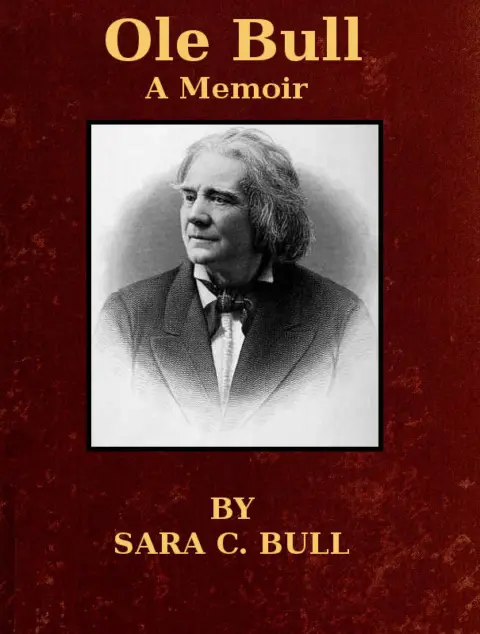
"Ole Bull: A Memoir" by Sara Chapman Thorp Bull is a biographical account written in the late 19th century. The work explores the life and legacy of Ole Bull, a celebrated Norwegian violinist and composer. Through various anecdotes and tributes, it aims to highlight Bull’s artistic journey, his rich cultural background, and the influence of Norwegian folklore and musical traditions on his development as a musician. At the start of the memoir, we are introduced to the picturesque city of Bergen, Norway, where Ole Bull was born in 1810. The opening portion presents a detailed glimpse into his childhood, describing his early experiences with music and nature, along with familial influences that shaped his artistic inclinations. Key moments include his first exposure to music through family gatherings and the poignant memories of his connection with the natural landscape that conveyed deep emotional resonance to his developing musical identity. His initial struggles with formal education, his burgeoning passion for the violin, and the subsequent artistic triumphs are also described, establishing a foundation for understanding his evolution into a prominent musical figure.
Introduction adapted from the source catalogue; source summaries may be automatically generated.
Free to read · English · 106,460 words · No account needed
MAKE TIME FOR A GOOD BOOK
On by default. Untick to stop anonymous reading totals. Each page counts after 10 seconds in view. How this works.
Anonymous counting is on unless you have switched it off.
It was one of those impromptu fêtes which, when successful, snatch a grace beyond the reach of art. Such occasions have the freshness of a rose suddenly plucked, with the dew and the bloom which disappear if kept waiting too long. It was the seventieth birthday of Mr. Ole Bull, and soon after he left us for his native land, never to return.
There was a little domestic conspiracy shared in somewhat by outside friends to make this fête a pleasant surprise to the object of it. The nearest intimates of Mr. Ole Bull were summoned secretly and in time to prepare their tributes of respect and affection, and the scene of this gathering had memories of its own, suitable, harmonious, and poetic. For Mr. Bull was then living at Elmwood, the home of our present ambassador to London, Mr. J. R. Lowell. In his drawing–room, where pictures of J. R. Stillman, Christopher Cranch, and other friends hung upon the paneled walls, there was an aroma of scholarship, of wit and fancy, in keeping with the old mansion, which shares with the residence of Mr. Longfellow an old–time dignity, a colonial pomp, as if to emphasize the genius of the poets with the added charm of antiquity. Communicating with the drawing–room is Mr. Lowell’s study. It was those study–windows which gave the title of one of his pleasantest books, and there indignation sharpened the shaft of satire which made the humor of the “Biglow Papers” a national event.
One by one in the fading twilight the friendly conspirators arrived. Mr. Bull was detained by unsuspected constraint in a neighboring family till the suitable moment for his appearance arrived. He could hardly have forgotten the date of so important an anniversary, yet in the fine simplicity of his nature one could see how unconscious he was of the delightful plot in which he was involved. When it broke upon him little by little it was beautiful to witness the mild surprise, the questioning astonishment, displaced by an affectionate ardor and cordial recognition of its significance. As the world knows, there is something fascinating, individual, and characteristic in the countenance of the great artist. Geniuses often, while most individual themselves, are yet the highest expression of national characteristics. Mr. Bull looked the mystic land to which he owes his birth. Seeing him, one better understood the Sagas which tell of the heroes who launched, a thousand years ago, their galleys over stormy seas to conquest. His smile, so sweet and genuine, lingered round his mouth, as the sunshine sweetens the northern valleys, while fancy could think it saw in his streaming locks of silver the icy crests above or the flickering of the pale aurora of the North. Among the presents of this birthday was a violin wholly composed of flowers, their harmonies, though silent, suggesting in a fresh way the melodies which lingered in the memory of all. A disk, also of flowers, displayed at its centre the word “skaal,” the proper word for the occasion. There were aquarelles and heaped–up baskets of flowers, and whatever suitable gift individual love prompted to bring. When the artist had received our salutes and hand–shakings, and smiles had warmed all with a common purpose, Ole Bull felt that he had but one thing to do, to reply to the spoken and silent messages of good–will in the language he loved best,—the one best suited to the occasion. And, standing in our midst, his snowy locks falling forward across his bent and sympathetic face, he bade his violin speak for him. He played with his whole heart an answer, a swan–song of melody, on which, as upon a great river, we were carried away into dreamland, into the Valhalla and the halls of Odin. His skill, the vigor and power of his bow arm, belied the seventy years they celebrated. Time had left as iron that wonderful right arm which never could grow old. A distinguished artist answered the violin with a voice into which was gathered the responsive cordial enthusiasm of all, and with these two musical expressions Mr. Ole Bull’s fête was accomplished. Supper and the tumult of chat, laughter, and content took off pleasantly the acute edge of excitement. Then later we were summoned away from the piano to the drawing–room, where a huge cake in frosted sugar displayed the name and age of the great artist. Amid much merriment it was cut and shared, each one eagerly hunting for the symbolic tiny golden violin, somewhere hid in its capacious flanks. When the little treasure was discovered it was found to have most suitably fallen to one of the oldest and dearest of friends, who was, perhaps, the nearest neighbor of them all in Cambridge. After the cake had been divided and the golden violin discovered, a venerable bottle of Tokay was produced, which Professor Horsford had brought home from his Austrian sojourn: this liqueur–like wine having been distributed in little glasses, Mr. Longfellow proposed the health and happiness of Ole Bull, which was drunk in a silence meaning more than words.
Your reading position is saved on this browser. Take it to another device with a library code. Reading pages adapt to text, rather than matching a printed edition.
BEHIND THE BOOK
This eBook is for the use of anyone anywhere in the United States and most other parts of the world at no cost and with almost no restrictions whatsoever. You may copy it, give it away or re-use it under the terms of the Project Gutenberg License included with this eBook or online at www.gutenberg.org. If you are not located in the United States, you will have to check the laws of the country where you are located before using this eBook. Read the source licence.
The original source file, including credits and licence, is retained by this library. Request an original-format copy at no charge. Please include the book title and Project Gutenberg identifier #40297.
KEEP YOUR CURIOSITY GOING
John L. Ransom

Herman W. Mudgett

Harriet Monroe
Daniel Dulany Addison
Charles Lanman

Harold Rosher