THE CLASSIC COLLECTION✦Andersonville diaryCLASSIC FREE BOOKS
Andersonville diary
John L. Ransom
THE CLASSIC COLLECTION · 1883
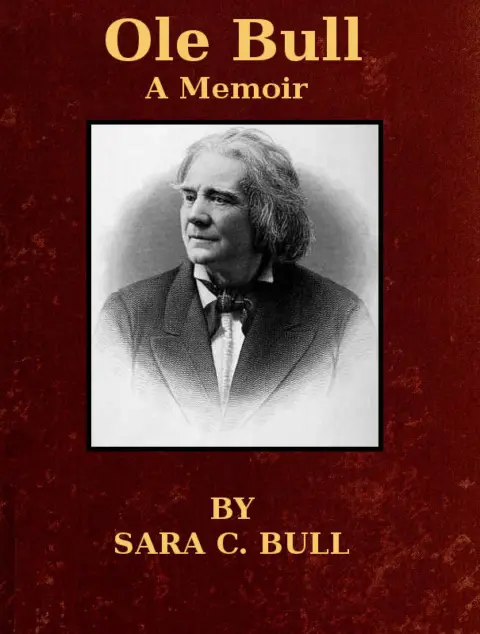
"Ole Bull: A Memoir" by Sara Chapman Thorp Bull is a biographical account written in the late 19th century. The work explores the life and legacy of Ole Bull, a celebrated Norwegian violinist and composer. Through various anecdotes and tributes, it aims to highlight Bull’s artistic journey, his rich cultural background, and the influence of Norwegian folklore and musical traditions on his development as a musician. At the start of the memoir, we are introduced to the picturesque city of Bergen, Norway, where Ole Bull was born in 1810. The opening portion presents a detailed glimpse into his childhood, describing his early experiences with music and nature, along with familial influences that shaped his artistic inclinations. Key moments include his first exposure to music through family gatherings and the poignant memories of his connection with the natural landscape that conveyed deep emotional resonance to his developing musical identity. His initial struggles with formal education, his burgeoning passion for the violin, and the subsequent artistic triumphs are also described, establishing a foundation for understanding his evolution into a prominent musical figure.
Introduction adapted from the source catalogue; source summaries may be automatically generated.
Free to read · English · 106,460 words · No account needed
MAKE TIME FOR A GOOD BOOK
On by default. Untick to stop anonymous reading totals. Each page counts after 10 seconds in view. How this works.
Anonymous counting is on unless you have switched it off.
Taken as a whole, the art of the great virtuoso is distinctive, original, and full of rugged strength. It may be truly said of him that he is the poet of the violin, especially when illustrating his own splendid compositions.
And the Tribune remarked:—
His fervid nature and personal magnetism are as powerful as ever, and he sways the audience of to–day pretty much as he did their fathers and mothers, in spite of the fact that critical taste is not always satisfied with his methods.
The “Violin Notes,” now first published, were written out that season, during the holidays, and he was experimenting on and developing the chin–rest.
The following characteristic anecdotes were related by a Brooklyn gentleman who called on Mr. Colton to meet Ole Bull, and was shown to the door of the model work–shop. He writes:—
I knocked, at first hesitatingly, lest I might disturb the quiet that reigned within, broken only by the tones of Ole Bull’s violin. Taking advantage of a pause, I knocked again, this time to be admitted by Mr. Colton, who forthwith presented me to the violinist. All my fear and embarrassment as to my reception were at once expelled by the pleasant greeting. His countenance was lit up by that same genial smile so well known to us all.... He explained that Mr. Colton was at work upon his famous Gaspar da Salo, while he was practicing on his beautiful Nicholas Amati. He seemed in such capital spirits that I ventured to ply question upon question, and all were answered with a perfect grace and simplicity. On his asking whether I had attended his last concert at the Academy of Music in Brooklyn, I replied, regretting my own engagement to play at a soirée musicale the same evening. “You play? What did you play at the soirée?” “‘L’Elegie’ by Ernst.” “What, do you play that? Here,” handing me his precious violin, “you shall play what I could not hear that night, and I will play for you what you could not hear.” With great caution and greater reluctance I took the fine Amati, and the studded diamonds seemed to laugh at me from the keys they adorned. I had not proceeded far when he suggested a different interpretation of one of the weird phrases of that composition. I yielded and tried to express his idea, but, failing completely, handed him the instrument, and with eagerness watched the movement and with better result. He then took the violin, straightened himself, and played the Paganini Concerto as I have never heard it played. He seemed completely lost to the surroundings. The very notes ring in my ears as I now think of that performance. Speaking of the German school of violinists, he objected to their heavy and coarse style of interpretation, saying, “The German plays his violin conveniently; that is, he would not play the larghetto in la of Mozart on the D and A strings, but use the E for the A when convenient and A for D, and thus spoil the most beautiful of melodies.” When I asked who was his favorite composer, he quickly exclaimed: “Mozart, yes, Mozart, and more, he is the most difficult composer to interpret.” I remonstrating gently, saying that I thought his melodies were easily written, as stated by Mozart himself, and more easily understood than a Beethoven composition, he replied warmly, “Just so; because so easy and graceful, the more noticeable are the breaks of coarse interpreters, as, for instance, in their poor modulation in changing from one string to another.” I must confess, his illustration on the violin corroborated his theories. Referring to Paganini, he said that it was next to impossible to play any one of his compositions as he played them; and apropos of the silly stories circulated throughout Europe during Paganini’s time, they were simply the products of the conspiring minds of Lafont and his musical friends, who but too keenly felt the superiority of the dark Italian. “I shall never forget,” he continued, “how Habeneck, the musical director, told me of Paganini’s reception in Paris. When Paganini went to rehearsal for the first concert, he was received with great coolness by the orchestra who were to accompany him. The first violins especially showed their contempt for their rival by playing an ensemble pizzicato movement for the left hand, as much as to say, You are not the only man that can do that. But Paganini’s quiet remark, ‘Gentlemen, you do not play in tune; you had better practice scales before attempting that,’ so completely upset them that they made no further efforts to discommode him. One of the tympani, however, persisted in beating out of time, which so exasperated Paganini that he shouted, ‘Wait, I’ll come there and make you play right,’ and started towards him; whereupon the fellow beat a hasty retreat, to the amusement of all as well as of Paganini himself.”
Your reading position is saved on this browser. Take it to another device with a library code. Reading pages adapt to text, rather than matching a printed edition.
BEHIND THE BOOK
This eBook is for the use of anyone anywhere in the United States and most other parts of the world at no cost and with almost no restrictions whatsoever. You may copy it, give it away or re-use it under the terms of the Project Gutenberg License included with this eBook or online at www.gutenberg.org. If you are not located in the United States, you will have to check the laws of the country where you are located before using this eBook. Read the source licence.
The original source file, including credits and licence, is retained by this library. Request an original-format copy at no charge. Please include the book title and Project Gutenberg identifier #40297.
KEEP YOUR CURIOSITY GOING
John L. Ransom

Herman W. Mudgett

Harriet Monroe
Daniel Dulany Addison
Charles Lanman

Harold Rosher