THE CLASSIC COLLECTION✦Andersonville diaryCLASSIC FREE BOOKS
Andersonville diary
John L. Ransom
THE CLASSIC COLLECTION · 1883
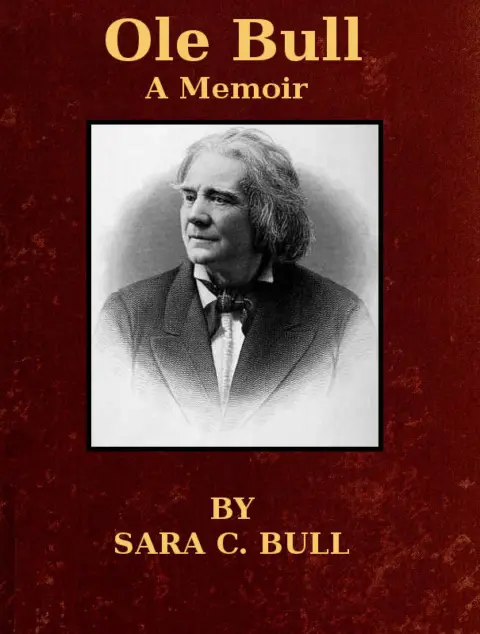
"Ole Bull: A Memoir" by Sara Chapman Thorp Bull is a biographical account written in the late 19th century. The work explores the life and legacy of Ole Bull, a celebrated Norwegian violinist and composer. Through various anecdotes and tributes, it aims to highlight Bull’s artistic journey, his rich cultural background, and the influence of Norwegian folklore and musical traditions on his development as a musician. At the start of the memoir, we are introduced to the picturesque city of Bergen, Norway, where Ole Bull was born in 1810. The opening portion presents a detailed glimpse into his childhood, describing his early experiences with music and nature, along with familial influences that shaped his artistic inclinations. Key moments include his first exposure to music through family gatherings and the poignant memories of his connection with the natural landscape that conveyed deep emotional resonance to his developing musical identity. His initial struggles with formal education, his burgeoning passion for the violin, and the subsequent artistic triumphs are also described, establishing a foundation for understanding his evolution into a prominent musical figure.
Introduction adapted from the source catalogue; source summaries may be automatically generated.
Free to read · English · 106,460 words · No account needed
MAKE TIME FOR A GOOD BOOK
On by default. Untick to stop anonymous reading totals. Each page counts after 10 seconds in view. How this works.
Anonymous counting is on unless you have switched it off.
In accordance with this invitation, Ole Bull gave a concert in Washington on the 26th of March. He had visited the city to learn more about the inducements and advantages offered emigrants to go to the Western States. He had now a better opportunity than ever of studying and understanding the government of this country, because of personal acquaintance with such men as Webster, Clay, and Sumner. Minister Sibbern, the resident Swedish ambassador at that time, was a friend of Ole Bull, and did everything in his power to make his stay pleasant.
He now performed by invitation in Philadelphia, Baltimore, and New York. The following notice of one of his concerts at this time (in the New York Tribune of May 24, 1852) is from the pen of Mr. George William Curtis:—
Nine years ago Ole Bull, then little known in America, made his début at the old Park Theatre. Those who remember the glowing enthusiasm of that evening, and the triumphal career of which it was the prelude, will understand the interest with which the news of his recent arrival among us was received, and the eager curiosity to know if he was again to witch our world. On Saturday evening that curiosity was satisfied by the re–appearance of the great violinist, and the revelation of undiminished power. The audience was in itself a triumph, on Saturday evening, in the midst of the present musical excitement attendant upon Madame Goldschmidt’s farewell series. To gather three thousand people in Metropolitan Hall was an evidence of cordial and admiring remembrance, and of genuine homage to genius of which any artist might be justly proud. Since Ole Bull played here before, our musical experience is enlarged and deepened. Our audience is no longer unused to fine performance. It has heard much of the best, and its approbation is more discriminating, and therefore more flattering. That Ole Bull’s success on Saturday evening was very great, it is unnecessary to say; for no audience (except the French), however critical and severe, can escape the electrical touch of his genius. One word, one glance, one sweep, if it is informed with magnetic power, leaves all rules in the rear, and asserts its own supremacy. Here is the characteristic and charm of Ole Bull. Like Paganini, he is an exceptional person. Like every man of remarkable and pronounced genius, he is a phenomenon. He is his own standard; he makes his own rules. It is useless to pursue him with the traditional rules. His orbit will not be prescribed or prophesied, for it is eccentric. In all that he does, the traditional temperament of genius betrays itself. He is tremulous and tender, but also rugged and stern, and strong as his native mountains. He is no unapt type of his Norway, with its sunny but breezy heights, with its dark and solemn depths, and, over all, the clear, blue heaven. In his mien and manner, in his music and his playing, the same thing is constantly felt. They are all wonderfully suggestive, but mainly of bold and melancholy outlines. For the pathos which inheres in air Northern story and character permeates all that he does, not as lachrymose sentiment, but as a genuine minor tone of feeling. It will not be difficult to infer the impression of his music and of his performance. It is all subjugated to himself. It is all means of expression for his own individuality. He aims not so much at a pure representation of the subject treated by his music, as at his own peculiarity of perception in regarding it. The hearer must know it as it struck him, and in the way he chooses, and all tends to impress upon that hearer the individuality of the artist. Hence Ole Bull stands in direct opposition to the “classical” school, of which the peculiarity is to subdue the artist to the music. He is essentially romantic. His performance, beyond any we have ever heard, is picturesque. He uses music as color, and it matters nothing to him if the treatment be more or less elaborate, or rhythmical, or detailed, if it succeed in striking the hearer with the vivid impression sought. It is unavoidable, therefore, that he is called a charlatan. It is natural that the classical artists are amazed at this bold buccaneer roving the great sea of musical approbation and capturing the costliest prizes of applause. But these prizes are never permanently held by weakness. They surrender only to majestic power. Hence we have the strange spectacle of an immense and miscellaneous audience hanging enchanted upon this wondrous bow, through performances of a length which, in itself, would be enough to wreck most success. Like the voice of an orator speaking for a people its hopes, its indignation, its pity and sorrow, so this violin sings for those who listen their own shifting, wild, and vague fancies. It is because the artist magnetizes them, for the time, and they think and dream as he chooses.
Your reading position is saved on this browser. Take it to another device with a library code. Reading pages adapt to text, rather than matching a printed edition.
BEHIND THE BOOK
This eBook is for the use of anyone anywhere in the United States and most other parts of the world at no cost and with almost no restrictions whatsoever. You may copy it, give it away or re-use it under the terms of the Project Gutenberg License included with this eBook or online at www.gutenberg.org. If you are not located in the United States, you will have to check the laws of the country where you are located before using this eBook. Read the source licence.
The original source file, including credits and licence, is retained by this library. Request an original-format copy at no charge. Please include the book title and Project Gutenberg identifier #40297.
KEEP YOUR CURIOSITY GOING
John L. Ransom

Herman W. Mudgett

Harriet Monroe
Daniel Dulany Addison
Charles Lanman

Harold Rosher