THE CLASSIC COLLECTION✦Andersonville diaryCLASSIC FREE BOOKS
Andersonville diary
John L. Ransom
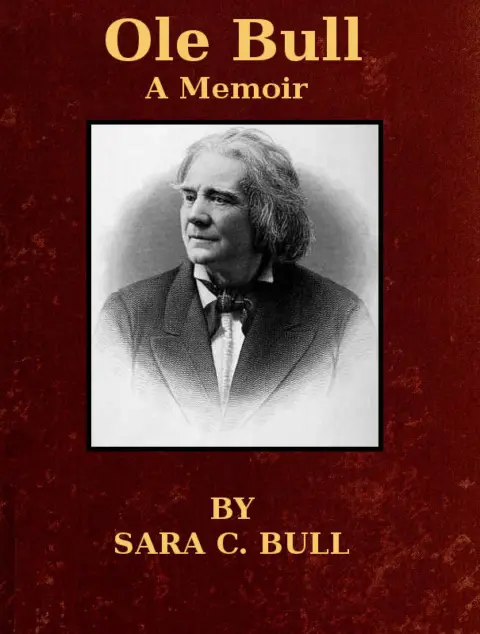
THE CLASSIC COLLECTION · 1883
"Ole Bull: A Memoir" by Sara Chapman Thorp Bull is a biographical account written in the late 19th century. The work explores the life and legacy of Ole Bull, a celebrated Norwegian violinist and composer. Through various anecdotes and tributes, it aims to highlight Bull’s artistic journey, his rich cultural background, and the influence of Norwegian folklore and musical traditions on his development as a musician. At the start of the memoir, we are introduced to the picturesque city of Bergen, Norway, where Ole Bull was born in 1810. The opening portion presents a detailed glimpse into his childhood, describing his early experiences with music and nature, along with familial influences that shaped his artistic inclinations. Key moments include his first exposure to music through family gatherings and the poignant memories of his connection with the natural landscape that conveyed deep emotional resonance to his developing musical identity. His initial struggles with formal education, his burgeoning passion for the violin, and the subsequent artistic triumphs are also described, establishing a foundation for understanding his evolution into a prominent musical figure.
Introduction adapted from the source catalogue; source summaries may be automatically generated.
Free to read · English · 106,460 words · No account needed
MAKE TIME FOR A GOOD BOOK
On by default. Untick to stop anonymous reading totals. Each page counts after 10 seconds in view. How this works.
Anonymous counting is on unless you have switched it off.
“Norse Ole! My naïve address will almost shock you; I could find no characteristic epithet for you, and, so far as I know, the peasants call you only Ole Bull—as if titles did not become this name. Therefore, Norse Ole!... May all go well! May the annoyances which necessarily attend your undertaking be as few as possible!”
The hasty, animated lines which he wrote to his wife that day, in which he mentions his exertions, his many disappointments, and his persevering, energetic hope for the undertaking, strike one very forcibly.
The selection of plays was restricted, since they were necessarily adapted to the limited powers of the actors. Ole Bull conducted the orchestra and played, as did also his friend, Möllar–gutten, or Thorgeir Andunson of Haukelid–Rock. Mr. Goldschmidt thus speaks of this peasant–violinist, celebrated all over Norway:[16]—
[16] Kristofer Janson has given a graphic and charming picture of Möllar–gutten in his “Spell–Bound Fiddler,” translated by Auber Forestier.
He used to play at dancing parties, and in him many of the old legends, pointing to the demoniac power of music, were revived. In order to understand this, one must have seen the national dances of Norway—the Halling–dance especially. It commences with a slow, majestic measure, and it is surprising to see with what dignity and grace the powerful forms of old and young move; by degrees it becomes quicker, the elder folk retire, and at last it turns into a leaping dance, which only the strongest young people can safely perform, and during which formidable leaps are executed by the lads.
“Oh, never talk again to me
Of Spanish girls and Southern dancers,”
you would say, paraphrasing Byron, if you saw this passionate, frantic, though serious and chaste dance, that exhibits the fierce, martial spirit of Norwegian youth. It once happened that, whilst the dance whirled to the wild, fiery music—to the strain proceeding, as it were, from the depths of earth, from the foaming waterfall from the howling tempest of the mountains—the knives of the lads “became loose in their sheaths,” and blood flowed along the floor. The cellar–man, on proceeding to the cellar to bring up beer, saw seated behind a hogshead Old Nick himself playing the fiddle; then, understanding why blood flowed so freely above, he came up and cried out: “Stop your ears, the devil plays the fiddle!” Well, it was said that Thorgeir Andunson could play in like manner, having on his lonely rock of Haukelid learnt it from the spirit reigning in the foaming river below, although his appearance was quiet and gentle and frequently sad. He had married a girl of the same station of life as himself, but always looked up to her as to a peculiar being that had descended to him. Being once asked what was his ambition in life, he answered: “To be able to buy a pair of shoes and a silk neckerchief for my wife.” Having heard of Ole Bull, he came to pay him a visit, and was quite bewildered when he heard one of Mozart’s compositions. “Well,” he said, “this is music!” and strolling about the garden all night, tried to play it from memory; but in his hands it turned into mere Halling–dance. His fine sense showed him in Ole Bull the happier artist, and far from envying, he attached himself to him with a kind of devotion that proved itself afterwards when the violinist established at Bergen the first Norwegian theatre. When the messenger came to Thorgeir, bidding him to gird his loins, and come down to play before a public, the shy artist overcame his bashfulness, and followed the messenger at once, “for I must do something to see and hear Ole.” The farmers along the mountain road, meanwhile, having heard the tidings that Thorgeir was going to Ole to establish an independent Norse theatre, gave him a mounted escort as a prince. One great farmer, a descendant of the old kings, wished to retain Thorgeir for a night to give a soirée, as we should say, and on Thorgeir declining and escaping from his house,—“for Ole expects me at the Norse theatre,”—it nearly came to a battle between the squads, which was prevented by Thorgeir’s solemn promise that he would return and play to the dancers “three entire nights.” He returned home a wealthy man. Ole Bull had made him earn 2000 specie dollars (about £400),—an immense fortune for the fiddler on Haukelid–Rock.
Your reading position is saved on this browser. Take it to another device with a library code. Reading pages adapt to text, rather than matching a printed edition.
BEHIND THE BOOK
This eBook is for the use of anyone anywhere in the United States and most other parts of the world at no cost and with almost no restrictions whatsoever. You may copy it, give it away or re-use it under the terms of the Project Gutenberg License included with this eBook or online at www.gutenberg.org. If you are not located in the United States, you will have to check the laws of the country where you are located before using this eBook. Read the source licence.
The original source file, including credits and licence, is retained by this library. Request an original-format copy at no charge. Please include the book title and Project Gutenberg identifier #40297.
KEEP YOUR CURIOSITY GOING
John L. Ransom

Herman W. Mudgett

Harriet Monroe
Daniel Dulany Addison
Charles Lanman

Harold Rosher