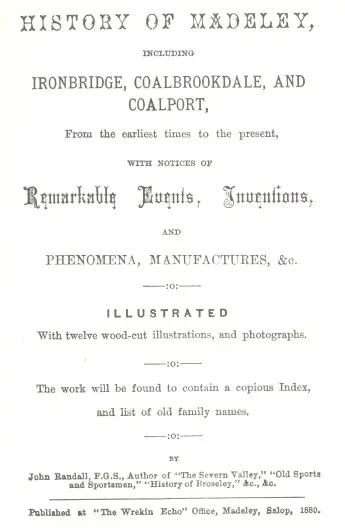
History of Madeley including Ironbridge, Coalbrookdale, and Coalport
John Randall
THE CLASSIC COLLECTION · 1873
"Old Sports and Sportsmen; or, the Willey Country" by John Randall is a historical account written in the late 19th century. This work details the rich traditions of hunting and the social life surrounding it in Shropshire, especially through the lens of Squire Forester and his whipper-in, Tom Moody. The book encompasses local history and the development of sporting culture in the region, revealing both the deep-rooted appreciation for nature and the complexities of human-nature relationships throughout time. The beginning of the work introduces the backdrop of Shropshire’s landscape and the significance of hunting as a prestigious pastime among the gentry. The author discusses the roots of this tradition, highlighting figures such as Squire Forester and his connections to the land and its folklore. The opening chapters suggest an exploration of the natural history of the region, the influence of different eras on sporting practices, and the relationships between nobility, local clergy, and the common folk within the context of outdoor sports and the conservation of wildlife. Randall's approach combines anecdotes, historical references, and a celebration of the enduring relationship humans have with nature.
Introduction adapted from the source catalogue; source summaries may be automatically generated.
Free to read · English · 44,678 words · No account needed
MAKE TIME FOR A GOOD BOOK
On by default. Untick to stop anonymous reading totals. Each page counts after 10 seconds in view. How this works.
Anonymous counting is on unless you have switched it off.
This John Forester first resided in Watling Street, where his ancestors for several generations had lived, in the old timbered mansion, now occupied by Dr. Cranage, but he afterwards removed to Easthope, whilst his son William resided at Upton; and Richard Forester, alias Forster of Sutton Maddock, secretary to Bishop Bonner, who built the old mansion in Bridgnorth, called “Forester’s Folly,” which was burnt down during the siege of the castle, when the high town became a heap of ruins, appears to have been a son of John Forester, of Easthope; and Anthony Forester or Foster of Sir Walter Scott’s novel, who was born about 1510, was a son of his.
In the 34th of Henry VIII., 1542–3, Thomas Foster and Elizabeth his wife, account in the Exchequer for several temporalities in connection with the monastery of St. Peter’s, Shrewsbury. Sir William Forester, KB., married Lady Mary Cecil, daughter of James, third Earl of Salisbury. He was a staunch Protestant, and represented the county with George Weld, as previously stated, with whom he voted in favour of the succession of the House of Hanover, and the family came into possession of the Willey estates by the marriage of Brook Forester of Dothill Park, with one of the Welds, the famous George Forester, the Willey Squire, being the fruit of that marriage. George Forester left the whole of his estates to his cousin, Cecil Forester, of Ross Hall, who was allowed by George the Fourth, whose personal friendship he had been permitted to enjoy for many years, to add the name of Weld in 1821. Cecil Weld Forester, Esq., was ennobled the same year by George the Fourth, who, when Prince of Wales, honoured him with a visit at Ross Hall. He married Catherine, daughter of His Grace the fourth Duke of Rutland, and was not less renowned than his cousin, as a sportsman. His eagerness for the chase was happily characterised by the late Mr. Meynell, who used to say, “First out of cover came Cecil Forester, next the fox, and then my hounds.” A famous leap of his, thirty feet across a stream, on his famous horse Bernardo, has been recorded in some lines now at Willey which accompany the portrait of the horse. He is supposed to have been one of the first who instituted the present system of hard riding to hounds, and a horse known to have been ridden by him, it is said, would at any time fetch £20 more than the ordinary price. Speaking of the classic proportions of a horse, and the perfection of the art of riding in connection with his lordship as a sportsman, Colonel Apperley, remarked some years ago, “Unless a man sits gracefully on his horse, and handles him well, that fine effect is lost. As the poet says, he would be incorporated with the brave beast, and such does Lord Forester appear to be. His eye to a country is also remarkably quick, and his knowledge of Leicestershire has given him no small advantage. On one occasion he disregarded the good old English custom of ‘looking before you leap,’ and landed in the middle of a deep pool. ‘Hold on,’ a countryman who saw him, shouted to others coming in the same direction. ‘Hold your tongue—say nothing, we shall have it full in a minute,’ said Lord Forester.” The Colonel added, “In consequence of residing in Shropshire, a country which has been so long famous for its breed of horses, he has a good opportunity of mounting himself well. He always insisted on the necessity of lengthy shoulders, good fetlocks, well formed hind legs and open feet; and knowing better than to confound strength and size, his horses seldom exceeded fifteen hands. On anything relating to a hunter his authority has long been considered classic, and if Forester said so it was enough. Lord Forester will always stand pre-eminent in the field, whilst in private life he is a very friendly man, and has ever adhered to those principles of honour and integrity which characterise the gentleman.” He died on the 23rd of May, 1828, in his 61st year. He had, as we have said, ten children, the gallant Frank Forester, as Colonel Apperley styles him, being one. The oldest was the present Right Hon. J. G. W. Forester, whose popularity in connection with the Belvoir Hunt is so well known.
Your reading position is saved on this browser. Take it to another device with a library code. Reading pages adapt to text, rather than matching a printed edition.
BEHIND THE BOOK
This eBook is for the use of anyone anywhere in the United States and most other parts of the world at no cost and with almost no restrictions whatsoever. You may copy it, give it away or re-use it under the terms of the Project Gutenberg License included with this eBook or online at www.gutenberg.org. If you are not located in the United States, you will have to check the laws of the country where you are located before using this eBook. Read the source licence.
The original source file, including credits and licence, is retained by this library. Request an original-format copy at no charge. Please include the book title and Project Gutenberg identifier #63805.
KEEP YOUR CURIOSITY GOING
Cécile Tormay

Moritz Busch
John L. Ransom
Frances Wright
Cécile Tormay

Mabel Potter Daggett