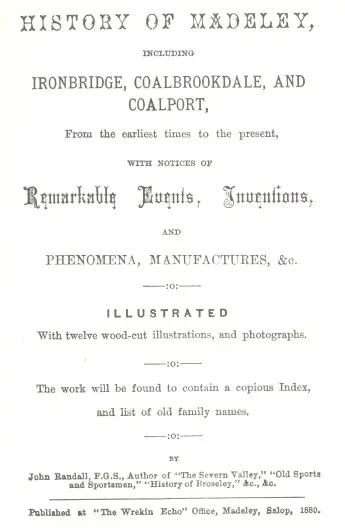
History of Madeley including Ironbridge, Coalbrookdale, and Coalport
John Randall
THE CLASSIC COLLECTION · 1873
"Old Sports and Sportsmen; or, the Willey Country" by John Randall is a historical account written in the late 19th century. This work details the rich traditions of hunting and the social life surrounding it in Shropshire, especially through the lens of Squire Forester and his whipper-in, Tom Moody. The book encompasses local history and the development of sporting culture in the region, revealing both the deep-rooted appreciation for nature and the complexities of human-nature relationships throughout time. The beginning of the work introduces the backdrop of Shropshire’s landscape and the significance of hunting as a prestigious pastime among the gentry. The author discusses the roots of this tradition, highlighting figures such as Squire Forester and his connections to the land and its folklore. The opening chapters suggest an exploration of the natural history of the region, the influence of different eras on sporting practices, and the relationships between nobility, local clergy, and the common folk within the context of outdoor sports and the conservation of wildlife. Randall's approach combines anecdotes, historical references, and a celebration of the enduring relationship humans have with nature.
Introduction adapted from the source catalogue; source summaries may be automatically generated.
Free to read · English · 44,678 words · No account needed
MAKE TIME FOR A GOOD BOOK
On by default. Untick to stop anonymous reading totals. Each page counts after 10 seconds in view. How this works.
Anonymous counting is on unless you have switched it off.
TOM MOODY never rose above his post of whipper-in, but he had the honour of being at the top of his profession; and before proceeding further with our sketch of Squire Forester it may be well to dwell for a time upon this well-known character, whom Dibdin immortalised in his song, so familiar to all sportsmen. He was in fact, in many respects, what Mr. Forester had made him: Nature supplied the material, and Squire Forester did the rest. Tom had the advantage of entering the Squire’s service when a youth. Like most boys of that period, he had been thrown a good deal upon his own resources, a state of things not unfavourable to a development of self-reliance, and a degree of humble heroism, such as made life wholesome. Tom had no opportunities of obtaining a national-school education, nor of carrying away the prize now sometimes awarded to the best behaved lad in the village. But in the unorganized school of common intercourse, common suffering, and interest, was developed a pluck and daring which led him to perform a feat on the bare back of a crop-eared cob that gave birth to the after events of his life. It appears that he was apprenticed to a Mr. Adams, a maltster, who had sent him to deliver malt at the Hall. On his return he was seen by the Squire trying his horse at a gate, and repeating the attempt till he compelled him to leap it. It is said that—
“He who excels in what we prize,
Appears a hero in our eyes.”
[Picture: Gone to earth]
And Squire Forester, struck by his pluck and perseverance, made up his mind to secure him. He sent to his master to ask if he were willing to give him up, adding that he would like to see him at the Hall. The message alarmed the mother, who was a widow, for, knowing her son’s froward nature, she at once imagined Tom had got into trouble. On learning the true state of the case, however, and thinking she saw the way open to Tom’s promotion, she consented to the change in his condition. His master, too, agreed to give him up, and Tom was transferred to the Willey stables, where, from his good nature and other agreeable qualities, he became a favourite, and from his daring courage quite a sort of little hero. It was Tom’s duty to go on errands from the Hall, and once outside the park, feeling he had his liberty, he did not fail to make use of opportunities for displaying his skill. In riding, it was generally up hill and down dale, at neck-or-nothing speed, stopping neither for gate nor hedge—his horse tearing away at a rate which would have given him three or four somersaults at a slip. He seldom turned his horse’s head if he could help it, and if he went down he was soon up again. Extraordinary tales are told of Tom’s adventures with the Squire’s buff-coloured chaise, in taking company from the Hall, and in fetching visitors from Shifnal, then the nearest place to reach a coach. Having a spite at a pike-keeper, who offended him by not opening the gate quick enough, “Tom tanselled his hide,” and resolved the next time he went that way not to trouble him. Driving up to the gate, he gave a spring, and touching his horse on the flanks, went straight over without starting a stitch or breaking a buckle. On another occasion he tried the same trick, but failed; the horse went clean over, but the gig caught the top rail, and Tom was thrown on his back. “That just sarves yo right,” said the pike-keeper. “So it does, and now we are quits,” added Tom; and they were friends ever after. This, however, did not prevent Tom trying it again; not that he wanted to defraud the pike-man, whom he generally paid another time, but for “the fun of the thing.” Indeed, with his old wild favourite, with or without the buff-coloured gig, there were no risks he was not prepared to run. “Ay, ay, sir,” said one of our aged informants, “you should have seen him on his horse, a mad, wild animal no one but Tom could ride. He could ride him though, with his eyes shut, savage as he was, and on a good road he would pass milestones as the clock measured minutes; but give him the green meadows, and Lord how I have seen him whip along the turf!” “He was like a winged Mercury, making light both of stone walls and five-feet six-inch gates. He was a regular centaur, for he and his horse seemed one,” said another. “I cannot tell you the height of his horse,” said a third, “but he was a big un; whilst Tom himself was a little one, and he used to be on horse-back all day long. If he got into the saddle in a morning he rarely left it till night.”
Your reading position is saved on this browser. Take it to another device with a library code. Reading pages adapt to text, rather than matching a printed edition.
BEHIND THE BOOK
This eBook is for the use of anyone anywhere in the United States and most other parts of the world at no cost and with almost no restrictions whatsoever. You may copy it, give it away or re-use it under the terms of the Project Gutenberg License included with this eBook or online at www.gutenberg.org. If you are not located in the United States, you will have to check the laws of the country where you are located before using this eBook. Read the source licence.
The original source file, including credits and licence, is retained by this library. Request an original-format copy at no charge. Please include the book title and Project Gutenberg identifier #63805.
KEEP YOUR CURIOSITY GOING
Cécile Tormay

Moritz Busch
John L. Ransom
Frances Wright
Cécile Tormay

Mabel Potter Daggett