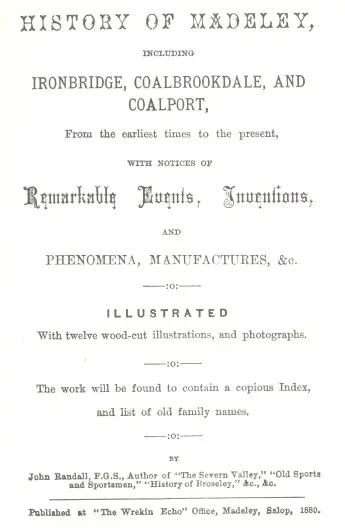
History of Madeley including Ironbridge, Coalbrookdale, and Coalport
John Randall
THE CLASSIC COLLECTION · 1873
"Old Sports and Sportsmen; or, the Willey Country" by John Randall is a historical account written in the late 19th century. This work details the rich traditions of hunting and the social life surrounding it in Shropshire, especially through the lens of Squire Forester and his whipper-in, Tom Moody. The book encompasses local history and the development of sporting culture in the region, revealing both the deep-rooted appreciation for nature and the complexities of human-nature relationships throughout time. The beginning of the work introduces the backdrop of Shropshire’s landscape and the significance of hunting as a prestigious pastime among the gentry. The author discusses the roots of this tradition, highlighting figures such as Squire Forester and his connections to the land and its folklore. The opening chapters suggest an exploration of the natural history of the region, the influence of different eras on sporting practices, and the relationships between nobility, local clergy, and the common folk within the context of outdoor sports and the conservation of wildlife. Randall's approach combines anecdotes, historical references, and a celebration of the enduring relationship humans have with nature.
Introduction adapted from the source catalogue; source summaries may be automatically generated.
Free to read · English · 44,678 words · No account needed
MAKE TIME FOR A GOOD BOOK
On by default. Untick to stop anonymous reading totals. Each page counts after 10 seconds in view. How this works.
Anonymous counting is on unless you have switched it off.
On the occasion of Dibdin’s visit there were at the Hall more than the usual local notables, and Parson Stephens was amongst them. As a treat intended specially for Dibdin, the second course at dinner consisted of Severn fish, such as we no longer have in the river. There were eels cooked in various ways, flounders, perch, trout, carp, grayling, pike, and at the head of the table that king of Severn fish, a salmon.
Dibdin: “This is a treat, Squire, and I can readily understand now why the Severn should be called the ‘Queen of Rivers;’ it certainly deserves the distinction for its fish, if for nothing else.”
Mr. Forester: “Do you know, Dibdin, that fellow Jessop, the engineer, set on by those Gloucester fellows, wants to put thirteen or fourteen bars or weirs in the river between here and Gloucester; why, it would shut out every fish worth eating.”
“What could be his object?” asked Dibdin.
“Oh, he believes, like Brindley, that rivers were made to feed canals with, and his backers—the Gloucester gentlemen, and the Stafford and Worcester Canal Company—say, to make the river navigable at all seasons up to Coalbrookdale; but my belief is that it is intended to crush what bit of trade there yet remains on the river here, and to give them a monopoly in the carrying trade, for our bargemen would be taxed, whilst their carriers would be free, or nearly so.”
“We beat them, though,” said Mr. Pritchard.
“So we did,” added the Squire, “but we had a hard job: begad, I thought our watermen had pretty well primed me when I went up to see Pitt on the subject; but I had not been with him five minutes before I found he knew far more about the river than I did:
“‘I am no orator, as Brutus is,
But, as you know me all, a plain and honest man.’”
Several voices: “Bravo, Squire.”
To Stephens: “Will you take a flounder?—‘flat as a flounder,’ they say. I know you have a sympathy with flats, if not a liking for them.”
“The Broseley colliers made a flat of him when they dragged his own pond for the fish he was so grateful for,” said Hinton.
The laugh went against the parson, who somehow missed his share of a venison pasty, which was a favourite of his. He had been helped to a slice from a haunch which stood in the centre of the table, and had had a cut out of a saddle of mutton at one end, but he missed his favourite dish.
Your reading position is saved on this browser. Take it to another device with a library code. Reading pages adapt to text, rather than matching a printed edition.
BEHIND THE BOOK
This eBook is for the use of anyone anywhere in the United States and most other parts of the world at no cost and with almost no restrictions whatsoever. You may copy it, give it away or re-use it under the terms of the Project Gutenberg License included with this eBook or online at www.gutenberg.org. If you are not located in the United States, you will have to check the laws of the country where you are located before using this eBook. Read the source licence.
The original source file, including credits and licence, is retained by this library. Request an original-format copy at no charge. Please include the book title and Project Gutenberg identifier #63805.
KEEP YOUR CURIOSITY GOING
Cécile Tormay

Moritz Busch
John L. Ransom
Frances Wright
Cécile Tormay

Mabel Potter Daggett