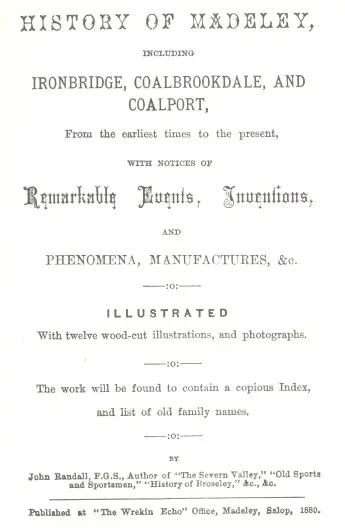
History of Madeley including Ironbridge, Coalbrookdale, and Coalport
John Randall
THE CLASSIC COLLECTION · 1873
"Old Sports and Sportsmen; or, the Willey Country" by John Randall is a historical account written in the late 19th century. This work details the rich traditions of hunting and the social life surrounding it in Shropshire, especially through the lens of Squire Forester and his whipper-in, Tom Moody. The book encompasses local history and the development of sporting culture in the region, revealing both the deep-rooted appreciation for nature and the complexities of human-nature relationships throughout time. The beginning of the work introduces the backdrop of Shropshire’s landscape and the significance of hunting as a prestigious pastime among the gentry. The author discusses the roots of this tradition, highlighting figures such as Squire Forester and his connections to the land and its folklore. The opening chapters suggest an exploration of the natural history of the region, the influence of different eras on sporting practices, and the relationships between nobility, local clergy, and the common folk within the context of outdoor sports and the conservation of wildlife. Randall's approach combines anecdotes, historical references, and a celebration of the enduring relationship humans have with nature.
Introduction adapted from the source catalogue; source summaries may be automatically generated.
Free to read · English · 44,678 words · No account needed
MAKE TIME FOR A GOOD BOOK
On by default. Untick to stop anonymous reading totals. Each page counts after 10 seconds in view. How this works.
Anonymous counting is on unless you have switched it off.
“A braver choice of dauntless spirits never
Dash’d after hound,”
it is said, and to commemorate one of the good things of this kind, a long home-spun ditty was wont to be sung in public-houses by tenants on the estate, the first few lines of which were as follows:—
“Salopians every one,
Of high and low degree,
Who take delight in fox-hunting,
Come listen unto me.
“A story true I’ll tell to you
Concerning of a fox,
How they hunted him on Tickwood side
O’er Benthall Edge and rocks.
“Says Reynard, ‘I’ll take you o’er to Willey Park
Above there, for when we fairly get aground
I value neither huntsmen all
Nor Squire Forester’s best hound.
“‘I know your dogs are stout and good,
That they’ll run me like the wind!
But I’ll tread lightly on the land,
And leave no scent behind.’”
Other verses describe the hunt, and Reynard, on being run to earth, asking for quarter on condition that
“He will both promise and fulfil,
Neither ducks nor geese to kill,
Nor lambs upon the hill;”
and how bold Ranter, with little faith in his promise, “seized him by the neck and refused to let him go.” It is one of many specimens of a like kind still current among old people. An old man, speaking of Mr. Stubbs, for whom, he remarked, the day was never too long, and who at its close would sometimes urge his brother sportsmen to draw for a fresh fox, with the reminder that there was a moon to kill by, said,
“One of the rummiest things my father, who hunted with the Squire, told me, was a run by moonlight. I’m not sure, but I think Mr. Dansey, Mr. Childe, and Mr. Stubbs, if not Mr. Meynell, were at the Hall. They came sometimes, and sometimes the Squire visited them. Howsomeever, there were three or four couples of fresh hounds at the kennels, and it was proposed to have an after-dinner run. They dined early, and, as nigh as I can tell, it was three o’clock when they left the Hall, after the Beggarlybrook fox. Mind that was a fox, that was—he was. He was a dark brown one, and a cunning beggar too, that always got off at the edge of a wood, by running first along a wall and then leaping part of the way down an old coal pit, which had run in at the sides. Well, they placed three couples of hounds near to this place in readiness, and the hark-in having been given, the gorse soon began to shake, and a hound or two were seen outside, and amongst them old Pilot, who now and then took a turn outside, and turned in, lashing his stern, and giving the right token. ‘Have at him!’ shouted one; ‘Get ready!’ said another; ‘Hold hard a bit, we shall have him, for a hundred!’ shouted the Squire. Then comes a tally-ho, said my father, and off they go; every hound out of cover, sterns up, carrying a beautiful head, and horses all in a straight line along the open, with the scent breast high. Reynard making straight for the tongue of the coppice, finds himself circumvented, and fresh hounds being let loose, he makes for Wenlock Walton as though he was going to give ’em an airing on the hill-top.
Your reading position is saved on this browser. Take it to another device with a library code. Reading pages adapt to text, rather than matching a printed edition.
BEHIND THE BOOK
This eBook is for the use of anyone anywhere in the United States and most other parts of the world at no cost and with almost no restrictions whatsoever. You may copy it, give it away or re-use it under the terms of the Project Gutenberg License included with this eBook or online at www.gutenberg.org. If you are not located in the United States, you will have to check the laws of the country where you are located before using this eBook. Read the source licence.
The original source file, including credits and licence, is retained by this library. Request an original-format copy at no charge. Please include the book title and Project Gutenberg identifier #63805.
KEEP YOUR CURIOSITY GOING
Cécile Tormay

Moritz Busch
John L. Ransom
Frances Wright
Cécile Tormay

Mabel Potter Daggett