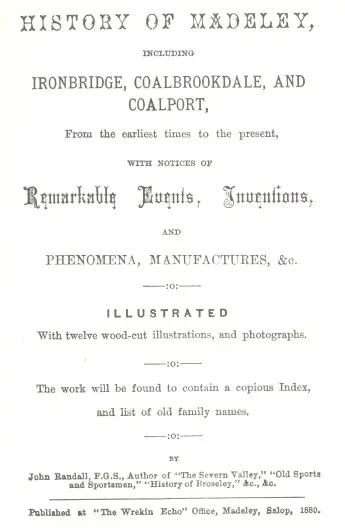
History of Madeley including Ironbridge, Coalbrookdale, and Coalport
John Randall
THE CLASSIC COLLECTION · 1873
"Old Sports and Sportsmen; or, the Willey Country" by John Randall is a historical account written in the late 19th century. This work details the rich traditions of hunting and the social life surrounding it in Shropshire, especially through the lens of Squire Forester and his whipper-in, Tom Moody. The book encompasses local history and the development of sporting culture in the region, revealing both the deep-rooted appreciation for nature and the complexities of human-nature relationships throughout time. The beginning of the work introduces the backdrop of Shropshire’s landscape and the significance of hunting as a prestigious pastime among the gentry. The author discusses the roots of this tradition, highlighting figures such as Squire Forester and his connections to the land and its folklore. The opening chapters suggest an exploration of the natural history of the region, the influence of different eras on sporting practices, and the relationships between nobility, local clergy, and the common folk within the context of outdoor sports and the conservation of wildlife. Randall's approach combines anecdotes, historical references, and a celebration of the enduring relationship humans have with nature.
Introduction adapted from the source catalogue; source summaries may be automatically generated.
Free to read · English · 44,678 words · No account needed
MAKE TIME FOR A GOOD BOOK
On by default. Untick to stop anonymous reading totals. Each page counts after 10 seconds in view. How this works.
Anonymous counting is on unless you have switched it off.
It will be observed that in this grant the name occurs in its abridged form as Foster, and in the Sheriffs of Shropshire and many old documents it is variously spelt as Forester, Forster, and Foster, a circumstance which during the progress of the present work suggested an inquiry, the result of which—mainly through the researches of a painstaking friend—may add weight and interest to the archæological lore previously collected in connection with the family. It appears, for instance, that the Anthony Foster of Sir Walter Scott’s “Kenilworth” was descended from the Foresters of Wellington; that he held the manor of Little Wenlock and other property in Shropshire in 1545; that the Richard Forester or Forster who built the interesting half-timbered mansion, {64} still standing in the Cartway, Bridgnorth, where Bishop Percy, the author of “Percy’s Reliques,” was born, was also a member; and that Anne, the daughter of this Richard Forester or Forster, was married in 1575 at Sutton Maddock to William Baxter, the antiquary, mentioned by the Rev. George Bellet at page 183 of the “Antiquities of Bridgnorth.” Mr. Bellet, speaking of another mansion of the Foresters at Bridgnorth, says, “One could wish, as a mere matter of curiosity, that a remarkable building, called ‘Forester’s Folly,’ had been amongst those which escaped the fire; for it was built by Richard Forester, the private secretary of no less famous a person than Bishop Bonner, and bore the above appellation most likely on account of the cost of its erection.” William Baxter, who, it will be seen, was a descendant of the Foresters, has an interesting passage in his life referring to the circumstance. {66}
[Picture: Richard Forester’s Old Mansion]
We believe that the Forester pedigree in the MS. collection of Shropshire pedigrees, now in possession of Sidney Stedman Smith, Esq., compiled by that careful and painstaking genealogist the late Mr. Hardwick, fully confirms this, and shows that the Foresters of Watling Street, the Foresters or Forsters of Sutton Maddock, and the Forsters or Fosters of Evelith Manor were the same family. The arms, like the names, differ; but all have the hunter’s horn stringed; and if any doubt existed as to the identity of the families, it is still further removed by a little work entitled “An Inquiry concerning the death of Amy Robsart,” by S. J. Pettigrew, F.R.S., F.S.A. Mr. Pettigrew says: “Anthony Forster was the fourth son of Richard Forster, of Evelith, in Shropshire, by Mary, daughter of Sir Thomas Gresley, of an ancient family. The Anthony Forster of Sir Walter Scott’s novel is supposed to have been born about 1510; and a relative, Thomas, was the prior of an ecclesiastical establishment at Wombridge, the warden of Tong, and the vicar of Idsall, as appears by his altar-tomb in Shifnal Church. He is conjectured to have attended to the early education of Anthony, whose after-connection with Berks is accounted for by the fact that he married somewhere between 1530 and 1540 a Berkshire lady, Ann, daughter of Reginald Williams, eldest son of Sir John Williams. He purchased Cumnor Place, in Berks, of William Owen, son of Dr. G. Owen, physician to Henry VIII. He was not, therefore, as Sir Walter Scott alleges, a tenant of the Earl of Leicester, to whom, however, he left Cumnor Place by will at his death in 1572.” It is gratifying to find that Mr. Pettigrew, in his “Inquiry,” shows how groundless was the charge built up by Sir Walter Scott against the Earl of Leicester; and, what is still more to our purpose, that he completely clears the character of Anthony Forster, who was supposed to have been the agent in the foul deed, of the imputation, and shows him to have been quite a different character to that represented by this distinguished writer. This, indeed, may be inferred from the fact that Anthony Forster not only enjoyed the confidence of his neighbours, but so grew in favour with the people of Abingdon that he acceded in 1570 to the representation of that borough, and continued to represent it till he died; also, from the inscription on his tomb, which is as follows:—
Your reading position is saved on this browser. Take it to another device with a library code. Reading pages adapt to text, rather than matching a printed edition.
BEHIND THE BOOK
This eBook is for the use of anyone anywhere in the United States and most other parts of the world at no cost and with almost no restrictions whatsoever. You may copy it, give it away or re-use it under the terms of the Project Gutenberg License included with this eBook or online at www.gutenberg.org. If you are not located in the United States, you will have to check the laws of the country where you are located before using this eBook. Read the source licence.
The original source file, including credits and licence, is retained by this library. Request an original-format copy at no charge. Please include the book title and Project Gutenberg identifier #63805.
KEEP YOUR CURIOSITY GOING
Cécile Tormay

Moritz Busch
John L. Ransom
Frances Wright
Cécile Tormay

Mabel Potter Daggett