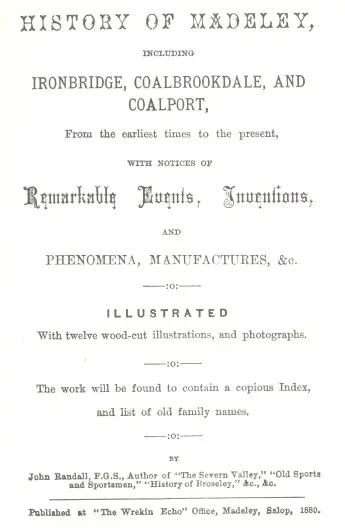
History of Madeley including Ironbridge, Coalbrookdale, and Coalport
John Randall
THE CLASSIC COLLECTION · 1873
"Old Sports and Sportsmen; or, the Willey Country" by John Randall is a historical account written in the late 19th century. This work details the rich traditions of hunting and the social life surrounding it in Shropshire, especially through the lens of Squire Forester and his whipper-in, Tom Moody. The book encompasses local history and the development of sporting culture in the region, revealing both the deep-rooted appreciation for nature and the complexities of human-nature relationships throughout time. The beginning of the work introduces the backdrop of Shropshire’s landscape and the significance of hunting as a prestigious pastime among the gentry. The author discusses the roots of this tradition, highlighting figures such as Squire Forester and his connections to the land and its folklore. The opening chapters suggest an exploration of the natural history of the region, the influence of different eras on sporting practices, and the relationships between nobility, local clergy, and the common folk within the context of outdoor sports and the conservation of wildlife. Randall's approach combines anecdotes, historical references, and a celebration of the enduring relationship humans have with nature.
Introduction adapted from the source catalogue; source summaries may be automatically generated.
Free to read · English · 44,678 words · No account needed
MAKE TIME FOR A GOOD BOOK
On by default. Untick to stop anonymous reading totals. Each page counts after 10 seconds in view. How this works.
Anonymous counting is on unless you have switched it off.
Since the old Forest Periods, and since old Squire Forester’s day even, the manners and the customs of the nation have changed; but the old love of sport discoverable in our ancestors, and inherited more or less by them from theirs, remains as a link connecting past generations with the present.
It matters not, it appears to me, whether either the writer or the reader indulges himself in such sports or not, he may be equally willing to recall the “Olden Time,” with its instances of rough and ready pluck and daring, and to listen to an old song, made by an aged pate,
“Of a fine old English gentleman who had a great estate.”
Shropshire and the surrounding counties during the past century had, as we all know, many old English gentlemen with large estates, who kept up their brave old houses at pretty liberal rates; but few probably exercised the virtue of hospitality more, or came nearer to the true type of the country gentleman of the period than the hearty old Willey Squire. Differ as we may in our views of the chase, we must admit that such amusements served to relieve the monotony of country life, and to make time pass pleasantly, which but for horses and hounds, and the opportunities they afforded of intercourse with neighbours, must have hung heavily on a country gentleman’s hands a hundred years ago.
It is, moreover, it appears to me, to this love of sport, in one form or another, that we of this generation are indebted for those grand old woods which now delight the eye, and which it would have been a calamity to have lost. The green fertility of fields answering with laughing plenty to human industry is truly pleasing; but now that blue-bells, and violets, foxgloves and primroses are being driven from the hedgerows, and these themselves are fast disappearing before the advances of agricultural science, it is gratifying to think that there are wastes and wilds where weeds may still resort—where the perfumes of flowers, the songs of birds, and the music of the breeze may be enjoyed. That the love of nature which the out-door exercises of our ancestors did so much to foster and perpetuate still survives is evident. How often, for instance, among dwellers in towns does the weary spirit pant for the fields, that it may wing its flight with the lark through the gushing sunshine, and join in the melody that goes pealing through the fretted cathedral of the woods, whilst caged by the demands of the hour, or kept prisoner by the shop, the counter, or the machine? Spring, with its regenerating influences, may wake the clods of the valley into life, may wreathe the black twigs with their garb of green and white, and give to the trees their livery; but men who should read the lessons they teach know nothing of the rejoicings that gladden the glades and make merry the woods. Nevertheless, proof positive that the love of nature—scourged, crushed, and overlaid, it may be, with anxious cares for existence—never dies out may be found in customs still lingering among us. In the blackest iron districts, where the surface is one great ink-blotch, where clouds of dust and columns of smoke obscure the day, where scoria heaps, smouldering fires, and never-ceasing flames give a scorched aspect to the scene, the quickening influences that renew creation are felt, teaching men—ignorant as Wordsworth’s “Peter Bell”—to take part in the festival of the year. When the sap has risen in the tree when the south wind stirs the young leaves, and the mechanism of the woods is in motion, when the blackbird has taken his place in the bush, and the thrush has perched itself upon the spray, in the month of pelting showers and laughing sunshine, when the first note of the cuckoo is heard from the ash in the hedge-row or the wild cherry in the woods, an old custom still proclaims a holiday in honour of his arrival. When the last lingering feature of winter has vanished; when brooks, no longer hoarse, sink their voices to a tinkling sweetness, flooding mead and dingle with their music; when the merry, merry month, although no longer celebrated for its floral shows and games as formerly, arrives, the May-bush may be seen over the door of the village smithy and on the heads of horses on the road.
Your reading position is saved on this browser. Take it to another device with a library code. Reading pages adapt to text, rather than matching a printed edition.
BEHIND THE BOOK
This eBook is for the use of anyone anywhere in the United States and most other parts of the world at no cost and with almost no restrictions whatsoever. You may copy it, give it away or re-use it under the terms of the Project Gutenberg License included with this eBook or online at www.gutenberg.org. If you are not located in the United States, you will have to check the laws of the country where you are located before using this eBook. Read the source licence.
The original source file, including credits and licence, is retained by this library. Request an original-format copy at no charge. Please include the book title and Project Gutenberg identifier #63805.
KEEP YOUR CURIOSITY GOING
Cécile Tormay

Moritz Busch
John L. Ransom
Frances Wright
Cécile Tormay

Mabel Potter Daggett