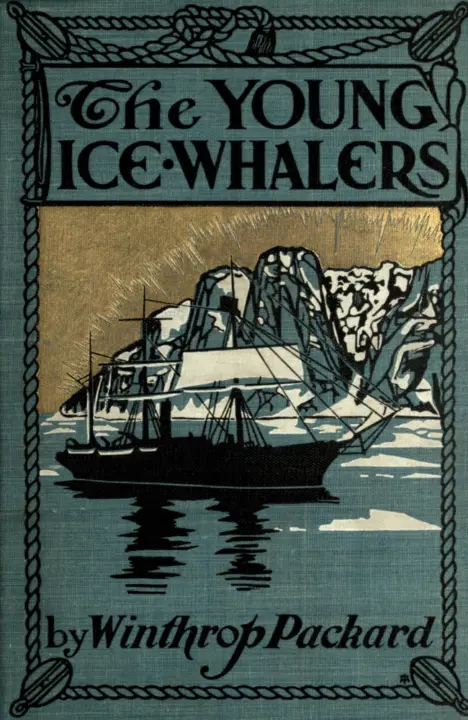
The Young Ice Whalers
Winthrop Packard
THE CLASSIC COLLECTION · 1920
"Old Plymouth Trails" by Winthrop Packard is a historical account written in the early 20th century. The work offers a detailed exploration of Plymouth, Massachusetts, and the trails walked by the Pilgrims, emphasizing the unique landscape and historical significance of the area. Through vivid descriptions and reflections, it likely aims to connect readers with the history and natural beauty of Old Plymouth, illustrating the charm of its trails and the vital role they played in early American history. The opening of the book sets the tone by invoking the storied past of the Pilgrims and the rugged, rock-bound coast they encountered upon their arrival. Packard begins with a poetic homage to the landscape, discussing the enduring natural features that still resonate with the experiences of the early settlers. He highlights Leyden Street as a modern path tracing back to the Pilgrims and invites readers to visualize the actual trails the Pilgrims took in their journey, rich with remnants of their presence along the way. As he contrasts modern Plymouth with its historical roots, he encourages exploration beyond the urban landscape to uncover traces of the past, blending natural observations with a heartfelt narrative of historical reverence.
Introduction adapted from the source catalogue; source summaries may be automatically generated.
Free to read · English · 74,545 words · No account needed
MAKE TIME FOR A GOOD BOOK
On by default. Untick to stop anonymous reading totals. Each page counts after 10 seconds in view. How this works.
Anonymous counting is on unless you have switched it off.
"Thus Cape Cod is anchored to the heavens, as it were," he goes on, "by a myriad little cables of beach grass, and, if they should fail would become a total wreck, and ere long go to the bottom. Formerly the cows were permitted to go at large, and they ate many strands of the cable by which the Cape is moored, and well-nigh set it adrift, as the bull did the boat that was moored by a grass rope, but now they are not permitted to wander."
All of which would seem to prove that Thoreau liked to crack a sly joke at the region he loved, as well as do the rest of us. The other day I too crossed the Cape, not exactly in Thoreau's footsteps but through the region of the "Chawums," which, I take it, are the Mashpees of later days. The trail began at East Sandwich where the sandy road crosses the State highway and goes on up the sandhills, always with the blue of the sea teasing from behind the keen javelin of the north wind pushing me on southward. It was wonderful, that blue of the cold, wind-beaten sea. It shone through the maze of mingled twigs for miles till I finally lost it in topping the plateau, passing from loose sand to clayey bottom and fairer growth in moister and more fertile soil. One fascination of the region comes in the fact that in a few rods one leaves all trace of civilization behind, unless one may call the narrow road a trace, and traverses the Cape Cod wilderness for mile on mile, just such a wilderness as Thorfinn Karlsefne may have tramped in armor with spear and crossbow of his day, such as Myles Standish and his men shivered through or Verrazani and Captain John Smith marched over and mapped. Pitch pines, small oaks of many varieties with an undergrowth "trash" of "hurts" and scrub oaks make up the forest which presses narrow cart paths and hangs over them. All the way up the slope the persistent chill of the north wind filled the air with the tonic tang of brine and held back the gray-green mist of leaves that strained at the buds, eager to be out. In hollows the spring had come. On ridges it delayed, finding the auguries unfavorable and waiting a new voice from file altar. But wherever the sun shone in and the wind was stayed it had loosed the butterflies that soared or flitted or flipped about in joy of long awaited warmth. Broad wings of gold-margined, brown Vanessa antiopa soared serenely along under overarching white oaks. "Little Miss Lavender" folded her gray-blue wings in demure beauty on the gray cladium-mossed stumps by the roadside, and dusky-winged species of the skipper brood were agile with new-born life, yet glad to fold wings and sleep in the sun on the road. These were sprites of the deep forest. None were visible in the town margin, though perhaps it was the sweep of the north wind that kept them away. Bird regions, too, showed a definite demarcation. In the orchards and open fields of the town were the home-loving birds, bluebirds, robins, song and other sparrows, swallows, and in the marshes the red-wing blackbirds. Not one of these did I see after leaving the open spaces behind. The avifauna of the scrub-oak underbrush and of the white oak and pitch-pine trees overhead was as distinct as that of a new continent. A flight of pine warblers was on and the oaks and pitch pines were alive with them. The juncos had gone north to nest in flocks of thousands, in a wonder of full song, all eagerly pressing on towards the hills but they left their songs behind them, as it were, to be sung by the other birds. In the pastures and cultivated fields the chipping sparrows, newly arrived from the South, took up the trill with an accent of their own, and all the pine warblers sang it, each with an individuality that slightly but clearly marked him from his fellow. I think all birds show this slight but definite individuality in manner and voice and are probably known to their neighbors of the same clan, as we are, each by his voice. And even so simple and definite a thing as the pine warbler's song may be varied by the individual singer from time to time. I heard one fine bird singing in the stereotyped form. As he sang a flicker flicked in the distance. Whereupon the pine warbler sang again, the same trill but with a tittering twang about it that just jocosely imitated the flicker. I saw no other warbler or other bird near enough to be the beneficiary of this joke. He did it just for himself, and his motions as he flew over to the next tree seemed a visible chuckle that ended in a saucy flirt of the two white tall feathers which are one distinguishing mark of the bird in flight.
Your reading position is saved on this browser. Take it to another device with a library code. Reading pages adapt to text, rather than matching a printed edition.
Winthrop Packard
Winthrop Packard
Winthrop Packard
Winthrop Packard
BEHIND THE BOOK
This eBook is for the use of anyone anywhere in the United States and most other parts of the world at no cost and with almost no restrictions whatsoever. You may copy it, give it away or re-use it under the terms of the Project Gutenberg License included with this eBook or online at www.gutenberg.org. If you are not located in the United States, you will have to check the laws of the country where you are located before using this eBook. Read the source licence.
The original source file, including credits and licence, is retained by this library. Request an original-format copy at no charge. Please include the book title and Project Gutenberg identifier #31250.
KEEP YOUR CURIOSITY GOING
Wilfrid Scawen Blunt
Wilfrid Scawen Blunt

E. W. (Edgar Watson) Howe
Cécile Tormay

Moritz Busch
John L. Ransom