THE CLASSIC COLLECTION✦Eline VereCLASSIC FREE BOOKS
Eline Vere
Louis Couperus

THE CLASSIC COLLECTION · 1918
"Old People and the Things That Pass" by Louis Couperus is a novel written in the early 20th century. The book explores the emotional landscape of aging, focusing on the complex relationships within an elderly family as they navigate love, loss, and the passage of time. Central characters include Ottilie, a woman grappling with the realities of her old age, her son Lot, who is preparing to marry Elly, and Steyn, Ottilie's second husband, highlighting themes of jealousy, loneliness, and the struggle to connect with loved ones. The opening of the novel introduces us to Ottilie as she interacts with her son Lot over coffee and prepares for his impending marriage to Elly. There is a palpable tension in Ottilie's emotions; she feels a mix of jealousy and sadness at the prospect of losing Lot. As they converse, Ottilie's reflections reveal her insecurities about aging and the changes in her family dynamics, particularly her complicated relationship with her husband Steyn. Lot, while affectionate, expresses his conflicting feelings about marriage, pondering why he proposed to Elly. The scene sets the stage for deeper explorations into the nuances of family bonds and the inevitability of aging as the narrative unfolds.
Introduction adapted from the source catalogue; source summaries may be automatically generated.
Free to read · English · 86,093 words · No account needed
MAKE TIME FOR A GOOD BOOK
On by default. Untick to stop anonymous reading totals. Each page counts after 10 seconds in view. How this works.
Anonymous counting is on unless you have switched it off.
"No, my boy, what's spoilt is spoilt. Twenty years wear out a man's energy to make something more of his life. I felt at the time that I oughtn't to desert Mamma, when she was left all alone, not wholly through my fault, perhaps, but still very much so. To leave her now, when she is an old woman, would be the act of a cad: I can't do it. I take that line not as a barren sacrifice, but because I can't help it. I don't allow my life to be made a hell of. I go my own way when I want to, though Mamma exaggerates when she pretends that I go to a woman at night."
"Mamma is naturally jealous and she's still jealous of you."
"And she's jealous of you. She's an unhappy woman; and the older she grows the unhappier she will be. She's one of those people who ought never to grow old.... Come along, Jack, we're going for a walk.... But, Lot, if Mamma goes on like this, we shall have to have her property administered for her. There's nothing else for it."
Lot gave a start: he pictured Mamma with her property transferred to an administrator; and yet Steyn was right. He thought that he had better have a quiet talk with Mamma. For the moment, there was nothing to be done: Mamma was exasperated, was behaving like a lunatic and would send Hugh the fifty pounds.
Lot went back to his room and tried to resume his work. He was writing an essay On Art, proving that art was entertainment and the artist an entertainer. He did not know whether he agreed with everything that he was saying, but that didn't matter and was of no importance. It was a subject to fill a few brilliant pages, written with all his talent for words; and it would catch the public, it would be read: it would rouse indignation on the one side and a smile on the other, because there really might be a good deal in it and because Charles Pauws might be right in what he said. He lovingly fashioned his sentences out of beautiful words, making them seem convincing through their brilliancy.... But in between the sentences he thought of poor Mamma and suddenly found that he could not go on writing. He pitied her. He felt for Steyn, but he pitied poor Mamma.... He rose and paced his room, which was full of spoils of Italy: a few bronzes, a number of photographs after the Italian masters. A good fellow, Steyn, to let him have this room next to Mamma's and to go up to the top floor himself. But he pitied his mother, who was such a child. She had always been a child: she could not help being and remaining a child. She had been so very pretty and so seductive: a little doll always; and he remembered, when he was already a boy of seventeen, how perfectly charming Mamma used to look: so young, so extraordinarily young, with that adorable little face, those blue childlike eyes and that perfect, plump figure. She was thirty-eight then, without a sign of age; she was a pretty woman in the full bloom of her attractiveness. He had no need to look at Mamma's photographs as she was in those days and earlier: he remembered her like that; he remembered her looking like a young girl in a low, creamy-white lace dress, which she did not even take the trouble to put on very neatly, looking above all things charming, so intensely charming; he remembered her in a brown-cloth frock trimmed with astrakhan, with a little astrakhan cap on her frizzy hair, skating with him on the ice, so lightly and gracefully that people believed her to be his sister.... Poor Mamma, growing old now! And yet she still looked very nice, but she was growing old; and she had nothing--he was sure of this--she had nothing but her faculty for love. She had five children, but she was not a mother: Lot laughed and shook his head at the thought. He had educated himself; Ottilie had very early become aware of her great talent and her beautiful voice and had also educated herself; the Trevelleys had run more wild.... No, Mamma was not a mother, was not a woman of domestic tastes, was not even a woman of the world: Mamma had nothing but her faculty for love. She needed love, probably no longer needed passion, but still needed love; and what she needed most, needed mortally, was petting, like a child. And nobody petted her more than he did, because he knew that Mamma was mad on petting. She had once said to him, pointing to a photograph of his half-brother Hugh Trevelley, a good-looking lad turned twenty:
Your reading position is saved on this browser. Take it to another device with a library code. Reading pages adapt to text, rather than matching a printed edition.
Louis Couperus
Louis Couperus

Louis Couperus
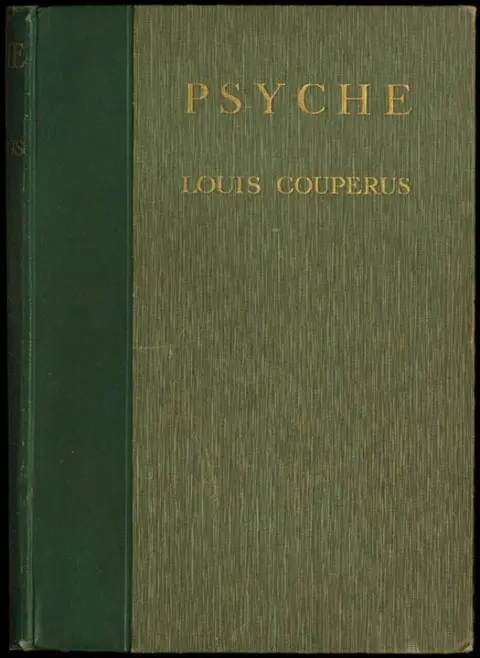
Louis Couperus
BEHIND THE BOOK
This eBook is for the use of anyone anywhere in the United States and most other parts of the world at no cost and with almost no restrictions whatsoever. You may copy it, give it away or re-use it under the terms of the Project Gutenberg License included with this eBook or online at www.gutenberg.org. If you are not located in the United States, you will have to check the laws of the country where you are located before using this eBook. Read the source licence.
The original source file, including credits and licence, is retained by this library. Request an original-format copy at no charge. Please include the book title and Project Gutenberg identifier #48271.
KEEP YOUR CURIOSITY GOING
Coulson Kernahan

Maurice Baring
Frances Wright
Cécile Tormay

Frederic Jesup Stimson

W. H. P. (William Henry Pope) Jarvis