THE CLASSIC COLLECTION✦Windmills: A book of fablesCLASSIC FREE BOOKS
Windmills: A book of fables
Gilbert Cannan
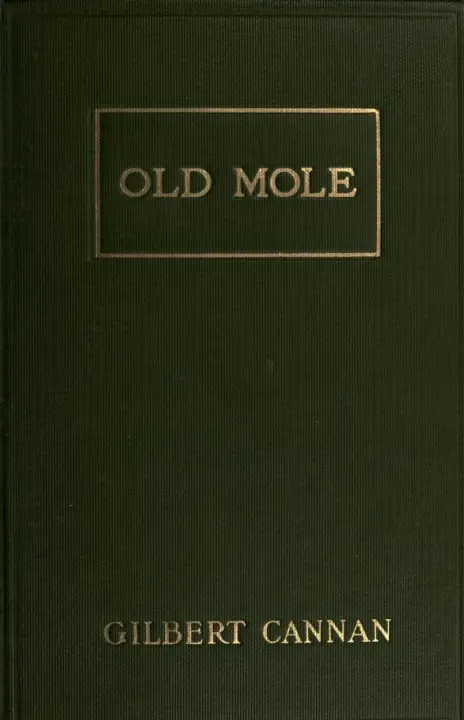
THE CLASSIC COLLECTION · 1914
"Old Mole" by Gilbert Cannan is a novel written in the early 20th century. The story centers around Herbert Jocelyn Beenham, referred to as "Old Mole," an unambitious schoolmaster at the Thrigsby Grammar School who leads a monotonous life. His world is shaken when a misunderstanding leads to a scandal that forces him to leave his position, ultimately setting him on a path of self-discovery and unexpected adventures. The opening of "Old Mole" introduces us to H. J. Beenham, a schoolmaster who has dedicated twenty-five years to Thrigsby but is well aware of his own lack of ambition and the limited reach of his life. His routine existence is abruptly derailed when he is accused of assaulting a young woman, Matilda Burn, on a train. Despite his genuine intentions to comfort her, Beenham's actions are misconstrued, leading to public humiliation and the possibility of losing everything he has known. The chapter sets the tone for his transition from the confines of an academic life to the chaos and uncharacteristic adventures of the theater world, where he encounters Matilda again and becomes entwined in her aspirations. This unexpected turn catalyzes a series of events that challenge both his identity and beliefs, pushing him into a new life filled with unpredictability.
Introduction adapted from the source catalogue; source summaries may be automatically generated.
Free to read · English · 89,091 words · No account needed
MAKE TIME FOR A GOOD BOOK
On by default. Untick to stop anonymous reading totals. Each page counts after 10 seconds in view. How this works.
Anonymous counting is on unless you have switched it off.
When Old Mole told Matilda that he had written a book she asked:
"Is it a story?"
"A sort of story."
"Has it a happy ending? I can't see why people write stories that make
you miserable."
"It's a wonderful book," said Edwin Watts.
And Old Mole said:
"I flatter myself there are worse books written."
When Watts had gone Matilda said:
"If it's not a nice book I couldn't bear it."
"What do you mean--you couldn't bear it?"
"If it's like that Lucretius you're so fond of I'd be ashamed."
In the intoxication that still endured from the fumes of writing he had been thinking that the book was not incomparable with "De Rerum Natura," something between that and the Satires of Juvenal.
In a few weeks his manuscript returned with a polite letter from the publisher declining it, desiring to see more of Mr. Beenham's work, and enclosing his reader's report. It was short:
" 'Syntax and Sympathy' is satire without passion or any basis of love for humanity. There is nothing more damnable. The book is clever enough. It would be beastly in French--there is a plentiful crop of them in Paris; in England, thank God, with our public's loathing of cleverness, it is impossible."
The author burned letter and report, and at night, when Matilda was at the theater, buried the manuscript in the sands.
If there be any man who, awaking from a moral crisis, finds himself withered by the fever of it and racked with doubt as to his power to go boldly and warmly among his fellowmen without being battered and bewildered into pride or priggishness or cold egoism or thin-blooded humanitarianism, let him go to Blackpool in holiday time. There he will find hundreds of thousands of men, women and children; he will hear them, see them, smell them, be jostled and chaffed by them. He will find them in and on the water, on the sands, in the streets, in the many public places, shows and booths, in the vast ballrooms, straggling and stravading, smoking, drinking, laughing, guffawing, cracking coarse jokes, singing bawdy and patriotic songs with equal gusto, making music with mouth-organs, concertinas, cornets; young men and maidens kissing and squeezing unashamed, and at night stealing out to the lonely sands; old men and women gurgling over beer and tobacco, yarning over the troubles that came of just such lovemaking in their young days; and all hot and perspiring; wearing out their bodies, for once in a way, in pleasure, gross pleasure with no savor to it nor lasting quality, but coarse as the food they eat, as the beds they lie on, as the clothes they wear; forgetting that their bodies are, day in, day out, bent in labor, forgetting the pinch and penury of their lives at home, forgetting that their bodies have any other than their brutish functions of eating, drinking, sleeping, excretion and fornication. . . . Old Mole watched it all, and, true to his ironical mood, he saw the mass in little, swarming like ants; in the early morning of the great day these creatures were belched forth from the black internal regions of the country, out upon the seashore; there they sprawled and struggled and made a great clatter and din, until at the end of the day they were sucked back again. Intellectually it interested him. It was a pageant of energy unharnessed; but it was all loose, unshaped, overdone, repeating itself again and again, so that at last it destroyed any feeling he might have had for it. He saw it through to the end, to the last excursion train going off, crammed in every compartment, with tired voices singing, often quite beautifully, in harmony.
Your reading position is saved on this browser. Take it to another device with a library code. Reading pages adapt to text, rather than matching a printed edition.
Gilbert Cannan

Gilbert Cannan
Gilbert Cannan
Gilbert Cannan
BEHIND THE BOOK
This eBook is for the use of anyone anywhere in the United States and most other parts of the world at no cost and with almost no restrictions whatsoever. You may copy it, give it away or re-use it under the terms of the Project Gutenberg License included with this eBook or online at www.gutenberg.org. If you are not located in the United States, you will have to check the laws of the country where you are located before using this eBook. Read the source licence.
The original source file, including credits and licence, is retained by this library. Request an original-format copy at no charge. Please include the book title and Project Gutenberg identifier #43423.
KEEP YOUR CURIOSITY GOING
Coulson Kernahan

Maurice Baring
Frances Wright
Cécile Tormay

Frederic Jesup Stimson

W. H. P. (William Henry Pope) Jarvis