THE CLASSIC COLLECTION✦Rocky ForkCLASSIC FREE BOOKS
Rocky Fork
Mary Hartwell Catherwood
THE CLASSIC COLLECTION · 1893
"Old Kaskaskia" by Mary Hartwell Catherwood is a historical novel written in the late 19th century. The narrative unfolds in the early 19th century, focusing on the lives of the residents of Kaskaskia, Illinois, as they navigate the complexities of community and personal aspirations. The story introduces us to characters like Jean Lozier, a young man longing for the vibrant town life he cannot quite attain, and Dr. Dunlap, who is caught in a tangled web of past relationships and current dilemmas, notably concerning Maria Jones, a frail newcomer with her own struggles. The opening of "Old Kaskaskia" establishes a picturesque yet bustling scene where Jean observes Kaskaskia from the bluff, yearning for a life beyond the fields where he feels trapped. As he gazes at the lively town, we are introduced to various prominent figures and social activities hinting at the vibrant cultural life of the time, including a festive bonfire celebrating St. John's Day. The narrative shifts between Jean's conflicted feelings about his place in society and the unfolding dynamics among the townsfolk, especially between Dr. Dunlap and Maria, whose past connections complicate their interactions. Through lively dialogues and vivid descriptions, Catherwood captures the interplay of aspirations, relationships, and the longing inherent in the human experience.
Introduction adapted from the source catalogue; source summaries may be automatically generated.
Free to read · English · 32,817 words · No account needed
MAKE TIME FOR A GOOD BOOK
On by default. Untick to stop anonymous reading totals. Each page counts after 10 seconds in view. How this works.
Anonymous counting is on unless you have switched it off.
"Oh," she cried out, "I have left the house without saying adieu to tante-gra'mere. My mind is distracted. She will as long as she lives remember this discourtesy."
"It could be easily remedied, madame," suggested Colonel Menard, panting as he braced his oar, "if she would step into the boat herself, as we all wish her to do."
"Oh, monsieur the colonel, you are the best of men. If you had only had the training of her instead of my poor gentle Francis, she might not be so hard to manage now."
"We must not flatter ourselves, madame. But Mademoiselle Angelique must not remain here much longer for anybody's whim."
"Do you think the water is rising?"
"It is certainly rising."
Madame Saucier uttered a shriek as a great swell rolled the boat. The searching wind penetrated all her garments and blew back loose ends of her hair. There was now a partially clear sky, and the moon sent forth a little lustre as a hint of what she might do when she had entirely freed herself from clouds.
The children were lowered, and after them their black nurse.
"There is room for at least one more!" called Pierre Menard.
Captain Saucier stood irresolute.
"Can you not trust me with these fragments of our families?" said Rice.
"Certainly, Monsieur Reece, certainly. It is not that. But you see the
water is still rising."
"I was testing the rise of the water when Colonel Menard reached us. The wind makes it seem higher than it really is. You can go and return, captain, while you are hesitating."
"I am torn in two," declared the Indian fighter. "It makes a child of me to leave Angelique behind."
"Francis Saucier," came in shrill French from the screens, "get into that boat, and leave my godchild alone."
The captain laughed. He also kissed the cheeks of tante-gra'mere's
godchild and let himself slide down the roof, and the boat was off
directly.
The slaves, before returning to their own room, again fastened the sashes of the dormer window. The clamor of bells which seemed to pour through the open window was thus partly silenced. The lantern made its dim illumination with specks of light, swinging from a nail over the window alcove. Maria had not yet unclosed her eyes. Her wasted hand made a network around one of Rice's fingers, and as the coughing spasm seized her she tightened it.
"She wants air," he said hastily, and Angelique again spread wide the window in the gable, when the thin cry of her tante-gra'mere forbade it.
"But, dear tante-gra'mere, Mademoiselle Zhone must have air."
Your reading position is saved on this browser. Take it to another device with a library code. Reading pages adapt to text, rather than matching a printed edition.
Mary Hartwell Catherwood
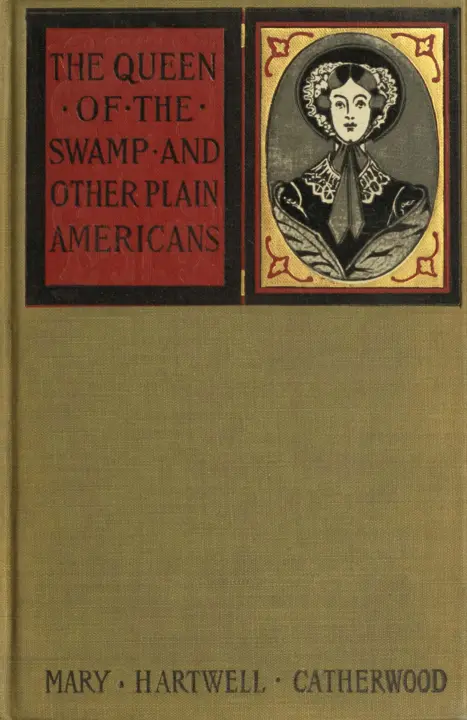
Mary Hartwell Catherwood

Mary Hartwell Catherwood

Mary Hartwell Catherwood
BEHIND THE BOOK
This eBook is for the use of anyone anywhere in the United States and most other parts of the world at no cost and with almost no restrictions whatsoever. You may copy it, give it away or re-use it under the terms of the Project Gutenberg License included with this eBook or online at www.gutenberg.org. If you are not located in the United States, you will have to check the laws of the country where you are located before using this eBook. Read the source licence.
The original source file, including credits and licence, is retained by this library. Request an original-format copy at no charge. Please include the book title and Project Gutenberg identifier #18423.
KEEP YOUR CURIOSITY GOING
Cécile Tormay

Moritz Busch
Coulson Kernahan
John L. Ransom

Maurice Baring
Frances Wright