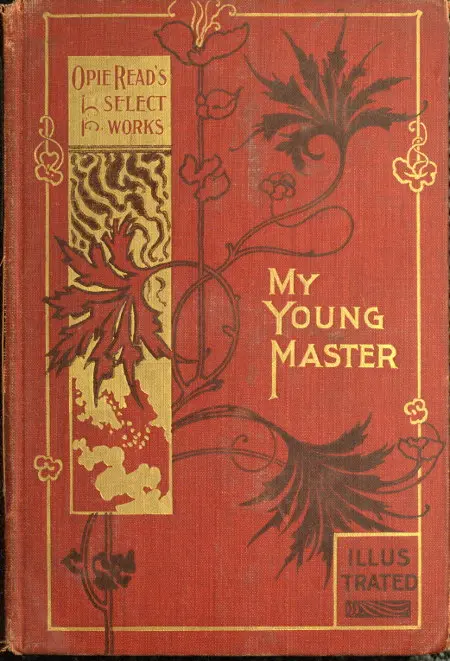
My Young Master: A Novel
Opie Percival Read
THE CLASSIC COLLECTION · 1897
"Old Ebenezer" by Opie Percival Read is a novel written in the late 19th century. The story revolves around Sam Lyman, a school teacher who has moved from Vermont to the laid-back town of Old Ebenezer in hopes of finding a fresh start. As he pursues a career in law, Lyman’s journey is intertwined with the eccentric local characters, including the wealthy banker McElwin and his daughter Eva, along with various humorous circumstances that unfold in their small-town setting. At the start of the novel, we are introduced to Lyman, who has settled into his role as a school teacher but yearns for something more fulfilling. His ambition drives him to study law and seek a partnership with a local attorney. The community's colorful residents, such as Uncle Buckley Lightfoot, provide a backdrop of humor and wisdom that underscores the peculiarities of small-town life. Lyman's aspirations come to a significant turning point when he becomes inadvertently entangled in a farcical marriage with McElwin's daughter, which sets off a series of comical and tumultuous events that challenge his values and ambitions. The opening chapters lay the groundwork for a story rich with character development and situational humor.
Introduction adapted from the source catalogue; source summaries may be automatically generated.
Free to read · English · 64,664 words · No account needed
MAKE TIME FOR A GOOD BOOK
On by default. Untick to stop anonymous reading totals. Each page counts after 10 seconds in view. How this works.
Anonymous counting is on unless you have switched it off.
"I can't afford to engage in trade," Lyman broke in. "Of course," he added, "trade is a good thing in its way, a sort of necessity, but the English have the right idea of it, after all--drawing a distinction between the tradesman and the gentleman. I remember a remark old Sam Johnson made concerning a fellow who had grown rich enough to stop buying and selling--'he had lost the servility of the tradesman without having acquired the manners of a gentleman.'"
McElwin bit his lip. "I didn't mean any offense," he said.
"Oh, surely not, and I have taken none. By the way, Mr. McElwin, Chancery court will meet next Monday."
"Ah! I had quite forgotten it. Time does fly, sir."
"Yes, and circumstances change, and men bow to circumstances."
"You are quite right, Mr. Lyman. And that reminds me that I have been forced through a change concerning Mr. Sawyer. I honor him on some grounds, you understand, but his confession of drunkenness shocked me greatly. In fact, sir, I am glad he did not marry my daughter."
"When I spoke of the meeting of the court," said Lyman, pretending to have paid no attention to McElwin's remark concerning Sawyer, "I wished to remind you of the petition for divorce."
"Yes, quite right," McElwin replied, uncrossing his legs and putting out his hand as if unconsciously feeling for his dignity, to pull it back to him.
"Is the paper which your daughter signed here or at your home?"
"At home, I think; yes, I am quite sure of it."
"Then would you mind walking up there with me so that I may sign it?"
"Why--er, not at all, sir, but we have plenty of time."
"No," Lyman insisted, "it is better to have it over with; and I ask your pardon for not having signed it sooner."
The banker got up, took down his hat, brushed it with the sleeve of his coat and announced his readiness to go. Together they walked out. Lyman assumed an unwonted gaiety. He commented humorously upon the tradesmen standing in their doors. The banker strove to laugh, but his heart was not in the effort. "Yes, sir," said he, "things change and women change, too. And I may make bold to say that my daughter--and my wife, sir--are not exceptions to the--er, rule."
"I don't quite understand," said Lyman.
"I mean, sir, that what at one time might have been distasteful may have become a--er--matter of endearment, you understand."
"I don't know that I do," the cruel tormenter replied.
Your reading position is saved on this browser. Take it to another device with a library code. Reading pages adapt to text, rather than matching a printed edition.
Opie Percival Read
Opie Percival Read
Opie Percival Read
Opie Percival Read
BEHIND THE BOOK
This eBook is for the use of anyone anywhere in the United States and most other parts of the world at no cost and with almost no restrictions whatsoever. You may copy it, give it away or re-use it under the terms of the Project Gutenberg License included with this eBook or online at www.gutenberg.org. If you are not located in the United States, you will have to check the laws of the country where you are located before using this eBook. Read the source licence.
The original source file, including credits and licence, is retained by this library. Request an original-format copy at no charge. Please include the book title and Project Gutenberg identifier #23215.
KEEP YOUR CURIOSITY GOING
Coulson Kernahan

Maurice Baring
Frances Wright
Cécile Tormay

Frederic Jesup Stimson

W. H. P. (William Henry Pope) Jarvis