THE CLASSIC COLLECTION✦Sketches in BedlamCLASSIC FREE BOOKS
Sketches in Bedlam
John Haslam
THE CLASSIC COLLECTION · 1809
"Observations on Madness and Melancholy" by John Haslam is a scientific publication written in the early 19th century. The work provides a comprehensive investigation into the nature of insanity, detailing the definitions, symptoms, and case studies of various mental disorders observed by the author during his tenure at Bethlem Hospital. Haslam's exploration seeks to bridge the gap between theoretical insights and practical observations in the field of psychiatry. The opening of the book sets the stage for a detailed examination of madness, beginning with Haslam's assertion that the term "madness" lacks a precise definition yet remains universally recognized among practitioners when they encounter an insane person. He discusses the challenges of defining mental disorders, the significance of understanding the human mind's functions, particularly in a state of despair, and the complexities of language in expressing mental conditions. Haslam introduces foundational concepts of insanity, contrasting mania and melancholia, while emphasizing the necessity of observing real cases and toxicological appearances in the brain to understand these conditions better. This detailed approach promises readers a blend of theoretical discourse and clinical observation as they delve deeper into the intricacies of mental illness.
Introduction adapted from the source catalogue; source summaries may be automatically generated.
Free to read · English · 50,700 words · No account needed
MAKE TIME FOR A GOOD BOOK
On by default. Untick to stop anonymous reading totals. Each page counts after 10 seconds in view. How this works.
Anonymous counting is on unless you have switched it off.
The head was opened twenty four hours after her decease. The tunica arachnoidea was in many places opake; the pia mater was highly inflamed, and loaded with blood, and a considerable quantity of water was contained between it and the former membrane. The ventricles were enlarged, but contained scarcely any fluid. The other parts of the brain were healthy, and its consistence was natural.
It is a common opinion, that Phthisis Pulmonalis is frequently suspended by the supervention of mania; medical books abound with such accounts, and some persons have supposed it difficult, if not impossible, for these diseases to co-exist. It is not my intention to dispute the accuracy of such relations, nor to question the power which Mania may possess in arresting the progress of Phthisis Pulmonalis, but, to state that the converse does not obtain; and, that whatever obligations may be due from Phthisis to Mania, the compliment has not been returned. From my own experience I can affirm, that insane persons are as liable to Phthisis Pulmonalis as others, that numbers of them die of that disease; and that I never saw any abatement of the maniacal symptoms through the progress of consumption.
J. P. aged 57, was admitted into the hospital, January 19, 1799; he was stated to have been insane about three weeks, and that his disorder came on shortly after the death of his master, in whose service he had continued many years, and to whom he was much attached. He had been in the hospital three times before, and had each time been discharged well. His disorder usually recurred every seven or eight years. His father also had been maniacal about the middle period of life, but never recovered. When admitted he was very talkative, although his natural character was reserved. He endeavoured to explain his meaning with superior correctness, and sought to define every subject, however trifling, with a tedious minuteness; but, upon religion and politics, the Scylla and Charybdis of human discussion, he was pertinacious and intollerant. This dictatorial manner and stubbornness of opinion, not being capable of producing the relations of peace and amity with other philosophers, equally obstinate, and whose principles had been matured by long confinement, it became necessary to shut him up in his cell. During the period of his seclusion, nothing very incoherent escaped from him; every thing he said was within the sphere of possibility. His fastidiousness rendered him unhappy: he acknowledged the food which was brought him to be good, but he conceived it might have been better. The cathartic medicine, which was administered to him, he confessed had answered the purpose, but its taste was most nauseous, and he had never before been so severely griped. He ornamented his person and apartment in a very whimsical manner: latterly he tore his clothes because he suspected the taylor had deceived him in the materials. After this he continued naked until the beginning of March, when he appeared more composed, and sensible of the state he had been in. On the morning of the 12th, when the keeper opened his cell, he was speechless; his mouth drawn to the right side, and so feeble that he could not support himself. A cathartic medicine was given, and sinapisms were applied to the feet and legs. In the evening he was much recovered, his speech had returned, and he was able to move himself. He was visited again at midnight, when he appeared still better. In the morning it was evident that he had experienced another attack, his mouth was drawn aside; he was stupid, and died within half an hour. The head was opened on the following day. The tunica arachnoidea was in some places slightly opake. The pia mater was inflamed, but not to any considerable degree. There was no water between any of the membranes. The ventricles were of a natural capacity, and did not contain any fluid. There was no extravasation in any part of the substance of the cerebrum or cerebellum. Excepting the slight inflammation of the pia mater, the brain had a very healthy appearance; its consistence was firm; the scull was unusually thick. I regret, from a promise which had been made to the friends, of inspecting the head only, that the thoracic and abdominal viscera were not examined.
Your reading position is saved on this browser. Take it to another device with a library code. Reading pages adapt to text, rather than matching a printed edition.
John Haslam
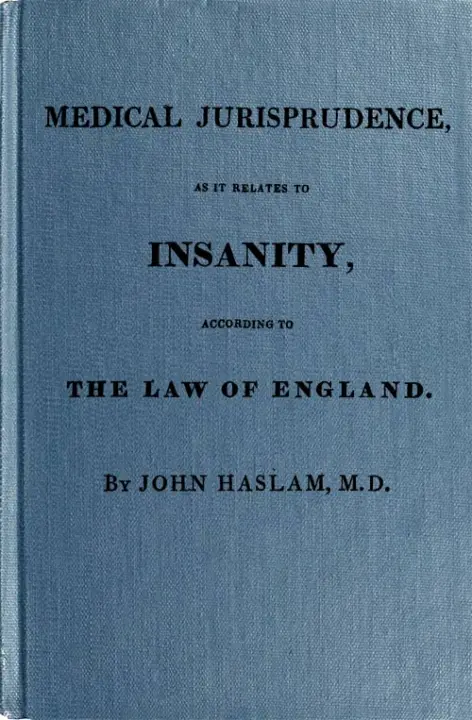
John Haslam
John Haslam
John Haslam
BEHIND THE BOOK
This eBook is for the use of anyone anywhere in the United States and most other parts of the world at no cost and with almost no restrictions whatsoever. You may copy it, give it away or re-use it under the terms of the Project Gutenberg License included with this eBook or online at www.gutenberg.org. If you are not located in the United States, you will have to check the laws of the country where you are located before using this eBook. Read the source licence.
The original source file, including credits and licence, is retained by this library. Request an original-format copy at no charge. Please include the book title and Project Gutenberg identifier #37144.
KEEP YOUR CURIOSITY GOING

Charles G. (Charles Griffith) Ross
Hannah Webster Foster

Emily Lawless
Edwin Hamlin Carr

Charles De Lano Hine
Andrew Ure