THE CLASSIC COLLECTION✦Sketches in BedlamCLASSIC FREE BOOKS
Sketches in Bedlam
John Haslam
THE CLASSIC COLLECTION · 1809
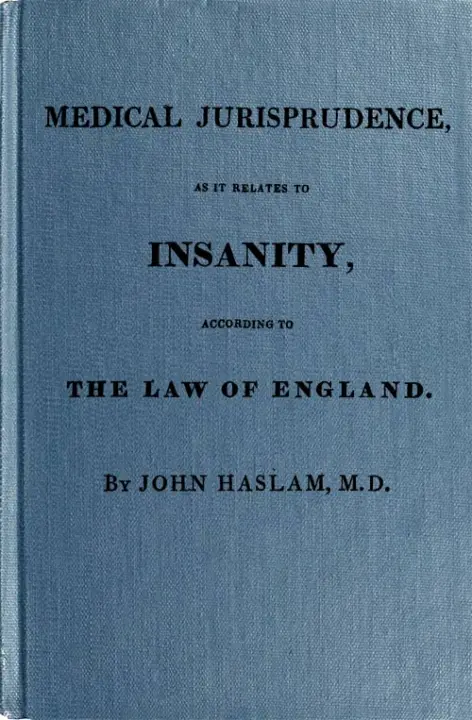
"Observations on Madness and Melancholy" by John Haslam is a scientific publication written in the early 19th century. The work provides a comprehensive investigation into the nature of insanity, detailing the definitions, symptoms, and case studies of various mental disorders observed by the author during his tenure at Bethlem Hospital. Haslam's exploration seeks to bridge the gap between theoretical insights and practical observations in the field of psychiatry. The opening of the book sets the stage for a detailed examination of madness, beginning with Haslam's assertion that the term "madness" lacks a precise definition yet remains universally recognized among practitioners when they encounter an insane person. He discusses the challenges of defining mental disorders, the significance of understanding the human mind's functions, particularly in a state of despair, and the complexities of language in expressing mental conditions. Haslam introduces foundational concepts of insanity, contrasting mania and melancholia, while emphasizing the necessity of observing real cases and toxicological appearances in the brain to understand these conditions better. This detailed approach promises readers a blend of theoretical discourse and clinical observation as they delve deeper into the intricacies of mental illness.
Introduction adapted from the source catalogue; source summaries may be automatically generated.
Free to read · English · 50,700 words · No account needed
MAKE TIME FOR A GOOD BOOK
On by default. Untick to stop anonymous reading totals. Each page counts after 10 seconds in view. How this works.
Anonymous counting is on unless you have switched it off.
From these considerations, I am inclined to think, that a lucid interval includes all the circumstances, which I have enumerated in my definition of it. If the person, who is to examine the state of the patient's mind, be unacquainted with his peculiar opinions, he may be easily deceived, because, wanting this information, he will have no clue to direct his enquiries, and madmen do not always, nor immediately intrude their incoherent notions: they have sometimes such a high degree of control over their minds, that when they have any particular purpose to carry, they will affect to renounce those opinions, which shall have been judged inconsistent: and it is well known, that they have often dissembled their resentment, until a favourable opportunity has occurred of gratifying their revenge.
Of this restraint, which madmen have sometimes the power of imposing on their opinions, the remark has been so frequent, that those who are more immediately about their persons, have termed it, in their rude phrase, stifling the disorder.
Among the numerous instances of this cunning and dissimulation, which I have witnessed in insane persons, the relation of one case will be sufficient to exemplify the subject.
An Essex farmer, about the middle age, had on one occasion so completely masked his disorder, that I was induced to suppose him well, when he was quite otherwise. He had not been at home many hours, before his derangement was discernable by all those, who came to congratulate him on the recovery of his reason. His impetuosity, and mischievous disposition daily increasing, he was sent to a private mad-house; there being, at that time, no vacancy in the hospital. Almost from the moment of his confinement he became tranquil, and orderly, but remonstrated on the injustice of his seclusion.
Having once deceived me, he wished much, that my opinion should be taken respecting the state of his intellects, and assured his friends that he would submit to my determination. I had taken care to be well prepared for this interview, by obtaining an accurate account of the manner in which he had conducted himself. At this examination, he managed himself with admirable address. He spoke of the treatment he had received, from the persons under whose care he was then placed, as most kind and fatherly: he also expressed himself as particularly fortunate in being under my care, and bestowed many handsome compliments on my skill in treating this disorder, and expatiated on my sagacity in perceiving the slightest tinges of insanity. When I wished him to explain certain parts of his conduct, and particularly some extravagant opinions, respecting certain persons and circumstances, he disclaimed all knowledge of such circumstances, and felt himself hurt, that my mind should have been poisoned so much to his prejudice. He displayed equal subtilty on three other occasions when I visited him; although by protracting the conversation, he let fall sufficient to satisfy my mind that he was a mad-man. In a short time he was removed to the hospital, where he expressed great satisfaction in being under my inspection. The private mad-house, which he had formerly so much commended, now became the subject of severe animadversion; he said that he had there been treated with extreme cruelty; that he had been nearly starved, and eaten up by vermin of various descriptions. On enquiring of some convalescent patients, I found (as I had suspected) that I was as much the subject of abuse, when absent, as any of his supposed enemies; although to my face his behaviour was courteous and respectful. More than a month had elapsed, since his admission into the hospital, before he pressed me for my opinion; probably confiding in his address, and hoping to deceive me. At length he appealed to my decision, and urged the correctness of his conduct during confinement as an argument for his liberation. But when I informed him of circumstances he supposed me unacquainted with, and assured him, that he was a proper subject for the asylum where he then inhabited; he suddenly poured forth a torrent of abuse; talked in the most incoherent manner; insisted on the truth of what he had formerly denied; breathed vengeance against his family and friends, and became so outrageous that it was necessary to order him to be strictly confined. He continued in a state of unceasing fury for more than fifteen months.
Your reading position is saved on this browser. Take it to another device with a library code. Reading pages adapt to text, rather than matching a printed edition.
John Haslam
John Haslam
John Haslam
John Haslam
BEHIND THE BOOK
This eBook is for the use of anyone anywhere in the United States and most other parts of the world at no cost and with almost no restrictions whatsoever. You may copy it, give it away or re-use it under the terms of the Project Gutenberg License included with this eBook or online at www.gutenberg.org. If you are not located in the United States, you will have to check the laws of the country where you are located before using this eBook. Read the source licence.
The original source file, including credits and licence, is retained by this library. Request an original-format copy at no charge. Please include the book title and Project Gutenberg identifier #37144.
KEEP YOUR CURIOSITY GOING

Charles G. (Charles Griffith) Ross
Hannah Webster Foster

Emily Lawless
Edwin Hamlin Carr

Charles De Lano Hine
Andrew Ure