THE CLASSIC COLLECTION✦Sketches in BedlamCLASSIC FREE BOOKS
Sketches in Bedlam
John Haslam
THE CLASSIC COLLECTION · 1809
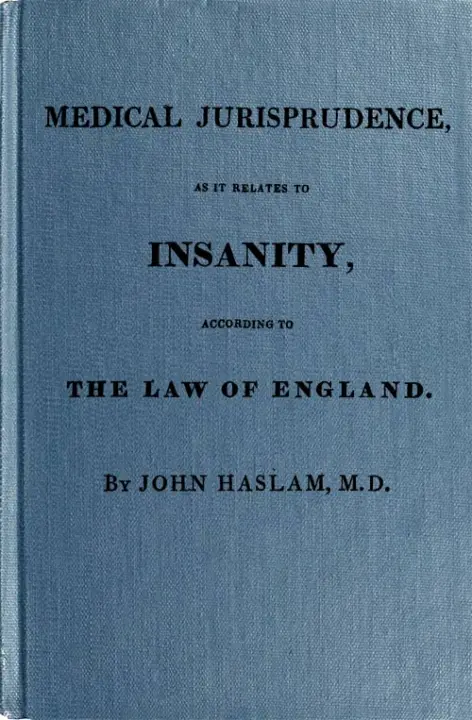
"Observations on Madness and Melancholy" by John Haslam is a scientific publication written in the early 19th century. The work provides a comprehensive investigation into the nature of insanity, detailing the definitions, symptoms, and case studies of various mental disorders observed by the author during his tenure at Bethlem Hospital. Haslam's exploration seeks to bridge the gap between theoretical insights and practical observations in the field of psychiatry. The opening of the book sets the stage for a detailed examination of madness, beginning with Haslam's assertion that the term "madness" lacks a precise definition yet remains universally recognized among practitioners when they encounter an insane person. He discusses the challenges of defining mental disorders, the significance of understanding the human mind's functions, particularly in a state of despair, and the complexities of language in expressing mental conditions. Haslam introduces foundational concepts of insanity, contrasting mania and melancholia, while emphasizing the necessity of observing real cases and toxicological appearances in the brain to understand these conditions better. This detailed approach promises readers a blend of theoretical discourse and clinical observation as they delve deeper into the intricacies of mental illness.
Introduction adapted from the source catalogue; source summaries may be automatically generated.
Free to read · English · 50,700 words · No account needed
MAKE TIME FOR A GOOD BOOK
On by default. Untick to stop anonymous reading totals. Each page counts after 10 seconds in view. How this works.
Anonymous counting is on unless you have switched it off.
Madmen, do not always continue in the same furious or depressed states: the maniacal paroxysm abates of its violence, and some beams of hope, occasionally cheer the despondency of the melancholic patients. We have in the hospital some unfortunate persons, who are obliged to be secured the greater part of their time, but who now and then become calm, and to a certain degree rational: upon such occasions, they are allowed a greater range, and are admitted to associate with the others. In some instances the degree of rationality is more considerable; they conduct themselves with propriety, and in a short conversation will appear sensible and coherent. Such remission has been generally termed a lucid interval.
When medical persons are called upon to attend a commission of lunacy, they are always asked, whether the patient has had a lucid interval? A term of such latitude as interval, requires to be explained in the most perspicuous and accurate manner. [The circumstances which probably occasioned the employment of this term are pointed out in the chapter which enumerates the causes of insanity.] In common language, it is made to signify both a moment and a number of years, consequently it does not comprize any stated time. The term lucid interval is therefore relative. As the law requires a precise developement of opinion, I should define a lucid interval to be a complete recovery of the patient's intellects, ascertained by repeated examinations of his conversation, and by constant observation of his conduct, for a time sufficient to enable the superintendant to form a correct judgment. Unthinking people, are frequently led to conclude, that if, during a short conversation, a person under confinement shall bewray nothing absurd or incorrect, he is well, and often remonstrate on the injustice of secluding him from the world. Even in common society, there are many persons whom we never suspect, from a few trifling topics of discourse, to be shallow minded; but, if we start a subject, and wish to discuss it through all its ramifications and dependancies, we find them incapable of pursuing a connected chain of reasoning. In the same manner insane people will often, for a short time, conduct themselves, both in conversation and behaviour, with such propriety, that they appear to have the just exercise and direction of their faculties: but let the examiner protract the discourse until the favourite subject shall have got afloat in the mad man's brain, and he will be convinced of the hastiness of his decision. To those unaccustomed to insane people, a few coherent sentences, or rational answers, would indicate a lucid interval, because they discovered no madness; but he, who is in possession of the peculiar turn of the patient's thoughts, might lead him to disclose them, or by a continuance of the conversation, they would spontaneously break forth. A beautiful illustration of this is contained in the Rasselas of Dr. Johnson, where the astronomer is admired as a person of sound intellect and great acquirements by Imlac, who is himself a philosopher, and a man of the world. His intercourse with the astronomer is frequent; and he always finds in his society information and delight. At length he receives Imlac into the most unbounded confidence, and imparts to him the momentous secret. "Hear, Imlac, what thou wilt not, without difficulty, credit. I have possessed, for five years, the regulation of weather, and the distribution of the seasons. The Sun has listened to my dictates, and passed from tropic to tropic by my direction. The clouds, at my call, have poured their waters, and the Nile has overflowed at my command. I have restrained the rage of the Dog-star, and mitigated the fervours of the Crab. The winds alone, of all the elemental powers, have hitherto refused my authority; and multitudes have perished by equinoctial tempests, which I found myself unable to prohibit or restrain. I have administered this great office with exact justice, and made to the different nations of the earth an impartial dividend of rain and sunshine. What must have been the misery of half the globe, if I had limited the clouds to particular regions, or confined the Sun to either side of the Equator?"
Your reading position is saved on this browser. Take it to another device with a library code. Reading pages adapt to text, rather than matching a printed edition.
John Haslam
John Haslam
John Haslam
John Haslam
BEHIND THE BOOK
This eBook is for the use of anyone anywhere in the United States and most other parts of the world at no cost and with almost no restrictions whatsoever. You may copy it, give it away or re-use it under the terms of the Project Gutenberg License included with this eBook or online at www.gutenberg.org. If you are not located in the United States, you will have to check the laws of the country where you are located before using this eBook. Read the source licence.
The original source file, including credits and licence, is retained by this library. Request an original-format copy at no charge. Please include the book title and Project Gutenberg identifier #37144.
KEEP YOUR CURIOSITY GOING

Charles G. (Charles Griffith) Ross
Hannah Webster Foster

Emily Lawless
Edwin Hamlin Carr

Charles De Lano Hine
Andrew Ure