THE CLASSIC COLLECTION✦Sketches in BedlamCLASSIC FREE BOOKS
Sketches in Bedlam
John Haslam
THE CLASSIC COLLECTION · 1809
"Observations on Madness and Melancholy" by John Haslam is a scientific publication written in the early 19th century. The work provides a comprehensive investigation into the nature of insanity, detailing the definitions, symptoms, and case studies of various mental disorders observed by the author during his tenure at Bethlem Hospital. Haslam's exploration seeks to bridge the gap between theoretical insights and practical observations in the field of psychiatry. The opening of the book sets the stage for a detailed examination of madness, beginning with Haslam's assertion that the term "madness" lacks a precise definition yet remains universally recognized among practitioners when they encounter an insane person. He discusses the challenges of defining mental disorders, the significance of understanding the human mind's functions, particularly in a state of despair, and the complexities of language in expressing mental conditions. Haslam introduces foundational concepts of insanity, contrasting mania and melancholia, while emphasizing the necessity of observing real cases and toxicological appearances in the brain to understand these conditions better. This detailed approach promises readers a blend of theoretical discourse and clinical observation as they delve deeper into the intricacies of mental illness.
Introduction adapted from the source catalogue; source summaries may be automatically generated.
Free to read · English · 50,700 words · No account needed
MAKE TIME FOR A GOOD BOOK
On by default. Untick to stop anonymous reading totals. Each page counts after 10 seconds in view. How this works.
Anonymous counting is on unless you have switched it off.
In a few cases setons have been employed, but no benefit has been derived from their use, although the discharge was continued above two months.
Respecting opium, it may be observed, that whenever it has been exhibited, during a violent paroxysm, it has hardly ever procured sleep: but, on the contrary, has rendered those who have taken it much more furious: and, where it has for a short time produced rest, the patient has, after its operation, awaked in a state of increased violence.
Many of the tribe of narcotic poisons have been recommended for the cure of madness; but, my own experience of those remedies is very limited, nor is it my intention to make further trials. Other, and perhaps whimsical modes of treating this disorder, have been mentioned: whirling,[40] or spinning a madman round, on a pivot, has been gravely proposed; and, music has been extolled, with a considerable glow of imagination, by the same gentleman.--That the medical student may be fully aware of the manifold agents which practical physicians have suggested for the restoration of reason, I shall conclude my volume with the following extract.[41]
"The medical philosopher, in his study of human nature, must have observed, that sympathetic correspondence of action between the mind and body, which is uniformly present in health and disease, though varying with circumstances. The different passions, according to their nature, the degree or intensity of application, and the sensibility of the party, exhibit certain characteristic expressions of countenance, and produce obvious changes, actions, or motions, in the animal economy. MUSIC has been found to occasion all these actions, changes, and movements, in some sensible systems; and where one passion morbidly predominates, as frequently happens in mania, those species of simple or combined sounds, capable of exciting an opposite passion, may be very usefully employed. If then such effects can be produced by such a power, acting on a mind only endued with its healthy proportion of susceptibility, what may we not expect where the sensibility is morbidly increased, and where the patient is alive to the most minute impressions? Cases frequently occur where such acuteness of sensibility, and extreme delicacy of system exist, that most of the more common, moral, and medical means are contra-indicated; here relief may be often administered through the medium of the senses; the varied modulations, the lulling, soothing cords of even an Eoelian harp have appeased contending passions, allayed miserable feeling, and afforded ease and tranquillity to the bosom tortured with real or fancied woe: and I can easily imagine, that jarring discord, grating harsh rending sounds, applied to an ear naturally musical, would uniformly excite great commotion. Under circumstances calculated to assist this action, by producing unpleasant impressions through the medium of the other senses, as when SCREECHES and YELLS are made in an apartment painted black and red, or glaring white, every man must be painfully affected: the maniacal patient, however torpid, must be roused: or, on the contrary, where an opposite state obtains, extreme sensibility and impatience of powerful impression, there much may be expected from placing the patient in an airy room, surrounded with flowers breathing odours, the walls and furniture coloured green, and the air agitated by undulations of the softest harmony. Much of this may appear FANCIFUL and RIDICULOUS, but the enquiring practitioner will find, on making the experiment, it deserves his serious attention; and no mean is to be despised that is capable of arresting the attention, changing the trains of thought, interesting the affections, removing or diminishing painful sensations, and ultimately rendering both mind and body sensible to impressions, and all this has been effected by music. Every individual is not capable of accurately estimating the extensive powers of this agent; but I would ask the musical amateur, or the experienced professor, if he have not frequently felt sensations the most exquisite and indescribable; if he have not experienced the whole frame trilling with inexpressible delight, when the tide of full harmony has FLOWN on his ear, and the most wretched miserable feeling, UNIVERSAL HORRIPILATIO and CUTIS ANSERINA from the grating crash of discord? All the varied sensations from transport to disgust, have been occasioned by the different movements in one piece of music. I might amuse my readers with a great variety of instances where persons have been very singularly affected by means of music, and where its powers have extended to the brute creation, but this I purposely avoid."
Your reading position is saved on this browser. Take it to another device with a library code. Reading pages adapt to text, rather than matching a printed edition.
John Haslam
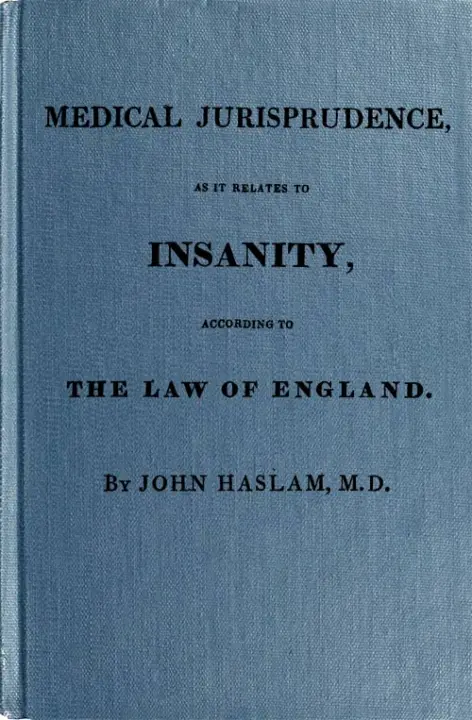
John Haslam
John Haslam
John Haslam
BEHIND THE BOOK
This eBook is for the use of anyone anywhere in the United States and most other parts of the world at no cost and with almost no restrictions whatsoever. You may copy it, give it away or re-use it under the terms of the Project Gutenberg License included with this eBook or online at www.gutenberg.org. If you are not located in the United States, you will have to check the laws of the country where you are located before using this eBook. Read the source licence.
The original source file, including credits and licence, is retained by this library. Request an original-format copy at no charge. Please include the book title and Project Gutenberg identifier #37144.
KEEP YOUR CURIOSITY GOING

Charles G. (Charles Griffith) Ross
Hannah Webster Foster

Emily Lawless
Edwin Hamlin Carr

Charles De Lano Hine
Andrew Ure