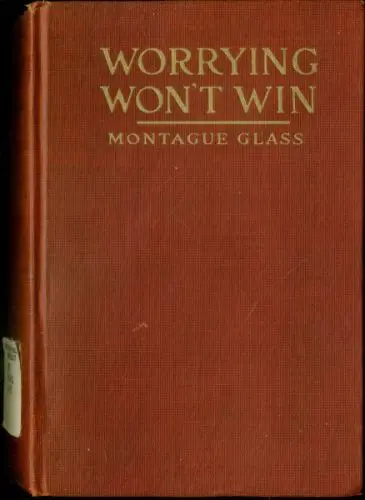
Worrying Won’t Win
Montague Glass
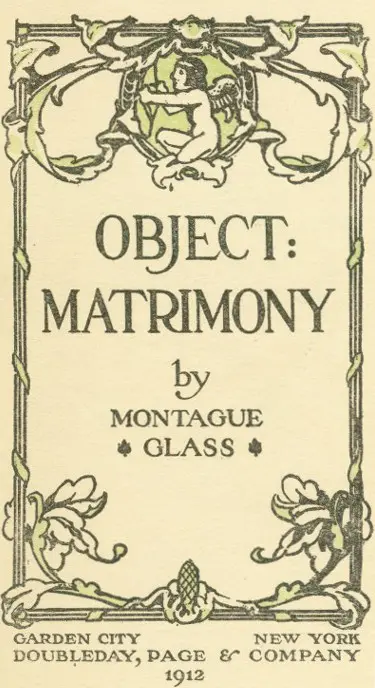
THE CLASSIC COLLECTION · 1909
"Object: matrimony" by Montague Glass is a comedic novel written in the early 20th century. The book delves into the themes of love and marriage, weaving a narrative centered around the misadventures and follies that arise in the pursuit of romantic relationships. Through the lens of its characters, it explores societal expectations and the humorous complexities surrounding the institution of marriage. The story revolves around Philip Margolius, a salesman in the cloak and suit trade who finds himself entangled in various romantic predicaments primarily involving the Goldblatt family. Initially facing foreclosure of his properties, Philip's financial woes intersect with his romantic aspirations when he attempts to help his love interest, Birdie Goldblatt, by also seeking a suitor for her less attractive sister, Fannie. Throughout his endeavors, viewers witness comic scenarios involving awkward encounters, misguided introductions, and the eccentricities of the characters, culminating in an unexpected marriage that complicates matters further. Ultimately, the book captures the chaos and delight that come with love and commitment, painting a humorous picture of matrimony in the context of early 20th-century life.
Introduction adapted from the source catalogue; source summaries may be automatically generated.
Free to read · English · 7,918 words · No account needed
MAKE TIME FOR A GOOD BOOK
On by default. Untick to stop anonymous reading totals. Each page counts after 10 seconds in view. How this works.
Anonymous counting is on unless you have switched it off.
Following the gefuellte Fische came a species of tripe farcie, the whole being washed down with coffee and topped off with delicious cake--cake which could be adequately described only by kissing the tips of one's fingers.
"After all, Margolius," Feigenbaum commented as he lit an all-tobacco cigarette on their way down the front stoop of the Goldblatt residence--"after all, she ain't such a bad-looking woman. I seen it lots worser, Margolius."
"That's nothing what we got it this evening," Philip said as they started off for the subway; "you should taste the Kreploch what that girl makes it."
"I'm going to," Feigenbaum said; "they asked me I should come to dinner
to-morrow night."
But Philip knew from his own experience that the glamour engendered of Fannie's gefuellte Fische would soon be dispelled, and then Henry Feigenbaum would hie him to the northern-tier counties of Pennsylvania, leaving Philip's love affair in worse condition than before.
"I got to cinch it," he murmured to himself as he went downtown next morning, "before that one-eyed feller skips out on me."
As soon as he reached Schindler & Baum's office he rang up the Goldblatt house, assuming for that purpose a high tenor voice lest Goldblatt himself answer the 'phone; but again fortune favoured him, and it was Birdie who responded.
"Birdie," he said, "do me the favour and come to lunch with me at the
Park Row Building."
"Why so far downtown?" Birdie asked.
"Reasons I got it," Philip replied. "Come at twelve o'clock at the Park
Row Building, sure."
Thus it happened at quarter past twelve Philip and Birdie sat at a table in the Park Row Building in such earnest conversation that a tureenful of soup remained unserved before them at a temperature of seventy degrees.
"An engagement party ain't nothing to me," Philip cried. "What do I care
for such things?"
"But it's something to me, Philip," Birdie declared. "Think of the
presents, Philip."
"Presents!" Philip repeated. "What for presents would we get it? Bargains in cut glass what would make our flat look like a five-and-ten-cent store."
"But Popper would be crazy if I did a thing like that," Birdie protested. "And, besides, I ain't got no clothes."
"Why, you look like a--like a--now--queen," Philip exclaimed. "And, anyhow, what would you want new clothes for when you got this?"
He dug his hand into his trousers pocket and produced a ring containing a solitaire diamond as big as a hazelnut.
"I took a chance on the size already," he said, "but I bet yer it will fit like it was tailor-made."
Your reading position is saved on this browser. Take it to another device with a library code. Reading pages adapt to text, rather than matching a printed edition.
Montague Glass
Montague Glass

Montague Glass
Montague Glass
BEHIND THE BOOK
This eBook is for the use of anyone anywhere in the United States and most other parts of the world at no cost and with almost no restrictions whatsoever. You may copy it, give it away or re-use it under the terms of the Project Gutenberg License included with this eBook or online at www.gutenberg.org. If you are not located in the United States, you will have to check the laws of the country where you are located before using this eBook. Read the source licence.
The original source file, including credits and licence, is retained by this library. Request an original-format copy at no charge. Please include the book title and Project Gutenberg identifier #37360.
KEEP YOUR CURIOSITY GOING
Coulson Kernahan

Maurice Baring
Frances Wright
Cécile Tormay

Frederic Jesup Stimson

W. H. P. (William Henry Pope) Jarvis