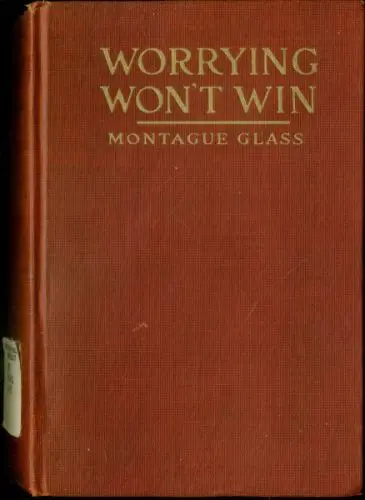
Worrying Won’t Win
Montague Glass
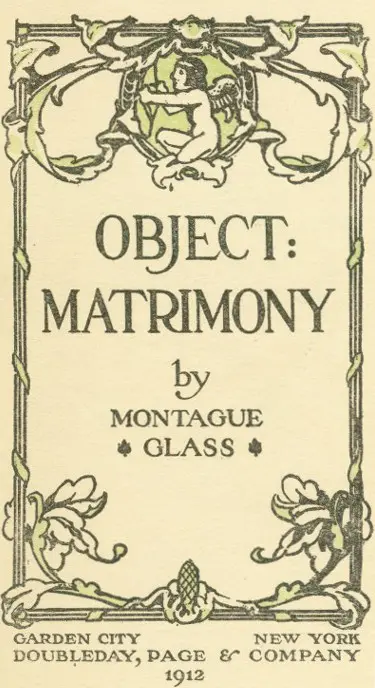
THE CLASSIC COLLECTION · 1909
"Object: matrimony" by Montague Glass is a comedic novel written in the early 20th century. The book delves into the themes of love and marriage, weaving a narrative centered around the misadventures and follies that arise in the pursuit of romantic relationships. Through the lens of its characters, it explores societal expectations and the humorous complexities surrounding the institution of marriage. The story revolves around Philip Margolius, a salesman in the cloak and suit trade who finds himself entangled in various romantic predicaments primarily involving the Goldblatt family. Initially facing foreclosure of his properties, Philip's financial woes intersect with his romantic aspirations when he attempts to help his love interest, Birdie Goldblatt, by also seeking a suitor for her less attractive sister, Fannie. Throughout his endeavors, viewers witness comic scenarios involving awkward encounters, misguided introductions, and the eccentricities of the characters, culminating in an unexpected marriage that complicates matters further. Ultimately, the book captures the chaos and delight that come with love and commitment, painting a humorous picture of matrimony in the context of early 20th-century life.
Introduction adapted from the source catalogue; source summaries may be automatically generated.
Free to read · English · 7,918 words · No account needed
MAKE TIME FOR A GOOD BOOK
On by default. Untick to stop anonymous reading totals. Each page counts after 10 seconds in view. How this works.
Anonymous counting is on unless you have switched it off.
Levy was as good as his word, for that very afternoon he filed a notice of pendency of action against the Heidenfeld Avenue property, and the next morning, as Philip left his house, a clerk from Levy's office served him with four copies of the summons and complaint in the foreclosure suit of Goldblatt vs. Margolius, actions numbers 1, 2, 3 and 4. But Philip stuffed them into his pocket unread; he had other and more poignant woes than foreclosure suits. Only ten days wed, and he was denied even the sight of his wife longer than five minutes; for she was not endangering future prospects in favour of present happiness.
"We could, anyway, get the furniture out of him," she argued when she saw Philip that day, "and, maybe, a couple of thousand dollars."
"I don't care a pinch of snuff for his furniture," Philip cried. "I will buy the furniture myself."
"But I can't leave Fannie just now," she declared; "she's all broke up
about that feller."
"What about me?" Philip protested. "Ain't I broke up, too?"
"So long you waited, you could wait a little longer yet," she replied; "but poor Fannie, you got no idea how that girl takes on."
"She shouldn't worry," Philip cried. "I promised I would fix her up, and
I will fix her up."
Daily the same scene was enacted at the Goldblatt residence on One Hundred and Eighteenth Street, and daily Birdie refused to forsake her sister, until six weeks had elapsed.
"But, Birdie," Philip announced for the hundredth time, "so sure as you stand there I couldn't keep this up no longer. I will either go crazy or either I will jump in the river."
Birdie patted him on the back.
"Don't think about it," she said. "Take your mind off it. To-day your property gets sold and Popper says he will be down at the salesroom at twelve o'clock."
"Let 'em sell it," Philip cried; "I don't care."
He turned away after a hurried embrace, and was proceeding down Lenox Avenue toward the subway when Marks Henochstein, the real-estate broker, encountered him. Marks clutched him by the shoulder.
"Well, Philip," Henochstein cried, "you are in luck at last."
"In luck!" Philip exclaimed bitterly. "A dawg shouldn't have the luck
what I got it."
"Well, if you don't call it lucky," Henochstein continued, "what would
you call it lucky?"
"Excuse me, Henochstein," said Philip; "I ain't good at guessing
puzzles. What am I lucky for?"
"Why, ain't you heard it yet?"
"I ain't heard nothing," Philip replied. "Do me the favour and don't
keep me on suspension."
Your reading position is saved on this browser. Take it to another device with a library code. Reading pages adapt to text, rather than matching a printed edition.
Montague Glass
Montague Glass

Montague Glass
Montague Glass
BEHIND THE BOOK
This eBook is for the use of anyone anywhere in the United States and most other parts of the world at no cost and with almost no restrictions whatsoever. You may copy it, give it away or re-use it under the terms of the Project Gutenberg License included with this eBook or online at www.gutenberg.org. If you are not located in the United States, you will have to check the laws of the country where you are located before using this eBook. Read the source licence.
The original source file, including credits and licence, is retained by this library. Request an original-format copy at no charge. Please include the book title and Project Gutenberg identifier #37360.
KEEP YOUR CURIOSITY GOING
Coulson Kernahan

Maurice Baring
Frances Wright
Cécile Tormay

Frederic Jesup Stimson

W. H. P. (William Henry Pope) Jarvis