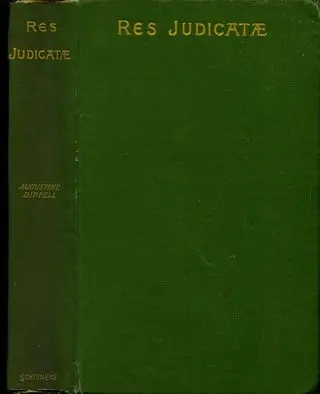
Res Judicatæ: Papers and Essays
Augustine Birrell
THE CLASSIC COLLECTION · 1884
"Obiter Dicta" by Augustine Birrell is a collection of essays written during the late 19th century. The work explores various literary and philosophical themes, offering critiques and insights on notable figures, particularly focusing on the life and writings of Thomas Carlyle, among others. Through these essays, Birrell provides an intriguing examination of the interplay between literature, criticism, and the human experience. The opening portion of "Obiter Dicta" sets the stage for Birrell's reflections by introducing the concept of an "obiter dictum," a legal term that signifies an incidental remark not binding to law. Birrell uses this as a metaphor to illustrate his own commentary on literature and culture. He begins by addressing Thomas Carlyle, discussing his reputation as a prolific writer and critic. Birrell highlights the complexities of Carlyle's character and literary output, critiquing the notion that Carlyle was merely eccentric. Instead, he frames Carlyle as a significant literary figure whose work merits serious consideration and analysis, thus establishing the tone for the essays that will follow.
Introduction adapted from the source catalogue; source summaries may be automatically generated.
Free to read · English · 34,124 words · No account needed
MAKE TIME FOR A GOOD BOOK
On by default. Untick to stop anonymous reading totals. Each page counts after 10 seconds in view. How this works.
Anonymous counting is on unless you have switched it off.
This same transcendental way of looking at things is very noticeable in the following view of Biography: 'For, as the highest gospel was a Biography, so is the life of every good man still an indubitable gospel, and preaches to the eye and heart and whole man, so that devils even must believe and tremble, these gladdest tidings. Man is heaven-born--not the thrall of circumstances, of necessity, but the victorious subduer thereof.' These, then, being his views, what are we to say of his works? His three principal historical works are, as everyone knows, 'Cromwell,' 'The French Revolution,' and 'Frederick the Great,' though there is a very considerable amount of other historical writing scattered up and down his works. But what are we to say of these three? Is he, by virtue of them, entitled to the rank and influence of a great historian? What have we a right to demand of an historian? First, surely, stern veracity, which implies not merely knowledge but honesty. An historian stands in a fiduciary position towards his readers, and if he withholds from them important facts likely to influence their judgment, he is guilty of fraud, and, when justice is done in this world, will be condemned to refund all moneys he has made by his false professions, with compound interest. This sort of fraud is unknown to the law, but to nobody else. 'Let me know the facts!' may well be the agonized cry of the student who finds himself floating down what Arnold has called 'the vast Mississippi of falsehood, History.' Secondly comes a catholic temper and way of looking at things. The historian should be a gentleman and possess a moral breadth of temperament. There should be no bitter protesting spirit about him. He should remember the world he has taken upon himself to write about is a large place, and that nobody set him up over us. Thirdly, he must be a born story-teller. If he is not this, he has mistaken his vocation. He may be a great philosopher, a useful editor, a profound scholar, and anything else his friends like to call him, except a great historian. How does Carlyle meet these requirements? His veracity, that is, his laborious accuracy, is admitted by the only persons competent to form an opinion, namely, independent investigators who have followed in his track; but what may be called the internal evidence of the case also supplies a strong proof of it. Carlyle was, as everyone knows, a hero-worshipper. It is part of his mysticism. With him man, as well as God, is a spirit, either of good or evil, and as such should be either worshipped or reviled. He is never himself till he has discovered or invented a hero; and, when he has got him, he tosses and dandles him as a mother her babe. This is a terrible temptation to put in the way of an historian, and few there be who are found able to resist it. How easy to keep back an ugly fact, sure to be a stumbling-block in the way of weak brethren! Carlyle is above suspicion in this respect. He knows no reticence. Nothing restrains him; not even the so-called proprieties of history. He may, after his boisterous fashion, pour scorn upon you for looking grave, as you read in his vivid pages of the reckless manner in which too many of his heroes drove coaches-and-six through the Ten Commandments. As likely as not he will call you a blockhead, and tell you to close your wide mouth and cease shrieking. But, dear me! hard words break no bones, and it is an amazing comfort to know the facts. Is he writing of Cromwell?--down goes everything--letters, speeches, as they were written, as they were delivered. Few great men are edited after this fashion. Were they to be so--Luther, for example--many eyes would be opened very wide. Nor does Carlyle fail in comment. If the Protector makes a somewhat distant allusion to the Barbadoes, Carlyle is at your elbow to tell you it means his selling people to work as slaves in the West Indies. As for Mirabeau, 'our wild Gabriel Honoré,' well! we are told all about him; nor is Frederick let off a single absurdity or atrocity. But when we have admitted the veracity, what are we to say of the catholic temper, the breadth of temperament, the wide Shakespearian tolerance? Carlyle ought to have them all. By nature he was tolerant enough; so true a humourist could never be a bigot. When his war-paint is not on, a child might lead him. His judgments are gracious, chivalrous, tinged with a kindly melancholy and divine pity. But this mood is never for long. Some gadfly stings him: he seizes his tomahawk and is off on the trail. It must sorrowfully be admitted that a long life of opposition and indigestion, of fierce warfare with cooks and Philistines, spoilt his temper, never of the best, and made him too often contemptuous, savage, unjust. His language then becomes unreasonable, unbearable, bad. Literature takes care of herself. You disobey her rules: well and good, she shuts her door in your face; you plead your genius: she replies, 'Your temper,' and bolts it. Carlyle has deliberately destroyed, by his own wilfulness, the value of a great deal he has written. It can never become classical. Alas! that this should be true of too many eminent Englishmen of our time. Language such as was, at one time, almost habitual with Mr. Ruskin, is a national humiliation, giving point to the Frenchman's sneer as to our distinguishing literary characteristic being 'la brutalité.' In Carlyle's case much must be allowed for his rhetoric and humour. In slang phrase, he always 'piles it on.' Does a bookseller misdirect a parcel, he exclaims, 'My malison on all Blockheadisms and Torpid Infidelities of which this world is full.' Still, all allowances made, it is a thousand pities; and one's thoughts turn away from this stormy old man and take refuge in the quiet haven of the Oratory at Birmingham, with his great Protagonist, who, throughout an equally long life spent in painful controversy, and wielding weapons as terrible as Carlyle's own, has rarely forgotten to be urbane, and whose every sentence is a 'thing of beauty.' It must, then, be owned that too many of Carlyle's literary achievements 'lack a gracious somewhat.' By force of his genius he 'smites the rock and spreads the water;' but then, like Moses, 'he desecrates, belike, the deed in doing.'
Your reading position is saved on this browser. Take it to another device with a library code. Reading pages adapt to text, rather than matching a printed edition.
Augustine Birrell
Augustine Birrell
Augustine Birrell
Augustine Birrell
BEHIND THE BOOK
This eBook is for the use of anyone anywhere in the United States and most other parts of the world at no cost and with almost no restrictions whatsoever. You may copy it, give it away or re-use it under the terms of the Project Gutenberg License included with this eBook or online at www.gutenberg.org. If you are not located in the United States, you will have to check the laws of the country where you are located before using this eBook. Read the source licence.
The original source file, including credits and licence, is retained by this library. Request an original-format copy at no charge. Please include the book title and Project Gutenberg identifier #7299.
KEEP YOUR CURIOSITY GOING

David Patterson (Spirit) Hatch

David Patterson (Spirit) Hatch

David Patterson (Spirit) Hatch
Cécile Tormay

Moritz Busch
John L. Ransom