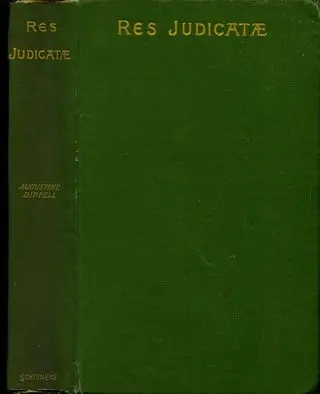
Res Judicatæ: Papers and Essays
Augustine Birrell
THE CLASSIC COLLECTION · 1884
"Obiter Dicta" by Augustine Birrell is a collection of essays written during the late 19th century. The work explores various literary and philosophical themes, offering critiques and insights on notable figures, particularly focusing on the life and writings of Thomas Carlyle, among others. Through these essays, Birrell provides an intriguing examination of the interplay between literature, criticism, and the human experience. The opening portion of "Obiter Dicta" sets the stage for Birrell's reflections by introducing the concept of an "obiter dictum," a legal term that signifies an incidental remark not binding to law. Birrell uses this as a metaphor to illustrate his own commentary on literature and culture. He begins by addressing Thomas Carlyle, discussing his reputation as a prolific writer and critic. Birrell highlights the complexities of Carlyle's character and literary output, critiquing the notion that Carlyle was merely eccentric. Instead, he frames Carlyle as a significant literary figure whose work merits serious consideration and analysis, thus establishing the tone for the essays that will follow.
Introduction adapted from the source catalogue; source summaries may be automatically generated.
Free to read · English · 34,124 words · No account needed
MAKE TIME FOR A GOOD BOOK
On by default. Untick to stop anonymous reading totals. Each page counts after 10 seconds in view. How this works.
Anonymous counting is on unless you have switched it off.
'This world has been harsh and strange,
Something is wrong: there needeth a change.
But what or where? at the last or first?
In one point only we sinned at worst.
'The Lord will have mercy on Jacob yet,
And again in his border see Israel set.
When Judah beholds Jerusalem,
The stranger seed shall be joined to them:
To Jacob's house shall the Gentiles cleave:
So the prophet saith, and his sons believe.
'Ay, the children of the chosen race
Shall carry and bring them to their place;
In the land of the Lord shall lead the same,
Bondsmen and handmaids. Who shall blame
When the slaves enslave, the oppressed ones o'er
The oppressor triumph for evermore?
'God spoke, and gave us the word to keep:
Bade never fold the hands, nor sleep
'Mid a faithless world, at watch and ward,
Till the Christ at the end relieve our guard.
By His servant Moses the watch was set:
Though near upon cockcrow, we keep it yet.
'Thou! if Thou wast He, who at mid-watch came,
By the starlight naming a dubious Name;
And if we were too heavy with sleep, too rash
With fear--O Thou, if that martyr-gash
Fell on Thee, coming to take Thine own,
And we gave the Cross, when we owed the throne;
'Thou art the Judge. We are bruised thus. But, the Judgment over, join sides with us! Thine, too, is the cause! and not more Thine Than ours is the work of these dogs and swine, Whose life laughs through and spits at their creed, Who maintain Thee in word, and defy Thee in deed.
'We withstood Christ then? Be mindful how
At least we withstand Barabbas now!
Was our outrage sore? But the worst we spared,
To have called these--Christians--had we dared!
Let defiance to them pay mistrust of Thee,
And Rome make amends for Calvary!
'By the torture, prolonged from age to age;
By the infamy, Israel's heritage;
By the Ghetto's plague, by the garb's disgrace,
By the badge of shame, by the felon's place,
By the branding-tool, the bloody whip,
And the summons to Christian fellowship,
'We boast our proof, that at least the Jew
Would wrest Christ's name from the devil's crew.'
The last quotation shall be from the veritable Browning--of one of those poetical audacities none ever dared but the Danton of modern poetry. Audacious in its familiar realism, in its total disregard of poetical environment, in its rugged abruptness: but supremely successful, and alive with emotion:
'What is he buzzing in my ears?
Now that I come to die,
Do I view the world as a vale of tears?
Ah, reverend sir, not I.
Your reading position is saved on this browser. Take it to another device with a library code. Reading pages adapt to text, rather than matching a printed edition.
Augustine Birrell
Augustine Birrell
Augustine Birrell
Augustine Birrell
BEHIND THE BOOK
This eBook is for the use of anyone anywhere in the United States and most other parts of the world at no cost and with almost no restrictions whatsoever. You may copy it, give it away or re-use it under the terms of the Project Gutenberg License included with this eBook or online at www.gutenberg.org. If you are not located in the United States, you will have to check the laws of the country where you are located before using this eBook. Read the source licence.
The original source file, including credits and licence, is retained by this library. Request an original-format copy at no charge. Please include the book title and Project Gutenberg identifier #7299.
KEEP YOUR CURIOSITY GOING

David Patterson (Spirit) Hatch

David Patterson (Spirit) Hatch

David Patterson (Spirit) Hatch
Cécile Tormay

Moritz Busch
John L. Ransom