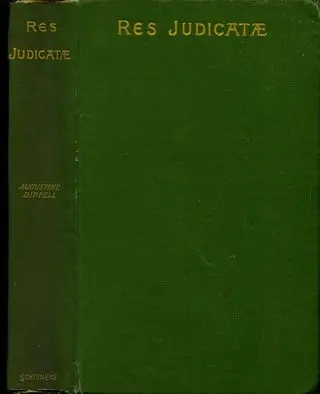
Res Judicatæ: Papers and Essays
Augustine Birrell
THE CLASSIC COLLECTION · 1884
"Obiter Dicta: Second Series" by Augustine Birrell is a collection of essays written in the late 19th century. This work reflects on literary topics, with an emphasis on the joys of literature and the lives of notable authors, particularly focusing on John Milton in the opening portion. The essays delve into the appreciation of literature's ability to evoke nostalgia and provoke thoughtful reflection, appealing to readers seeking enjoyment and contemplation amid their busy lives. The opening of this volume includes Birrell's preface, where he expresses a desire to offer readers reminders of their literary past while suggesting that the life and works of John Milton serve as an excellent subject. He reflects on Milton's character, examining his life choices and achievements, along with a mix of critiques and praises that the poet received during his lifetime. Birrell discusses Milton’s literary education, his aspirations to become a great poet, his notable works, and even his interactions with the political landscape of his time. This initial exploration sets a tone of admiration blended with a candid acknowledgment of Milton's complexities, managing to enthrall both literary enthusiasts and casual readers alike.
Introduction adapted from the source catalogue; source summaries may be automatically generated.
Free to read · English · 54,588 words · No account needed
MAKE TIME FOR A GOOD BOOK
On by default. Untick to stop anonymous reading totals. Each page counts after 10 seconds in view. How this works.
Anonymous counting is on unless you have switched it off.
This pamphlet on divorce marks the beginning of Milton's mental isolation. Nobody had a word to say for it. Episcopalian, Presbyterian, and Independent held his doctrine in as much abhorrence as did the Catholic, and all alike regarded its author as either an impracticable dreamer or worse. It was written certainly in too great haste, for his errant wife, actuated by what motives cannot now be said, returned to her allegiance, was mindful of her plighted troth, and, suddenly entering his room, fell at his feet and begged to be forgiven. She was only nineteen, and she said it was all her mother's fault. Milton was not a sour man, and though perhaps too apt to insist upon repentance preceding forgiveness, yet when it did so he could forgive divinely. In a very short time the whole family of Powells, whom the war had reduced to low estate, were living under his roof in the Barbican, whither he moved on the Aldersgate house proving too small for his varied belongings. The poet's father also lived with his son.
Mrs. Milton had four children, three of whom, all daughters, lived to grow up. The mother died in childbirth in 1652, being then twenty-six years of age.
The Areopagitica, a Speech for Unlicensed Printing, followed the divorce pamphlet, but it also fell upon deaf ears. Of all religious sects the Presbyterians, who were then dominant, are perhaps the least likely to forego the privilege of interference in the affairs of others. Instead of the Archbishop of Canterbury and the Bishop of London, instead of 'a lordly Imprimatur, one from Lambeth House, another from the west end of Paul's,' there was appointed a commission of twenty Presbyterians to act as State Licensers. Then was Milton's soul stirred within him to a noble rage. His was a threefold protest--as a citizen of a State he fondly hoped had been free, as an author, and as a reader. As a citizen he protested against so unnecessary and improper an interference. It is not, he cried, 'the unfrocking of a priest, the unmitring of a bishop, that will make us a happy nation,' but the practice of virtue, and virtue means freedom to choose. Milton was a manly politician, and detested with his whole soul grandmotherly legislation. 'He who is not trusted with his own actions, his drift not being known to be evil, and standing to the hazard of law and penalty, has no great argument to think himself reputed in the commonwealth wherein he was born, for other than a fool or a foreigner.' 'They are not skilful considerers of human things who imagine to remove sin by removing the matter of sin.' 'And were I the chooser, a dram of well-doing should be preferred before many times as much the forcible hindrance of evil doing.' These are texts upon which sermons, not inapplicable to our own day, might be preached. Milton has made our first parent so peculiarly his own, that any observations of his about Adam are interesting. 'Many there be that complain of Divine Providence for suffering Adam to transgress. Foolish tongues! When God gave him reason He gave him freedom to choose, for reason is but choosing; he had been else a mere artificial Adam. We ourselves esteem not of that obedience a love or gift which is of force. God therefore left him free, set before him a provoking object ever almost in his eyes; herein consisted his merit, herein the right of his reward, the praise of his abstinence.' So that according to Milton even Eden was a state of trial. As an author, Milton's protest has great force. 'And what if the author shall be one so copious of fancy as to have many things well worth the adding come into his mind after licensing, while the book is yet under the press, which not seldom happens to the best and diligentest writers, and that perhaps a dozen times in one book? The printer dares not go beyond his licensed copy. So often then must the author trudge to his leave-giver that those his new insertions may be viewed, and many a jaunt will be made ere that licenser--for it must be the same man--can either be found, or found at leisure; meanwhile either the press must stand still, which is no small damage, or the author lose his accuratest thoughts, and send forth the book worse than he made it, which to a diligent writer is the greatest melancholy and vexation that can befall.'
Your reading position is saved on this browser. Take it to another device with a library code. Reading pages adapt to text, rather than matching a printed edition.
Augustine Birrell
Augustine Birrell
Augustine Birrell
Augustine Birrell
BEHIND THE BOOK
This eBook is for the use of anyone anywhere in the United States and most other parts of the world at no cost and with almost no restrictions whatsoever. You may copy it, give it away or re-use it under the terms of the Project Gutenberg License included with this eBook or online at www.gutenberg.org. If you are not located in the United States, you will have to check the laws of the country where you are located before using this eBook. Read the source licence.
The original source file, including credits and licence, is retained by this library. Request an original-format copy at no charge. Please include the book title and Project Gutenberg identifier #21793.
KEEP YOUR CURIOSITY GOING

David Patterson (Spirit) Hatch

David Patterson (Spirit) Hatch

David Patterson (Spirit) Hatch
Cécile Tormay

Moritz Busch
John L. Ransom