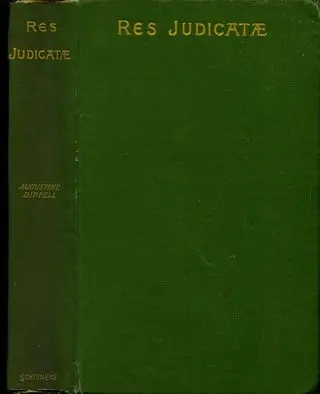
Res Judicatæ: Papers and Essays
Augustine Birrell
THE CLASSIC COLLECTION · 1884
"Obiter Dicta: Second Series" by Augustine Birrell is a collection of essays written in the late 19th century. This work reflects on literary topics, with an emphasis on the joys of literature and the lives of notable authors, particularly focusing on John Milton in the opening portion. The essays delve into the appreciation of literature's ability to evoke nostalgia and provoke thoughtful reflection, appealing to readers seeking enjoyment and contemplation amid their busy lives. The opening of this volume includes Birrell's preface, where he expresses a desire to offer readers reminders of their literary past while suggesting that the life and works of John Milton serve as an excellent subject. He reflects on Milton's character, examining his life choices and achievements, along with a mix of critiques and praises that the poet received during his lifetime. Birrell discusses Milton’s literary education, his aspirations to become a great poet, his notable works, and even his interactions with the political landscape of his time. This initial exploration sets a tone of admiration blended with a candid acknowledgment of Milton's complexities, managing to enthrall both literary enthusiasts and casual readers alike.
Introduction adapted from the source catalogue; source summaries may be automatically generated.
Free to read · English · 54,588 words · No account needed
MAKE TIME FOR A GOOD BOOK
On by default. Untick to stop anonymous reading totals. Each page counts after 10 seconds in view. How this works.
Anonymous counting is on unless you have switched it off.
But fortunately for us, Burke was not content with private adjuration, or even public speech. His literary instincts, his dominating desire to persuade everybody that he, Edmund Burke, was absolutely in the right, and every one of his opponents hopelessly wrong, made him turn to the pamphlet as a propaganda, and in his hands
'The thing became a trumpet, whence he blew
Soul-animating strains.'
So accustomed are we to regard Burke's pamphlets as specimens of our noblest literature, and to see them printed in comfortable volumes, that we are apt to forget that in their origin they were but the children of the pavement, the publications of the hour. If, however, you ever visit any old public library, and grope about a little, you are likely enough to find a shelf holding some twenty-five or thirty musty, ugly little books, usually lettered 'Burke,' and on opening any of them you will come across one of Burke's pamphlets as originally issued, bound up with the replies and counter-pamphlets it occasioned. I have frequently tried, but always in vain, to read these replies, which are pretentious enough--usually the works of deans, members of Parliament, and other dignitaries of the class Carlyle used compendiously to describe as 'shovel-hatted'--and each of whom was as much entitled to publish pamphlets as Burke himself. There are some things it is very easy to do, and to write a pamphlet is one of them; but to write such a pamphlet as future generations will read with delight is perhaps the most difficult feat in literature. Milton, Swift, Burke, and Sydney Smith are, I think, our only great pamphleteers.
I have now rather more than kept my word so far as Burke's pre-parliamentary life is concerned, and will proceed to mention some of the circumstances that may serve to account for the fact that, when the Rockingham party came into power for the second time in 1782, Burke, who was their life and soul, was only rewarded with a minor office. First, then, it must be recorded sorrowfully of Burke that he was always desperately in debt, and in this country no politician under the rank of a baronet can ever safely be in debt. Burke's finances are, and always have been, marvels and mysteries; but one thing must be said of them--that the malignity of his enemies, both Tory enemies and Radical enemies, has never succeeded in formulating any charge of dishonesty against him that has not been at once completely pulverized, and shown on the facts to be impossible. {159} Burke's purchase of the estate at Beaconsfield in 1768, only two years after he entered Parliament, consisting as it did of a good house and 1,600 acres of land, has puzzled a great many good men--much more than it ever did Edmund Burke. But how did he get the money? After an Irish fashion--by not getting it at all. Two-thirds of the purchase-money remained on mortgage, and the balance he borrowed; or, as he puts it, 'With all I could collect of my own, and by the aid of my friends, I have established a root in the country.' That is how Burke bought Beaconsfield, where he lived till his end came; whither he always hastened when his sensitive mind was tortured by the thought of how badly men governed the world; where he entertained all sorts and conditions of men--Quakers, Brahmins (for whose ancient rites he provided suitable accommodation in a greenhouse), nobles and abbes flying from revolutionary France, poets, painters, and peers; no one of whom ever long remained a stranger to his charm. Burke flung himself into farming with all the enthusiasm of his nature. His letters to Arthur Young on the subject of carrots still tremble with emotion. You all know Burke's Thoughts on the Present Discontents. You remember--it is hard to forget--his speech on Conciliation with America, particularly the magnificent passage beginning, 'Magnanimity in politics is not seldom the truest wisdom, and a great empire and little minds go ill together.' You have echoed back the words in which, in his letter to the Sheriffs of Bristol on the hateful American War, he protests that it was not instantly he could be brought to rejoice when he heard of the slaughter and captivity of long lists of those whose names had been familiar in his ears from his infancy, and you would all join with me in subscribing to a fund which should have for its object the printing and hanging up over every editor's desk in town and country a subsequent passage from the same letter:
Your reading position is saved on this browser. Take it to another device with a library code. Reading pages adapt to text, rather than matching a printed edition.
Augustine Birrell
Augustine Birrell
Augustine Birrell
Augustine Birrell
BEHIND THE BOOK
This eBook is for the use of anyone anywhere in the United States and most other parts of the world at no cost and with almost no restrictions whatsoever. You may copy it, give it away or re-use it under the terms of the Project Gutenberg License included with this eBook or online at www.gutenberg.org. If you are not located in the United States, you will have to check the laws of the country where you are located before using this eBook. Read the source licence.
The original source file, including credits and licence, is retained by this library. Request an original-format copy at no charge. Please include the book title and Project Gutenberg identifier #21793.
KEEP YOUR CURIOSITY GOING

David Patterson (Spirit) Hatch

David Patterson (Spirit) Hatch

David Patterson (Spirit) Hatch
Cécile Tormay

Moritz Busch
John L. Ransom