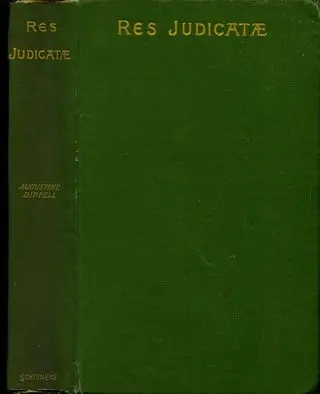
Res Judicatæ: Papers and Essays
Augustine Birrell
THE CLASSIC COLLECTION · 1884
"Obiter Dicta: Second Series" by Augustine Birrell is a collection of essays written in the late 19th century. This work reflects on literary topics, with an emphasis on the joys of literature and the lives of notable authors, particularly focusing on John Milton in the opening portion. The essays delve into the appreciation of literature's ability to evoke nostalgia and provoke thoughtful reflection, appealing to readers seeking enjoyment and contemplation amid their busy lives. The opening of this volume includes Birrell's preface, where he expresses a desire to offer readers reminders of their literary past while suggesting that the life and works of John Milton serve as an excellent subject. He reflects on Milton's character, examining his life choices and achievements, along with a mix of critiques and praises that the poet received during his lifetime. Birrell discusses Milton’s literary education, his aspirations to become a great poet, his notable works, and even his interactions with the political landscape of his time. This initial exploration sets a tone of admiration blended with a candid acknowledgment of Milton's complexities, managing to enthrall both literary enthusiasts and casual readers alike.
Introduction adapted from the source catalogue; source summaries may be automatically generated.
Free to read · English · 54,588 words · No account needed
MAKE TIME FOR A GOOD BOOK
On by default. Untick to stop anonymous reading totals. Each page counts after 10 seconds in view. How this works.
Anonymous counting is on unless you have switched it off.
The attorney in Dublin grew anxious, and searched for precedents of a son behaving like his, and rising to eminence. Had his son got the legal mind?--which, according to a keen observer, chiefly displays itself by illustrating the obvious, explaining the evident, and expatiating on the commonplace. Edmund's powers of illustration, explanation, and expatiation could not indeed be questioned; but then the subjects selected for the exhibition of those powers were very far indeed from being obvious, evident, or commonplace, and the attorney's heart grew heavy within him. The paternal displeasure was signified in the usual manner--the supplies were cut off. Edmund Burke, however, was no ordinary prodigal, and his reply to his father's expostulations took the unexpected and unprecedented shape of a copy of a second and enlarged edition of his treatise on the Sublime and Beautiful, which he had published in 1756 at the price of three shillings. Burke's father promptly sent the author a bank-bill for 100 pounds--conduct on his part which, considering he had sent his son to London and maintained him there for six years to study law, was, in my judgment, both sublime and beautiful. In the same year Burke published another pamphlet--a one-and- sixpenny affair--written ironically in the style of Lord Bolingbroke, and called A Vindication of Natural Society; or, A View of the Miseries and Evils arising to Mankind from Every Species of Civil Society. Irony is a dangerous weapon for a public man to have ever employed, and in after-life Burke had frequently to explain that he was not serious. On these two pamphlets' airy pinions Burke floated into the harbour of literary fame. No less a man than the great David Hume referred to him, in a letter to the hardly less great Adam Smith, as an Irish gentleman who had written a 'very pretty treatise on the Sublime.' After these efforts Burke, as became an established wit, went to Bath to recruit, and there, fitly enough, fell in love. The lady was Miss Jane Mary Nugent, the daughter of a celebrated Bath physician, and it is pleasant to be able to say of the marriage that was shortly solemnized between the young couple, that it was a happy one, and then to go on our way, leaving them--where man and wife ought to be left--alone. Oddly enough, Burke's wife was also the offspring of a 'mixed marriage'--only in her case it was the father who was the Catholic; consequently both Mr. and Mrs. Edmund Burke were of the same way of thinking, but each had a parent of the other way. Although getting married is no part of the curriculum of a law student, Burke's father seems to have come to the conclusion that after all it was a greater distinction for an attorney in Dublin to have a son living amongst the wits in London, and discoursing familiarly on the 'Sublime and Beautiful,' than one prosecuting some poor countryman, with a brogue as rich as his own, for stealing a pair of breeches; for we find him generously allowing the young couple 200 pounds a year, which no doubt went some way towards maintaining them. Burke, who was now in his twenty-eighth year, seems to have given up all notion of the law. In 1758 he wrote for Dodsley the first volume of the Annual Register, a melancholy series which continues to this day. For doing this he got 100 pounds. Burke was by this time a well-known figure in London literary society, and was busy making for himself a huge private reputation. The Christmas Day of 1758 witnessed a singular scene at the dinner table of David Garrick. Dr. Johnson, then in full vigour of his mind, and with the all-dreaded weapons of his dialectics kept burnished by daily use, was flatly contradicted by a fellow-guest some twenty years his junior, and, what is more, submitted to it without a murmur. One of the diners, Arthur Murphy, was so struck by this occurrence, unique in his long experience of the Doctor, that on returning home he recorded the fact in his journal, but ventured no explanation of it. It can only be accounted for--so at least I venture to think--by the combined effect of four wholly independent circumstances: First, the day was Christmas Day, a day of peace and goodwill, and our beloved Doctor was amongst the sincerest, though most argumentative, of Christians, and a great observer of days. Second, the house was David Garrick's, and consequently we may be certain that the dinner had been a superlatively good one; and has not Boswell placed on record Johnson's opinion of the man who professed to be indifferent about his dinner? Third, the subject under discussion was India, about which Johnson knew he knew next to nothing. And fourth, the offender was Edmund Burke, whom Johnson loved from the first day he set eyes upon him to their last sad parting by the waters of death.
Your reading position is saved on this browser. Take it to another device with a library code. Reading pages adapt to text, rather than matching a printed edition.
Augustine Birrell
Augustine Birrell
Augustine Birrell
Augustine Birrell
BEHIND THE BOOK
This eBook is for the use of anyone anywhere in the United States and most other parts of the world at no cost and with almost no restrictions whatsoever. You may copy it, give it away or re-use it under the terms of the Project Gutenberg License included with this eBook or online at www.gutenberg.org. If you are not located in the United States, you will have to check the laws of the country where you are located before using this eBook. Read the source licence.
The original source file, including credits and licence, is retained by this library. Request an original-format copy at no charge. Please include the book title and Project Gutenberg identifier #21793.
KEEP YOUR CURIOSITY GOING

David Patterson (Spirit) Hatch

David Patterson (Spirit) Hatch

David Patterson (Spirit) Hatch
Cécile Tormay

Moritz Busch
John L. Ransom