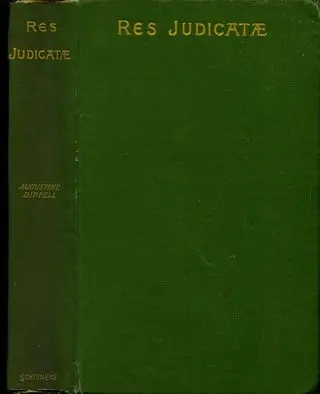
Res Judicatæ: Papers and Essays
Augustine Birrell
THE CLASSIC COLLECTION · 1884
"Obiter Dicta: Second Series" by Augustine Birrell is a collection of essays written in the late 19th century. This work reflects on literary topics, with an emphasis on the joys of literature and the lives of notable authors, particularly focusing on John Milton in the opening portion. The essays delve into the appreciation of literature's ability to evoke nostalgia and provoke thoughtful reflection, appealing to readers seeking enjoyment and contemplation amid their busy lives. The opening of this volume includes Birrell's preface, where he expresses a desire to offer readers reminders of their literary past while suggesting that the life and works of John Milton serve as an excellent subject. He reflects on Milton's character, examining his life choices and achievements, along with a mix of critiques and praises that the poet received during his lifetime. Birrell discusses Milton’s literary education, his aspirations to become a great poet, his notable works, and even his interactions with the political landscape of his time. This initial exploration sets a tone of admiration blended with a candid acknowledgment of Milton's complexities, managing to enthrall both literary enthusiasts and casual readers alike.
Introduction adapted from the source catalogue; source summaries may be automatically generated.
Free to read · English · 54,588 words · No account needed
MAKE TIME FOR A GOOD BOOK
On by default. Untick to stop anonymous reading totals. Each page counts after 10 seconds in view. How this works.
Anonymous counting is on unless you have switched it off.
Here surely is proof of an aesthetic nature beyond most of our modern raptures; but none the less, and at the very same time, Rome was for Milton the 'grim wolf' who, 'with privy paw, daily devours apace.' It is with a sigh of sad sincerity that Dr. Newman admits that Milton breathes through his pages a hatred of the Catholic Church, and consequently the Cardinal feels free to call him a proud and rebellious creature of God. That Milton was both proud and rebellious cannot be disputed. Nonconformists need not claim him for their own with much eagerness. What he thought of Presbyterians we know, and he was never a church member, or indeed a church-goer. Dr. Newman has admitted that the poet Pope was an unsatisfactory Catholic; Milton was certainly an unsatisfactory Dissenter. Let us be candid in these matters. Milton was therefore bidden by his friends, and by those with whom he took counsel, to hold his peace whilst in Rome about the 'grim wolf,' and he promised to do so, adding, however, the Miltonic proviso that this was on condition that the Papists did not attack his religion first. 'If anyone,' he wrote, 'in the very city of the Pope attacked the orthodox religion, I defended it most freely.' To call the Protestant religion, which had not yet attained to its second century, the orthodox religion under the shadow of the Vatican was to have the courage of his opinions. But Milton was not a man to be frightened of schism. That his religious opinions should be peculiar probably seemed to him to be almost inevitable, and not unbecoming. He would have agreed with Emerson, who declares that would man be great he must be a Nonconformist.
There is something very fascinating in the records we have of Milton's one visit to the Continent. A more impressive Englishman never left our shores. Sir Philip Sidney perhaps approaches him nearest. Beautiful beyond praise, and just sufficiently conscious of it to be careful never to appear at a disadvantage, dignified in manners, versed in foreign tongues, yet full of the ancient learning--a gentleman, a scholar, a poet, a musician, and a Christian--he moved about in a leisurely manner from city to city, writing Latin verses for his hosts and Italian sonnets in their ladies' albums, buying books and music, and creating, one cannot doubt, an all too flattering impression of an English Protestant. To travel in Italy with Montaigne or Milton, or Evelyn or Gray, or Shelley, or, pathetic as it is, with the dying Sir Walter, is perhaps more instructive than to go there for yourself with a tourist's ticket. Old Montaigne, who was but forty-seven when he made his journey, and whom therefore I would not call old had not Pope done so before me, is the most delightful of travelling companions, and as easy as an old shoe. A humaner man than Milton, a wiser man than Evelyn--with none of the constraint of Gray, or the strange, though fascinating, outlandishness of Shelley--he perhaps was more akin to Scott than any of the other travellers; but Scott went to Italy an overwhelmed man, whose only fear was he might die away from the heather and the murmur of Tweed. However, Milton is the most improving companion of them all, and amidst the impurities of Italy, 'in all the places where vice meets with so little discouragement, and is protected with so little shame,' he remained the Milton of Cambridge and Horton, and did nothing to pollute the pure temple of a poet's mind. He visited Paris, Nice, Genoa, Pisa, and Florence, staying in the last city two months, and living on terms of great intimacy with seven young Italians, whose musical names he duly records. These were the months of August and September, not nowadays reckoned safe months for Englishmen to be in Florence--modern lives being raised in price. From Florence he proceeded through Siena to Rome, where he also stayed two months. There he was present at a magnificent entertainment given by the Cardinal Francesco Barberini in his palace, and heard the singing of the celebrated Leonora Baroni. It is not for one moment to be supposed that he sought an interview with the Pope, as Montaigne had done, who was exhorted by His Holiness 'to persevere in the devotion he had ever manifested in the cause of the Church;' and yet perhaps Montaigne by his essays did more to sap the authority of Peter's chair than Milton, however willing, was able to do.
Your reading position is saved on this browser. Take it to another device with a library code. Reading pages adapt to text, rather than matching a printed edition.
Augustine Birrell
Augustine Birrell
Augustine Birrell
Augustine Birrell
BEHIND THE BOOK
This eBook is for the use of anyone anywhere in the United States and most other parts of the world at no cost and with almost no restrictions whatsoever. You may copy it, give it away or re-use it under the terms of the Project Gutenberg License included with this eBook or online at www.gutenberg.org. If you are not located in the United States, you will have to check the laws of the country where you are located before using this eBook. Read the source licence.
The original source file, including credits and licence, is retained by this library. Request an original-format copy at no charge. Please include the book title and Project Gutenberg identifier #21793.
KEEP YOUR CURIOSITY GOING

David Patterson (Spirit) Hatch

David Patterson (Spirit) Hatch

David Patterson (Spirit) Hatch
Cécile Tormay

Moritz Busch
John L. Ransom