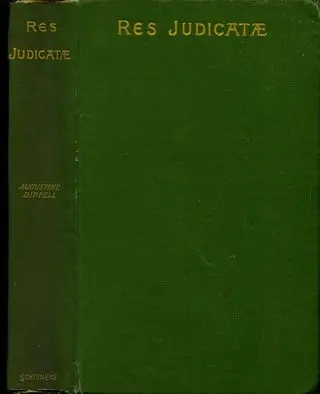
Res Judicatæ: Papers and Essays
Augustine Birrell
THE CLASSIC COLLECTION · 1884
"Obiter Dicta: Second Series" by Augustine Birrell is a collection of essays written in the late 19th century. This work reflects on literary topics, with an emphasis on the joys of literature and the lives of notable authors, particularly focusing on John Milton in the opening portion. The essays delve into the appreciation of literature's ability to evoke nostalgia and provoke thoughtful reflection, appealing to readers seeking enjoyment and contemplation amid their busy lives. The opening of this volume includes Birrell's preface, where he expresses a desire to offer readers reminders of their literary past while suggesting that the life and works of John Milton serve as an excellent subject. He reflects on Milton's character, examining his life choices and achievements, along with a mix of critiques and praises that the poet received during his lifetime. Birrell discusses Milton’s literary education, his aspirations to become a great poet, his notable works, and even his interactions with the political landscape of his time. This initial exploration sets a tone of admiration blended with a candid acknowledgment of Milton's complexities, managing to enthrall both literary enthusiasts and casual readers alike.
Introduction adapted from the source catalogue; source summaries may be automatically generated.
Free to read · English · 54,588 words · No account needed
MAKE TIME FOR A GOOD BOOK
On by default. Untick to stop anonymous reading totals. Each page counts after 10 seconds in view. How this works.
Anonymous counting is on unless you have switched it off.
Later on music was dragged into the fray. The Court was all for Handel and the Germans; the Prince of Wales and the Tory nobility affected the Italian opera. The Whigs went to the Haymarket; the Tories to the Opera House in Lincoln's Inn Field. In this latter strife Pope took small part; for, notwithstanding his Ode on St. Cecilia's Day, he hated music with an entire sincerity. He also affected to hate the drama; but some have thought this accounted for by the fact that, early in his career, he was damned for the farce of Three Hours after Marriage, which, after the fashion of our own days, he concocted with another, the co-author in this case being a wit of no less calibre than Gay, the author of The Beggars' Opera. The astonished audience bore it as best they might till the last act, when the two lovers, having first inserted themselves respectively into the skins of a mummy and a crocodile, talk at one another across the boards; then they rose in their rage, and made an end of that farce. Their yells were doubtless still in Pope's ears when, years afterwards, he wrote the fine lines--
'While all its throats the gallery extends
And all the thunder of the pit ascends,
Loud as the wolves on Orca's stormy steep
Howl to the roarings of the northern deep.'
Pope, as we have said, became a partisan, and so had his hands full of ready-made quarrels; but his period was certainly one that demanded a satirist. Perhaps most periods do; but I am content to repeat, his did. Satire like Pope's is essentially modish, and requires a restricted range. Were anyone desirous of satirizing humanity at large I should advise him to check his noble rage, and, at all events, to begin with his next-door neighbour, who is almost certain to resent it, which humanity will not do. This was Pope's method. It was a corrupt set amongst whom he moved. The gambling in the South Sea stock had been prodigious, and high and low, married and single, town and country, Protestant and Catholic, Whig and Tory, took part in it. One could gamble in that stock. The mania began in February 1720, and by the end of May the price of 100 pounds stock was up to 340 pounds. In July and August it was 950 pounds, and even touched, 1,000 pounds. In the middle of September it was down to 590 pounds, and before the end of the year it had dropped to 125 pounds. Pope himself bought stock when it stood so low as 104 pounds, but he had never the courage to sell, and consequently lost, according to his own account, half his worldly possessions. The Prime Minister, Sir Robert Walpole, also bought stock, but he sold--as did his Most Gracious Majesty the King--at 1,000 pounds. The age was also a scandalous, ill-living age, and Pope, who was a most confirmed gossip and tale-bearer, picked up all that was going. The details of every lawsuit of a personal character were at his finger-ends. Whoever starved a sister, or forged a will, or saved his candle-ends, made a fortune dishonestly, or lost one disgracefully, or was reported to do so, be he citizen or courtier, noble duke or plump alderman, Mr. Pope was sure to know all about it, and as likely as not to put it into his next satire. Living, as the poet did, within easy distance of London, he always turned up in a crisis as regularly as a porpoise in a storm, so at least writes a noble friend. This sort of thing naturally led to quarrels, and the shocking incompleteness of this lecture stands demonstrated by the fact that, though I have almost done, I have as yet said nothing abort Pope's quarrels, which is nearly as bad as writing about St. Paul and leaving out his journeys. Pope's quarrels are celebrated. His quarrel with Mr. Addison, culminating in the celebrated description, almost every line of which is now part and parcel of the English language; his quarrel with Lady Mary Wortley Montagu, whom he satirized in the most brutal lines ever written by man of woman; his quarrel with Lord Hervey; his quarrel with the celebrated Sarah, Duchess of Marlborough, ought not to be dismissed so lightly, but what can I do? From the Duchess of Marlborough Pope is said to have received a sum of money, sometimes stated at 1,000 pounds and sometimes at 3,000 pounds, for consenting to suppress his description of her as Atossa, which, none the less, he published. I do not believe the story; money passed between the parties and went to Miss Martha Blount, but it must have been for some other consideration. Sarah Jennings was no fool, and loved money far too well to give it away without security; and how possibly could she hope by a cash payment to erase from the tablets of a poet's memory lines dictated by his hate, or bind by the law of honour a man capable of extorting blackmail? Then Pope quarrelled most terribly with the elder Miss Blount, who, he said, used to beat her mother; then he quarrelled with the mother because she persisted in living with the daughter and pretending to be fond of her. As for his quarrels with the whole tribe of poor authors, are they not writ large in the four books of the Dunciad? Mr. Swinburne is indeed able to find in some, at all events, of these quarrels a species of holy war, waged, as he says, in language which is at all events strong, 'against all the banded bestialities of all dunces and all dastards, all blackguardly blockheads and all blockheaded blackguards.'
Your reading position is saved on this browser. Take it to another device with a library code. Reading pages adapt to text, rather than matching a printed edition.
Augustine Birrell
Augustine Birrell
Augustine Birrell
Augustine Birrell
BEHIND THE BOOK
This eBook is for the use of anyone anywhere in the United States and most other parts of the world at no cost and with almost no restrictions whatsoever. You may copy it, give it away or re-use it under the terms of the Project Gutenberg License included with this eBook or online at www.gutenberg.org. If you are not located in the United States, you will have to check the laws of the country where you are located before using this eBook. Read the source licence.
The original source file, including credits and licence, is retained by this library. Request an original-format copy at no charge. Please include the book title and Project Gutenberg identifier #21793.
KEEP YOUR CURIOSITY GOING

David Patterson (Spirit) Hatch

David Patterson (Spirit) Hatch

David Patterson (Spirit) Hatch
Cécile Tormay

Moritz Busch
John L. Ransom