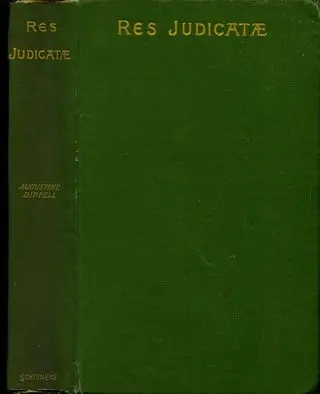
Res Judicatæ: Papers and Essays
Augustine Birrell
THE CLASSIC COLLECTION · 1884
"Obiter Dicta: Second Series" by Augustine Birrell is a collection of essays written in the late 19th century. This work reflects on literary topics, with an emphasis on the joys of literature and the lives of notable authors, particularly focusing on John Milton in the opening portion. The essays delve into the appreciation of literature's ability to evoke nostalgia and provoke thoughtful reflection, appealing to readers seeking enjoyment and contemplation amid their busy lives. The opening of this volume includes Birrell's preface, where he expresses a desire to offer readers reminders of their literary past while suggesting that the life and works of John Milton serve as an excellent subject. He reflects on Milton's character, examining his life choices and achievements, along with a mix of critiques and praises that the poet received during his lifetime. Birrell discusses Milton’s literary education, his aspirations to become a great poet, his notable works, and even his interactions with the political landscape of his time. This initial exploration sets a tone of admiration blended with a candid acknowledgment of Milton's complexities, managing to enthrall both literary enthusiasts and casual readers alike.
Introduction adapted from the source catalogue; source summaries may be automatically generated.
Free to read · English · 54,588 words · No account needed
MAKE TIME FOR A GOOD BOOK
On by default. Untick to stop anonymous reading totals. Each page counts after 10 seconds in view. How this works.
Anonymous counting is on unless you have switched it off.
Twenty years ago the chances were that a lecturer on Pope began by asking the, perhaps not impertinent, question, 'Was he a poet?' And the method had its merits, for the question once asked, it was easy for the lecturer, like an incendiary who has just fired a haystack, to steal away amidst the cracklings of a familiar controversy. It was not unfitting that so quarrelsome a man as Pope should have been the occasion of so much quarrelsomeness in others. For long the battle waged as fiercely over Pope's poetry as erst it did in his own Homer over the body of the slain Patroclus. Stout men took part in it, notably Lord Byron, whose letters to Mr. Bowles on the subject, though composed in his lordship's most ruffianly vein, still make good reading--of a sort. But the battle is over, at all events for the present. It is not now our humour to inquire too curiously about first causes or primal elements. As we are not prepared with a definition of poetry, we feel how impossible it would be for us to deny the rank of a poet to one whose lines not infrequently scan and almost always rhyme. For my part, I should as soon think of asking whether a centipede has legs or a wasp a sting as whether the author of the Rape of the Lock and the Epistle to Dr. Arbuthnot was or was not a poet.
Pope's life has been described as a succession of petty secrets and third- rate problems, but there seems to be no doubt that it began on May 21st, 1688, in Lombard Street, in the city of London. But this event over, mystery steps in with the question, What was his father? The occupation of the elder Pope occasioned nearly as fierce a controversy as the poetical legitimacy of the younger. Malice has even hinted that old Pope was a hatter. The poet, of course, knew, but wouldn't tell, being always more ready, as Johnson observes, to say what his father was not than what he was. He denied the hatter, and said his father was of the family of the Earls of Downe; but on this statement being communicated to a relative of the poet, the brutal fellow, who was probably without a tincture of polite learning, said he heard of the relationship for the first time! 'Hard as thy heart, and as thy birth obscure,' sang one of Pope's too numerous enemies in the easy numbers he had taught his age. It is, however, now taken as settled that the elder Pope, like Izaak Walton and John Gilpin, and many other good fellows, was a linen-draper. He made money, and one would like to know how he did it in the troublesome times he lived in; but his books have all perished. He was a Roman Catholic, as also was the poet's mother, who was her husband's second wife, and came out of Yorkshire. It used to be confidently asserted that the elder Pope, on retiring from business, which he did early in the poet's childhood, put his fortune in a box and spent it as he needed it,--a course of conduct the real merits of which are likely to be hid from a lineal descendant. Old Pope, however, did nothing of the kind, but invested money in the French funds, his conscience not allowing him to do so in the English, and he also lent sums on bond to fellow-Catholics, one of whom used to remit him his half-year's interest calculated at the rate of 4 pounds per cent. per annum, whereas by the terms of the bond he was to pay 4.25 pounds per cent. per annum. On another occasion the same borrower deducted from the interest accrued due a pound he said he had lent the youthful poet. These things annoyed the old gentleman, as they would most old gentlemen of my acquaintance. The poet was the only child of his mother, and a queerly constituted mortal he was. Dr. Johnson has recorded the long list of his infirmities with an almost chilling bluntness; but, alas! so malformed was Pope's character, so tortuous and twisted were his ways, so elaborately artificial and detestably petty many of his devices, that it is not malice, but charity, that bids us remember that, during his whole maturity, he could neither dress nor undress himself, go to bed or get up without help, and that on rising he had to be invested with a stiff canvas bodice and tightly laced, and have put on him a fur doublet and numerous stockings to keep off the cold and fill out his shrunken form. If ever there was a man whose life was one long provocation, that man was the author of the Dunciad. Pope had no means of self-defence save his wit. Dr. Johnson was a queer fellow enough, having inherited, as he tells us, a vile melancholy from his father, and he certainly was no Adonis to look at, but those who laughed at him were careful to do so behind his gigantic back. When a rapacious bookseller insulted him he knocked him down. When the caricaturist Foote threatened to take him off upon the stage, the most Christian of lexicographers caused it to be intimated to him that if he did the author of Rasselas would thrash him in the public street, and the buffoon desisted. 'Did not Foote,' asked Boswell, 'think of exhibiting you, sir?' and our great moralist replied, 'Sir, fear restrained him; he knew I would have broken his bones.' When he denounced Macpherson for his Ossian frauds, and the irate Celt said something about personal chastisement, Johnson told him, in writing, that he was not to be deterred from detecting a cheat by the menaces of a ruffian, and by way of a temporary provision for his self-defence selected a most grievous cudgel, six feet in height, and terminating in a head (once the root) of the size of a large orange. The possession of great physical strength is no mean assistance to a straightforward life. The late Professor Fawcett, who, though blind, delighted, arm-in-arm with a friend, to skate furiously on the fens, never could be brought to share the fears entertained on his behalf by some of the less stalwart of his acquaintances. 'Why,' he used to exclaim apologetically, 'even if I do run up against anybody, it is always the other fellow who gets the worst of it.' But poor Pope, whom a child could hustle, had no such resources. We should always remember this; it is brutal to forget it.
Your reading position is saved on this browser. Take it to another device with a library code. Reading pages adapt to text, rather than matching a printed edition.
Augustine Birrell
Augustine Birrell
Augustine Birrell
Augustine Birrell
BEHIND THE BOOK
This eBook is for the use of anyone anywhere in the United States and most other parts of the world at no cost and with almost no restrictions whatsoever. You may copy it, give it away or re-use it under the terms of the Project Gutenberg License included with this eBook or online at www.gutenberg.org. If you are not located in the United States, you will have to check the laws of the country where you are located before using this eBook. Read the source licence.
The original source file, including credits and licence, is retained by this library. Request an original-format copy at no charge. Please include the book title and Project Gutenberg identifier #21793.
KEEP YOUR CURIOSITY GOING

David Patterson (Spirit) Hatch

David Patterson (Spirit) Hatch

David Patterson (Spirit) Hatch
Cécile Tormay

Moritz Busch
John L. Ransom