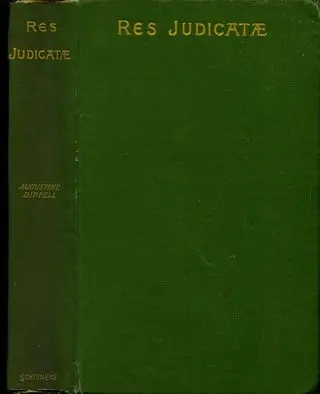
Res Judicatæ: Papers and Essays
Augustine Birrell
THE CLASSIC COLLECTION · 1884
"Obiter Dicta: Second Series" by Augustine Birrell is a collection of essays written in the late 19th century. This work reflects on literary topics, with an emphasis on the joys of literature and the lives of notable authors, particularly focusing on John Milton in the opening portion. The essays delve into the appreciation of literature's ability to evoke nostalgia and provoke thoughtful reflection, appealing to readers seeking enjoyment and contemplation amid their busy lives. The opening of this volume includes Birrell's preface, where he expresses a desire to offer readers reminders of their literary past while suggesting that the life and works of John Milton serve as an excellent subject. He reflects on Milton's character, examining his life choices and achievements, along with a mix of critiques and praises that the poet received during his lifetime. Birrell discusses Milton’s literary education, his aspirations to become a great poet, his notable works, and even his interactions with the political landscape of his time. This initial exploration sets a tone of admiration blended with a candid acknowledgment of Milton's complexities, managing to enthrall both literary enthusiasts and casual readers alike.
Introduction adapted from the source catalogue; source summaries may be automatically generated.
Free to read · English · 54,588 words · No account needed
MAKE TIME FOR A GOOD BOOK
On by default. Untick to stop anonymous reading totals. Each page counts after 10 seconds in view. How this works.
Anonymous counting is on unless you have switched it off.
'It is, indeed, the evident tendency of all literature to generalize and dissipate character by giving men the same artificial education and the same common stock of ideas; so that we see all objects from the same point of view, and through the same reflected medium; we learn to exist not in ourselves, but in books; all men become alike, mere readers--spectators, not actors in the scene and lose all proper personal identity. The templar--the wit--the man of pleasure and the man of fashion, the courtier and the citizen, the knight and the squire, the lover and the miser--Lovelace, Lothario, Will Honeycomb and Sir Roger de Coverley, Sparkish and Lord Foppington, Western and Tom Jones, my Father and my Uncle Toby, Millament and Sir Sampson Legend, Don Quixote and Sancho, Gil Blas and Guzman d'Alfarache, Count Fathom and Joseph Surface--have all met and exchanged commonplaces on the barren plains of the haute litterature--toil slowly on to the Temple of Science, seen a long way off upon a level, and end in one dull compound of politics, criticism, chemistry, and metaphysics.'
Very pretty writing, certainly; {244} nor can it be disputed that uniformity of surroundings puts a tax upon originality. To make bricks and find your own straw are terms of bondage. Modern characters, like modern houses, are possibly built too much on the same lines, Dickens's description of Coketown is not easily forgotten:
'All the public inscriptions in the town were painted alike, in severe characters of black and white. The jail might have been the infirmary, the infirmary might have been the jail, the town hall might have been either, or both, or anything else, for anything that appeared to the contrary in the graces of their construction.'
And the inhabitants of Coketown are exposed to the same objection as their buildings. Every one sinks all traces of what he vulgarly calls 'the shop' (that is, his lawful calling), and busily pretends to be nothing. Distinctions of dress are found irksome. A barrister of feeling hates to be seen in his robes save when actually engaged in a case. An officer wears his uniform only when obliged. Doctors have long since shed all outward signs of their healing art. Court dress excites a smile. A countess in her jewels is reckoned indecent by the British workman, who, all unemployed, puffs his tobacco smoke against the window- pane of the carriage that is conveying her ladyship to a drawing-room; and a West-end clergyman is with difficulty restrained from telling his congregation what he had been told the British workman said on that occasion. Had he but had the courage to repeat those stirring words, his hearers (so he said) could hardly have failed to have felt their force--so unusual in such a place; but he had not the courage, and that sermon of the pavement remains unpreached. The toe of the peasant is indeed kibing the heel of the courtier. The passion for equality in externals cannot be denied. We are all woven strangely in the same piece, and so it comes about that, though our modern society has invented new callings, those callings have not created new types. Stockbrokers, directors, official liquidators, philanthropists, secretaries--not of State, but of companies--speculative builders, are a new kind of people known to many--indeed, playing a great part among us--but who, for all that, have not enriched the stage with a single character. Were they to disappear to-morrow, to be blown dancing away like the leaves before Shelley's west wind, where in reading or playgoing would posterity encounter them? Alone amongst the children of men, the pale student of the law, burning the midnight oil in some one of the 'high lonely towers' recently built by the Benchers of the Middle Temple (in the Italian taste), would, whilst losing his youth over that interminable series, The Law Reports, every now and again strike across the old track, once so noisy with the bayings of the well-paid hounds of justice, and, pushing his way along it, trace the history of the bogus company, from the acclamations attendant upon its illegitimate birth to the hour of disgrace when it dies by strangulation at the hands of the professional wrecker. The pale student will not be a wholly unsympathetic reader. Great swindles have ere now made great reputations, and lawyers may surely be permitted to take a pensive interest in such matters.
Your reading position is saved on this browser. Take it to another device with a library code. Reading pages adapt to text, rather than matching a printed edition.
Augustine Birrell
Augustine Birrell
Augustine Birrell
Augustine Birrell
BEHIND THE BOOK
This eBook is for the use of anyone anywhere in the United States and most other parts of the world at no cost and with almost no restrictions whatsoever. You may copy it, give it away or re-use it under the terms of the Project Gutenberg License included with this eBook or online at www.gutenberg.org. If you are not located in the United States, you will have to check the laws of the country where you are located before using this eBook. Read the source licence.
The original source file, including credits and licence, is retained by this library. Request an original-format copy at no charge. Please include the book title and Project Gutenberg identifier #21793.
KEEP YOUR CURIOSITY GOING

David Patterson (Spirit) Hatch

David Patterson (Spirit) Hatch

David Patterson (Spirit) Hatch
Cécile Tormay

Moritz Busch
John L. Ransom