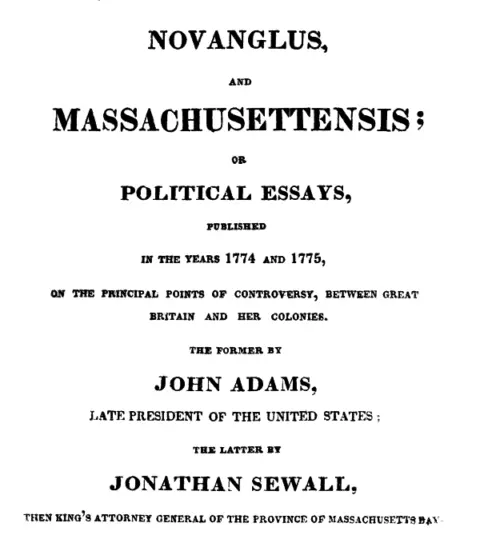
Novanglus, and Massachusettensis or, Political Essays, Published in the Years 1774 and 1775, on the Principal Points of Controversy, between Great Britain and Her Colonies
"The best writers upon the law of nations, tell us, that when a nation takes possession of a distant country and settles there, that country, though separated from the principal establishment, or mother country, naturally becomes a part of the state, equal with its ancient possessions." We are not told who these "best writers" are: I think we ought to be introduced to them. But their meaning may be no more, than that it is best they should be incorporated with the ancient establishment by contract, or by some new law and institution, by which the new country shall have equal right, powers and privileges, as well as equal protection; and be under equal obligations of obedience with the old. Has there been any such contract between Britain and the colonies? Is America incorporated into the realm? Is it a part of the realm? Is it a part of the kingdom? Has it any share in the legislative of the realm? The constitution requires that every foot of land should be represented in the third estate, the democratical branch of the constitution. How many millions of acres in America, how many thousands of wealthy landholders, have no representatives there.
But let these "best writers" say what they will, there is nothing in the law of nations, which is only the law of right reason, applied to the conduct of nations, that requires that emigrants from a state that should continue, or be made a part of the state.
The practice of nations has been different. The Greeks planted colonies, and neither demanded nor pretended any authority over them, but they became distinct independent commonwealths.
The Romans continued their colonies under the jurisdiction of the mother commonwealth; but, nevertheless, she allowed them the privileges of cities. Indeed that sagacious city seems to have been aware of difficulties, similar to those, under which Great Britain is now labouring; she seems to have been sensible of the impossibility of keeping colonies, planted at great distances, under the absolute controul of her senatus consulta. Harrington tells us, Oceana p. 43. that "the commonwealth of Rome, by planting colonies of its citizens within the bounds of Italy, took the best way of propagating itself, and naturalizing the country; whereas if it had planted such colonies without the bounds of Italy, it would have alienated the citizens, and given a root to liberty abroad, that might have sprung up foreign, or savage and hostile to her; wherefore it never made any such dispersion of itself and its strength, till it was under the yoke of the emperors, who disburdening themselves of the people, as having less apprehension of what they could do abroad than at home, took a contrary course." But these Italian cities, although established by decrees of the senate of Rome, to which the colonist was always party, either as a Roman citizen about to emigrate, or as a conquered enemy treating upon terms; were always allowed all the rights of Roman citizens, and were governed by senates of their own. It was the policy of Rome to conciliate her colonies, by allowing them equal liberties with her citizens. Witness the example of the Privernates. This people had been conquered, and complaining of oppressions, revolted. At last they sent ambassadors to Rome to treat of peace. The senate was divided in opinion. Some were for violent, others for lenient measures. In the course of the debate, a senator, whose opinion was for bringing them to his feet, proudly asked one of the ambassadors, what punishment he thought his countrymen deserved? Eam inquit, quam merentur, qui se libertate dignos censent. That punishment which those deserve, who think themselves worthy of liberty. Another senator, seeing that the ministerial members were exasperated with the honest answer, in order to divert their anger, asks another question. What if we remit all punishment? What kind of a peace may we hope for with you? Si bonam dederitis, inquit et fidam, et perpetuam; si malam, haud diuturnam. If you give us a just peace, it will be faithfully observed, and perpetually: but if a bad one, it will not last long. The ministerial senators were all on fire at this answer, cried out sedition and rebellion; but the wiser majority decreed, "viri et liberi, vocem auditam, an credi posse, ullum populum, aut hominem denique, in ea conditione, cujus cum paeniteat, diutius, quam necesse sit, mansurum? Ibi pacem esse fidam, ubi voluntarii pacati sint; neque eo loco, ubi servitutem esse velint, fidem sperandam esse." "That they had heard the voice of a man and a son of liberty; that it was not natural or credible that any people, or any man, would continue longer than necessity should compel him, in a condition that grieved and displeased him. A faithful peace was to be expected from men whose affections were conciliated, nor was any kind of fidelity to be expected from slaves." The consul exclaimed, "Eos demum qui nihil, praeterquam de libertate, existent, dignos esse qui Romani fiant." That they who regarded nothing so much as their liberty, deserved to be Romans. "Itaque et in senatu causam obtinuere, et ex auctoritate patrum, latum ad populum est, ut Privernatibus civitas daretur." Therefore the Privernates obtained their cause in the senate, and it was by the authority of those fathers, recommended to the people, that the privileges of a city should be granted them. The practice of free nations only can be adduced, as precedents of what the law of nature has been thought to dictate upon this subject of colonies. Their practice is different. The senate and people of Rome did not interfere commonly by making laws for their colonies, but left them to be ruled by their governors and senates. Can Massachusettensis produce from the whole history of Rome, or from the Digest, one example of a Senatus consultum or a Plebiscitum laying taxes on the colony?