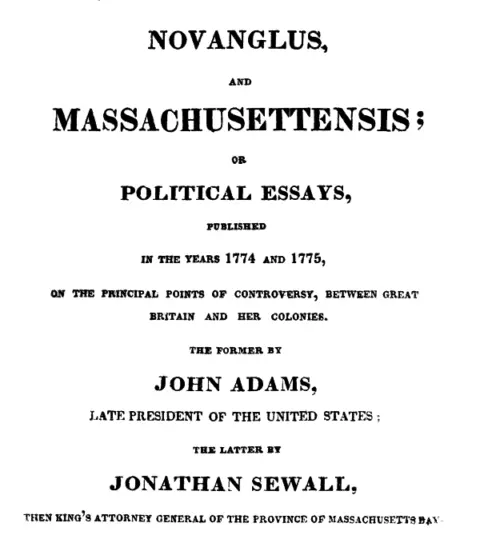
Novanglus, and Massachusettensis or, Political Essays, Published in the Years 1774 and 1775, on the Principal Points of Controversy, between Great Britain and Her Colonies
The mistaken policy of the ministry, in obstinately persisting in their claim of right to tax America, and refusing to repeal the duty on tea, with those on glass, paper and paint, had induced all America, except a few merchants in Boston, most of whom were closely connected with the junto, to refuse to import tea from Great Britain; the consequence of which was a kind of stagnation in the affairs of the company, and an immense accumulation of tea in their stores, which they could not sell. This, among other causes, contributed to affect their credit, and their dividends were on the point of falling below twelve per cent. and consequently the government was upon the point of losing 400,000l. sterling a year of revenue. The company solicited the ministry to take off the duty in America: but they adhering to their plan of taxing the colonies and establishing a precedent, framed an act to enable the company to send their tea directly to America. This was admired as a master-piece of policy. It was thought they would accomplish four great purposes at once: establish their precedent of taxing America; raise a large revenue there by the duties; save the credit of the company, and the 400,000l. to the government. The company however, were so little pleased with this, that there were great debates among the directors, whether they should risque it, which were finally determined by a majority of one only, and that one the chairman, being unwilling as it is said, to interfere, in the dispute between the minister and the colonies, and uncertain what the result would be: and this small majority was not obtained, as it is said, until a sufficient intimation was given that the company should not be losers.
When these designs were made known, it appeared, that American politicians were not to be deceived; that their sight was as quick and clear as the minister's; and that they were as steady to their purpose, as he was to his. This was thought by all the colonies to be the precise point of time, when it became absolutely necessary to make a stand. If the tea should be landed, it would be sold; if sold, the duties would amount to a large sum, which would be instantly applied to increase the friends and advocates for more duties, and to divide the people; and the company would get such a footing, that no opposition afterwards could ever be effectual. And as soon as the duties on tea should be established, they would be ranked among post-office fees, and other precedents, and used as arguments, both of the right and expediency of laying on others, perhaps on all the necessaries, as well as conveniences and luxuries of life. The whole continent was united in the sentiment, that all opposition to parliamentary taxation must be given up forever, if this critical moment was neglected. Accordingly, New York and Philadelphia determined that the ships should be sent back; and Charleston, that the tea should be stored and locked up. This was attended with no danger in that city, because they are fully united in sentiment and affection, and have no Junto to perplex them. Boston was under greater difficulties. The consignees at New York and Philadelphia most readily resigned. The consignees at Boston, the children, cousins, and most intimate connections of governor Hutchinson, refused. I am very sorry that I cannot stir a single step in developing the causes of my country's miseries, without stumbling upon this gentleman. But so it is. From the near relation and most intimate connection of the consignees with him, there is great cause of jealousy, if not a violent presumption, that he was at the bottom of all this business, that he had planned it, in his confidential letters with Bernard, and both of them joined in suggesting and recommending it to the ministry. Without this supposition, it is difficult to account for the obstinacy with which the consignees refused to resign, and the governor to let the vessel go. However this might be, Boston is the only place upon the continent, perhaps in the world, which ever breeds a species of misanthropes, who will persist in their schemes for their private interest, with such obstinacy, in opposition to the public good; disoblige all their fellow citizens for a little pelf, and make themselves odious and infamous, when they might be respected and esteemed. It must be said, however, in vindication of the town, that this breed is spawned chiefly by the Junto. The consignees would not resign; the custom house refused clearances; governor Hutchinson refused passes by the castle. The question then was, with many, whether the governor, officers, and consignees should be compelled to send the ships hence? An army and navy was at hand, and bloodshed was apprehended. At last, when the continent, as well as the town and province, were waiting the issue of this deliberation with the utmost anxiety, a number of persons, in the night, put them out of suspense, by an oblation to Neptune. I have heard some gentlemen say, "this was a very unjustifiable proceeding"--"that if they had gone at noon-day, and in their ordinary habits, and drowned it in the face of the world, it would have been a meritorious, a most glorious action: but to go in the night, and much more in disguise, they thought very inexcusable."