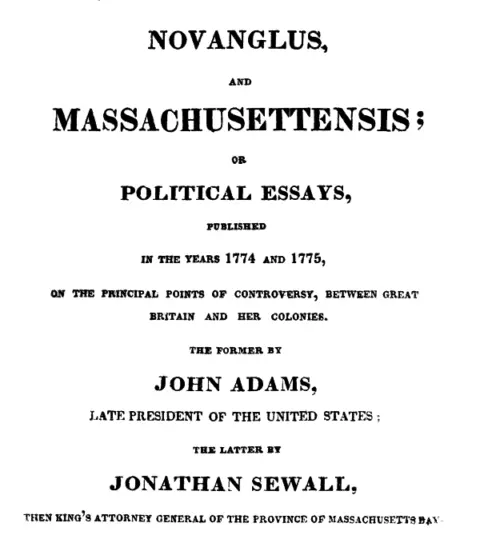
Novanglus, and Massachusettensis or, Political Essays, Published in the Years 1774 and 1775, on the Principal Points of Controversy, between Great Britain and Her Colonies
13th and 14th of Charles 2nd, chapter 13. "An act for prohibiting the importation of foreign bone-lace, cutwork, embroidery, fringe, band-strings, buttons and needle work." Pray sir, do not laugh! for something very serious comes in section third. "Be it further enacted, that for the preventing of the importing of the said manufactures as aforesaid, upon complaint and information given, to the justices of the peace or any or either of them within their respective counties, cities and towns corporate, at times reasonable, he or they are hereby authorized and required to issue forth his or their warrants to the constables of their respective counties, cities and towns, corporate, to enter and search for such manufactures in the shops being open, or warehouses and dwelling houses of such person or persons, as shall be suspected, to have any such foreign bone-laces, embroideries, cut-work, fringe, band-strings, buttons or needle work within their respective counties, cities, and towns corporate, and to seize the same, any act, statute or ordinance to the contrary thereof in any wise notwithstanding."
Another curious act was produced, to prove the legality of writs of assistance, though it was no more to the purpose than all the others. I mean the statute of the 12th of Charles the second, chapter third, "An act for the continuance of process and judicial proceedings continued." In which it is enacted, section first, "That no pleas, writs, bills, actions, suits, plaints, process, precepts, or other thing or things, &c. shall be in any wise continued," &c.
But I must refer to the act. I cannot transcribe. If any antiquarian should hereafter ever wish to review this period, he will see with compassion how such a genius as Otis was compelled to delve among the rubbish of such statutes, to defend the country against the gross sophistry of the crown and its officers.
Another act of 12 C. 2d, ch. 12, "An act for confirmation of judicial proceedings," in which it is enacted, &c. "that nor any writs, or actions on, or returns of any writs, orders or other proceedings in law or equity, had made, given, taken or done, or depending in the courts of chancery, king's bench, upper bench, common pleas, and court of exchequer, and court of exchequer chamber, or any of them, &c. in the kingdom of England, &c. shall be avoided, &c." I must refer to the statute.
In short, wherever the custom house officers could find in any statute the word "writs", the word "continued" and the words "court of exchequer," they had instructed their counsel to produce it, though in express "words restricted to the realm." Mr. Gridley was incapable of prevaricating or duplicity.