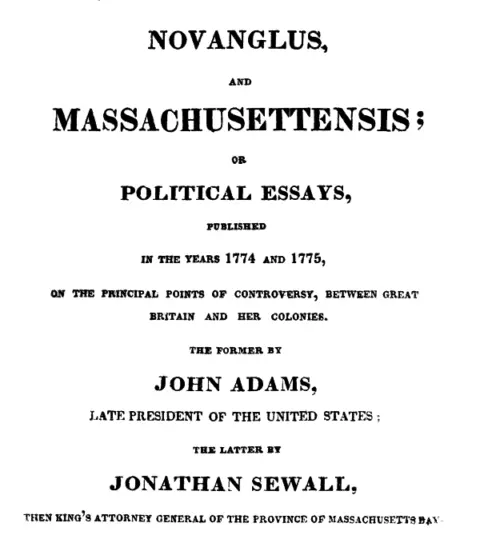
Novanglus, and Massachusettensis or, Political Essays, Published in the Years 1774 and 1775, on the Principal Points of Controversy, between Great Britain and Her Colonies
Section second enacts, all governors shall take a solemn oath to do their utmost, that every clause shall be punctually obeyed. See the statute at large.
See also section third of this statute, which I wish I could
transcribe.
Section fourth enacts, that no goods of foreign growth, production or manufacture, shall be brought, even in English shipping, from any other countries, but only from those of the said growth, production or manufacture, under all the foregoing penalties.
Mr. Otis commented on this statute in all its parts, especially on the foregoing section, with great severity. He expatiated on its narrow, contracted, selfish, and exclusive spirit. Yet he could not and would not deny its policy, or controvert the necessity of it, for England, in that age, surrounded as she was by France, Spain, Holland, and other jealous rivals; nor would he dispute the prudence of governor Leverett, and the Massachusetts legislature, in adopting it, in 1675, after it had laid dormant for fifteen years; though the adoption of it was infinitely prejudicial to the interests, the growth, the increase, the prosperity of the colonies in general, of New England in particular; and most of all, to the town of Boston. It was an immense sacrifice to what was called the mother country. Mr. Otis thought, that this statute ought to have been sufficient to satisfy the ambition, the avarice, the cupidity of any nation, but especially of one who boasted of being a tender mother of her children colonies; and when those children had always been so fondly disposed to acknowledge the condescending tenderness of their dear indulgent mother.
This statute, however, Mr. Otis said, was wholly prohibitory. It abounded, indeed, with penalties and forfeitures, and with bribes to governors and informers, and custom house officers, and naval officers and commanders; but it imposed no taxes. Taxes were laid in abundance by subsequent acts of trade; but this act laid none. Nevertheless, this was one of the acts that were to be carried into strict execution by these writs of assistance. Houses were to be broken open, and if a piece of Dutch linen could be found, from the cellar to the cock loft, it was to be seized and become the prey of governors, informers, and majesty.
When Mr. Otis had extended his observations on this act of navigation, much farther than I dare to attempt to repeat, he proceeded to the subsequent acts of trade. These, he contended, imposed taxes, and enormous taxes, burthensome taxes, oppressive, ruinous, intolerable taxes. And here he gave the reins to his genius, in declamation, invective, philippic, call it which you will, against the tyranny of taxation, without representation.