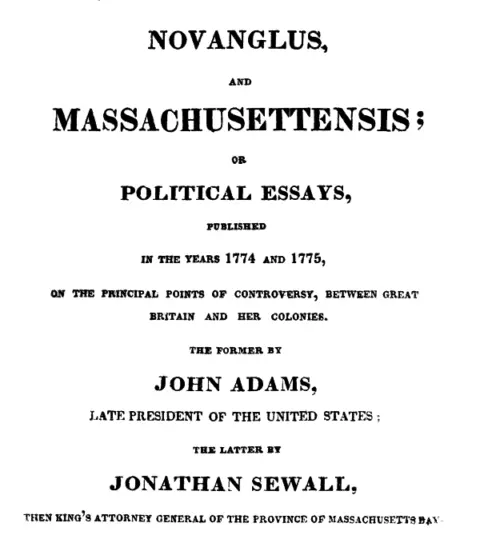
Novanglus, and Massachusettensis or, Political Essays, Published in the Years 1774 and 1775, on the Principal Points of Controversy, between Great Britain and Her Colonies
Pardon the trouble of reading the letter, from your habitual
partiality for your friend.
JOHN ADAMS.
TO THE HON. WM. TUDOR.
Quincy, April 15, 1818.
DEAR SIR,
I have received your obliging favour of the 8th, but cannot consent to your resolution to ask no more questions. Your questions revive my sluggish memory. Since our national legislature have established a national painter--a wise measure, for which I thank them, my imagination runs upon the art, and has already painted, I know not how many, historical pictures. I have sent you one, give me leave to send another. The bloody rencontre between the citizens and the soldiers, on the 5th of March, 1770, produced a tremendous sensation throughout the town and country. The people assembled first at Faneuil Hall, and adjourned to the old South Church, to the number, as was conjectured, of ten or twelve thousand men, among whom were the most virtuous, substantial, independent, disinterested and intelligent citizens.--They formed themselves into a regular deliberative body, chose their moderator and secretary, entered into discussions, deliberations and debates, adopted resolutions, appointed committees. What has become of these records, Mr. Tudor? Where are they? Their resolutions in public were conformable to those of every man in private, who dared to express his thoughts or his feelings, "that the regular soldiers should be banished from the town, at all hazards." Jonathan Williams, a very pious, inoffensive and conscientious gentleman, was their moderator. A remonstrance to the governor, or the governor and council, was ordained, and a demand that the regular troops should be removed from the town. A committee was appointed to present this remonstrance, of which Samuel Adams was the chairman.
Now for the picture. The theatre and the scenery are the same with those at the discussion of writs of assistance. The same glorious portraits of king Charles II. and king James II. to which might be added, and should be added, little miserable likenesses of Gov. Winthrop, Gov. Bradstreet, Gov. Endicott and Gov. Belcher, hung up in obscure corners of the room. Lieut. Gov. Hutchinson, commander in chief in the absence of the governor, must be placed at the head of the council table. Lieut. Col. Dalrymple, commander in chief of his majesty's military forces, taking rank of all his majesty's counsellors, must be seated by the side of the lieutenant governor and commander in chief of the province. Eight and twenty counsellors must be painted, all seated at the council board. Let me see, what costume? What was the fashion of that day, in the month of March? Large white wigs, English scarlet cloth cloaks, some of them with gold laced hats, not on their heads, indeed, in so august a presence, but on a table before them. Before these illustrious personages appeared SAMUEL ADAMS, a member of the house of representatives and their clerk, now at the head of the committee of the great assembly at the old South church. Thucidydes, Livy or Sallust would make a speech for him, or, perhaps, the Italian Bota, if he had known any thing of this transaction, one of the most important of the revolution; but I am wholly incapable of it; and, if I had vanity enough to think myself capable of it, should not dare to attempt it. He represented the state of the town and the country; the dangerous, ruinous and fatal effects of standing armies in populous cities in time of peace, and the determined resolution of the public, that the regular troops, at all events, should be removed from the town. Lieutenant governor Hutchinson, then commander in chief, at the head of a trembling council, said, "he had no authority over the king's troops, that they had their separate commander and separate orders and instructions, and that he could not interfere with them." Mr. Adams instantly appealed to the charter of the province, by which the governor, and in his absence the lieutenant governor, was constituted "commander in chief of all the military and naval power within its jurisdiction." So obviously true and so irrefragable was the reply, that it is astonishing that Mr. Hutchinson should have so grossly betrayed the constitution, and so atrociously have violated the duties of his office by asserting the contrary. But either the fears or the ambition of this gentleman, upon this and many other occasions, especially in his controversy with the two houses, three years afterwards, on the supremacy of parliament, appear to have totally disarranged his understanding. He certainly asserted in public, in the most solemn manner, a multitude of the roundest falshoods, which he must have known to be such, and which he must have known could be easily and would certainly be detected, if he had not wholly lost his memory, even of his own public writing. You, Mr. Tudor, knew Mr. Adams from your childhood to his death. In his common appearance, he was a plain, simple, decent citizen, of middling stature, dress and manners. He had an exquisite ear for music, and a charming voice, when he pleased to exert it.--Yet his ordinary speeches in town meetings, in the house of representatives and in congress, exhibited nothing extraordinary; but upon great occasions, when his deeper feelings were excited, he erected himself, or rather nature seemed to erect him, without the smallest symptom of affectation, into an upright dignity of figure and gesture, and gave a harmony to his voice, which made a strong impression on spectators and auditors, the more lasting for the purity, correctness and nervous elegance of his style.